Foreword, Sculpture, Lunds Konsthall
Maskinöversatt — ännu ej granskad.
"The surface of the human body is the boundary between inside and outside. Is there a similar surface in the realm of thought that separates the inside of thought from its outside, from the unthought?" In Paul Valéry's Cahiers, one finds a series of reflections that develop the notion of an abstract surface preceding human consciousness, a surface that can fold and bend back over itself, thus creating the inner space of human thought.
To gain access to this surface, writes Valéry, implies the thought of thinking beyond man – of thinking the inhuman.
Is it this surface that manifests itself in Sivert Lindblom's sculptures from the 60s, these turned figures that, like chess pieces, seem to move in an abstract space beyond the human? The personal, the artist's own profile, has in these sculptures been generalized into an omnipresent form – the signature of one's own body has become a figure without relation to the unique self. This is an art liberated from traditional notions of origin and originality; the unique has given way to series without absolute beginning or end.
"Today we can no longer think other than in the vacuum left by the disappearance of man," reads a statement by Michel Foucault that Lindblom uses as a motto for his exhibition at the Venice Biennale in 1968.
Man, as studied by the modern human sciences, is according to Foucault a temporary crystallization of forces, like a kind of knot that will in the future unravel and give way to new forms of life. This is the meaning of the prophetic conclusion of Les mots et les choses: "As the archaeology of our thought has shown, man is an invention of recent date. And perhaps one that is nearing its end."
Man, writes Foucault, is a formation that will soon "be erased, like a face drawn in the sand at the edge of the sea."
What is one's own profile, or the unique signature of the hand, in such a post-humanist space?
Lindblom's art explores the very tension between the unique and the general – between the individual and mechanical reproduction. Already in the early bronze works, despite the proximity to Rodin and classical sculpture, this tension exists. Lindblom works with repetitive elements – the works are inscribed into series, which undermines their status as unique. The singular expression disappears into a more comprehensive movement.
Nowhere is this movement of disappearance, which also interested Foucault, clearer than in the turned works from the 60s. But dehumanization is driven even further in the coming years: here it is no longer about the transformation of the human body into a generalized form, but about a complete absence of the human. The very opposition between man and world has given way to a kind of artificial nature, a landscape that unites the organic with abstract constructions: branches are joined to simple architectural elements, massive boulders are connected with coarse chains. Nowhere do human forms appear.
More essential than the individual work is the model capable of generating a form – once or infinitely many times. Lindblom's works rarely include an account of the artistic method itself: the template, the mold, and the measuring tools. Here there is a proximity to science. Nothing is left hidden; nothing is secret.
Repetition has its place in this exploration of the model's possibilities: a form can be repeated and varied in endless materials and techniques. When man is reintroduced into Lindblom's landscape, it functions as such a variable.
The casting of one's own body is reproduced in various sizes and executions; it is not about any re-establishment of a humanistic body, but about experimenting with a form that is multiplied and integrated into a larger logic. Like the ornament, which follows the principle of repetition and small displacements, this art works its way through all the possibilities of form.
But the ornamentation is never closed; the pattern remains open. At the exhibition Ibid, the two small figures sit huddled at different heights – around them on the wall a kind of plaster ornament. "Ornament ist Verbrechen," writes Adolf Loos. The crime is punished: the ornamentation breaks apart and falls into pieces.
Plaster fragments lie scattered across the floor.
Daniel Birnbaum
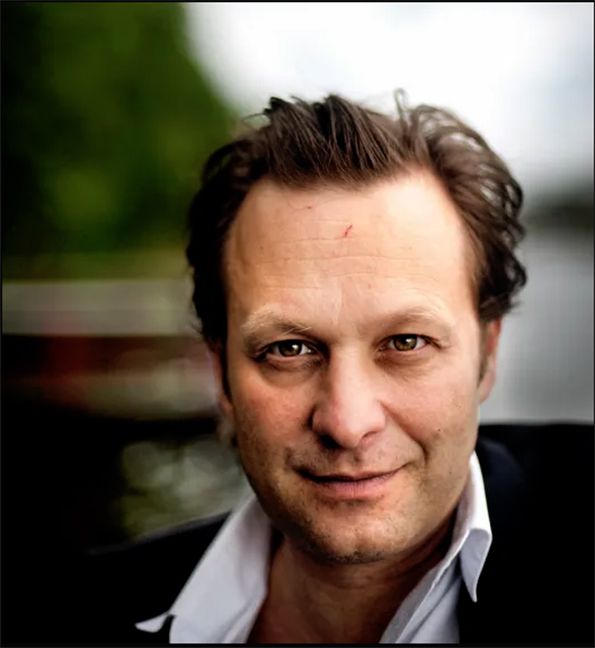
Photo: Magnus Hallgren