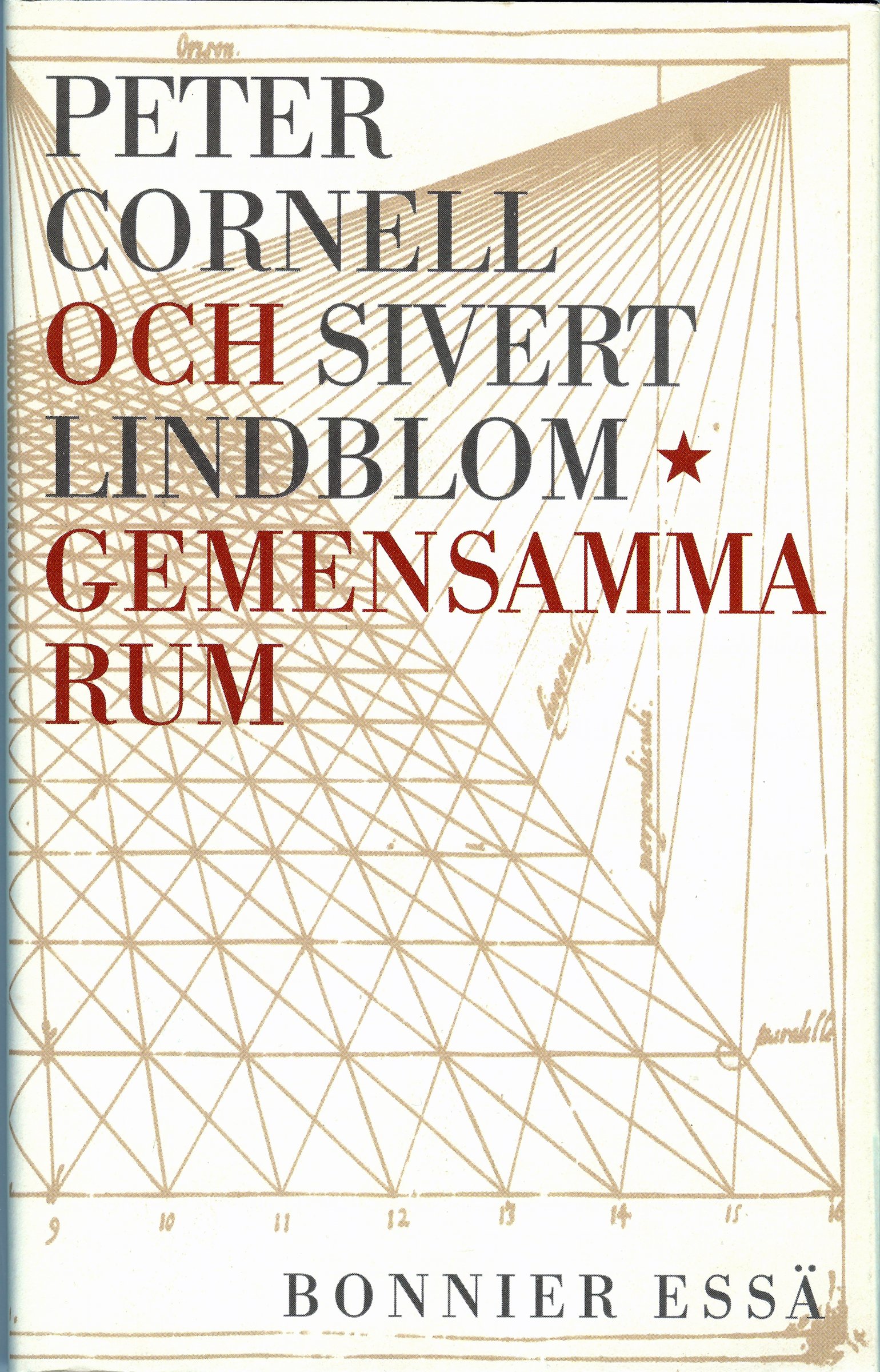
Quotes from Gemensamma rum
Maskinöversatt — ännu ej granskad.
Reflections from conversations with Sivert Lindblom recorded by Peter Cornell, and here are some quotes taken from their book
★ GEMENSAMMA RUM Bonnier essä 1998 ISBN 91-3452034-1
On Sivert's view on photography:
"In a completely different context, Sivert Lindblom mentioned that he wanted to show me some photographs that I might be able to comment on in a series of captions. This idea turned out to hold the solution for the form of this book. … Sivert Lindblom does not use photography as an artistic medium but rather as a working material. His images are a documentation of something he has noticed and which can later give him impulses in his sculpture." (p. 1)
On the role of the artist:
"Sivert Lindblom has maintained a critical distance from modernism's romantic role of the artist. His self-portrait and recurring signature is the de-individualized, psychologically mute, turned sculpture – we see a variant in the foreground of the studio. He prefers to call himself a sculptor, which he considers a more factual professional title than the more nebulous title of artist. At the same time, he is undoubtedly close to modernism's world of forms as it appears, for example, in Arp, Schlemmer, or Brancusi. But he has never wanted to submit to modernism's orthodoxy and has been surprised that contemporary art has been so unilaterally tied to the gallery and has refrained from the public space that has occupied artists throughout all ages." (p. 19)
On art:
"The art of tradition is eternal and anonymous, impersonal and objective, and it lives on in folk art and non-European art, but also characterized European art up until the Renaissance. In this art, there is no distinction between pure and applied art, between sacred and profane, nor was it separated into special museums. It has religion as its source but is not religious in the sense that it uses religious motifs or a religious iconography. The art of tradition is more universal and is based on abstract measures, harmonies, rhythms, and geometry. Its task is both to beautify the things around us and to invite a contemplative viewing of metaphysics and philosophia perennis, in a state that Ivan Aguèli described as a 'transcendent emptiness of thought'." (pp. 27–28)
On the meaning of the work:
"Sivert Lindblom works in this sphere of invisibility without any fear that the work will not be seen. Here, too, one can draw a comparison with theatre set design, where the objects in the play have multiple roles: they are used tangibly as utilitarian objects by the actors on stage, but are simultaneously art objects for the audience's disinterested and attentive contemplation." (p. 39)
On public art:
"Public art – what is its place in the public sphere? For the public sphere also includes the gallery and the museum, as they are accessible to everyone. … By 'public art,' one usually means artworks in urban spaces that are not already claimed as spaces for art. Such places do not, like the museum and the gallery, have the unique and miraculous ability to transform anything – bottle racks, urinals, trash – into art. … Public art generally has a certain permanence, but not always …". (p. 51)
On the artist's mission:
"The artist should not come to the site as a stranger, with a finished concept from the studio, but rather participate in the life of the area and listen to its wishes and concerns. The context of the place includes the people who live and work there. The audience for this kind of public art is no longer an anonymous, abstract entity but participates in a very concrete way in the work. Relational aesthetics does not consider itself bound to any medium, and the physical work can sometimes dissolve in favor of the social relationships that are created." (pp. 57–58)