Inga-Maj Beck on ”Terrakotta” — Frescati, Stockholm University
Maskinöversatt — ännu ej granskad.
For the National Public Art Council's annual publication No. 22, which reports on state art acquisitions, Inga-Maj Beck wrote an analysis of Sivert and Marianne's artistic design of passages on the campus area connecting the buildings at Stockholm University. (ISSN 0349-8220)
Here lies a sphinx buried!
SIVERT LINDBLOM's embellishment "Terrakotta" reunites the park in Frescati with an archaic tradition. With simple means and expressions, the university park outside Stockholm has gained an iconography that connects it with Olympus and Delphi, thereby re-establishing the bonds of knowledge that the modular architecture of the 60s had destroyed.
In the Lindblom competition proposal, the embellishment is described solely in terms of beauty and function. However, it is emphasized that the entrance from the subway should be precisely an entrance and not an exit (out into the park), as are the apple trees which are Eve's, i.e., the trees of knowledge.
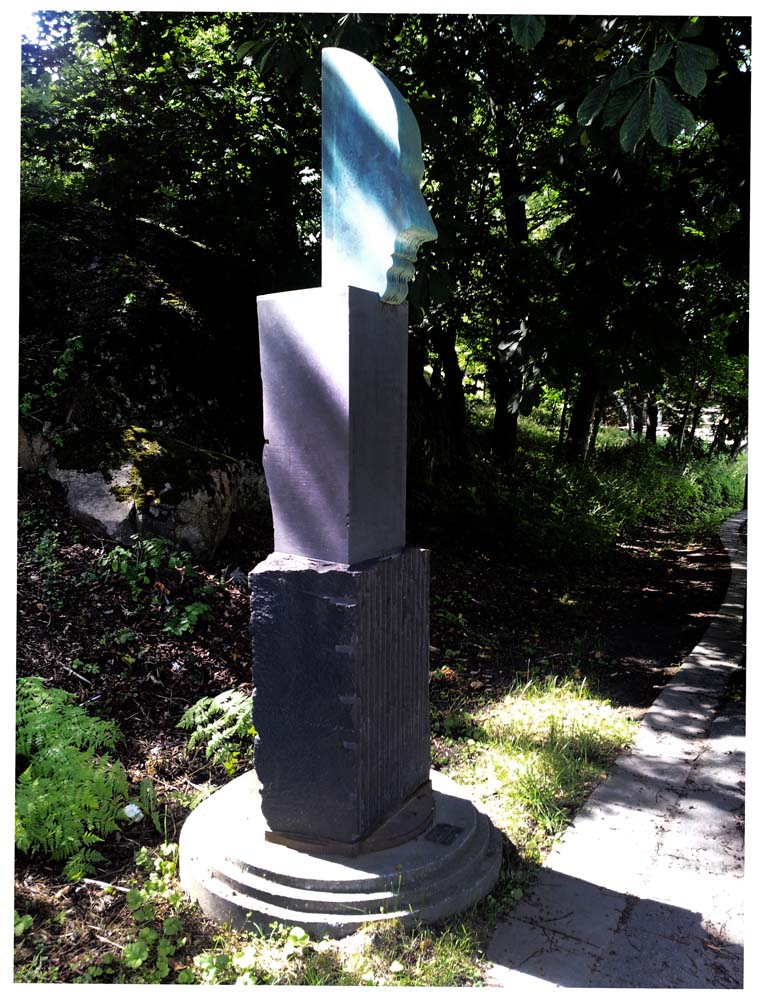
"Terrakotta" expresses itself in a very contemporary yet classical aesthetic: simple circular forms, rectangles, pillars, and columns in terracotta and granite. Three human sculptures, in granite, marble, and bronze, have been shaped like early classical (5th century BC) sculptures – though chipped by time, or disassembled according to our era's complex system of rules. Sculptures and embellishment details in "Terrakotta" are part of the park's overall image: color and form create accents in the landscape, frame functions, such as paths and architectural polarities that discreetly adapt to the dominant rhythm of the park landscape.
"Terrakotta" unites architecture, art, and nature. The entrance to the area is a gate but also an open space; pillars and paving are exquisite in their form, while the curved shapes and organic contours are like a part of nature itself. As one continues into the Frescati area, the sculptures appear like natural rock outcrops or sudden floral splendor in the midst of nature untouched by human hand.
As one then moves into the park, the natural hills and the Lindblom pillars form an archaic landscape, where it is impossible to distinguish, from a distance, what is made by man and what is made by some higher power.
The fusion between architectural elements (the paths, the directional indicators to various buildings) and nature and art is complete; therefore, the choice of materials and colors is also congenial with nature: the soft skin tone of terracotta, the organic nuances of bronze and granite, the softened contours that make the sculptures part of the visual character of the branches. But the embellishment, which was intended to be a romantic-classical stage backdrop, is more than that. "Terrakotta" hides a clear, albeit mysterious, iconography.
If Ulrik Samuelson's Pompeian walls and Sivert Lindblom's romantic candelabras in Stockholms Stadsteater recreated the stages of the Roman Republic, then the Lindblom embellishment in Frescati has naturally recreated the very earliest places of knowledge. The theater, the spectacle, is the invention of the Romans; knowledge and wisdom belong to archaic Greece.
In Frescati, the ties to Homeric wisdom are re-established with simple and subtle means. "Terrakotta" is divided into three sections. Each of these transitions into a function but maintains a certain degree of iconographic freedom. The Lindblom iconography is based on both sculptural forms and architectural structures.
The iconographic narrative in "Terrakotta" is about "Knowledge".
It starts from the ENTRANCE to the park, which has been shaped into a circular space around a globe supported by four small bronze paws. The circular surface is encircled by oak trees and apple trees, as well as twelve similar twisted pillars, plus one of a different design.
This entrance is Olympus. Olympus was formed by twelve pillars that held up the sky. The oak grove was Zeus, and when the wind whistled through the oak leaves, it could listen to Logos. In the middle of Olympus, the earth was born, and it now stands as a globe in the Lindblom scenography.
After the encounter with Wisdom and the World, the visitor continues down the paths towards the university buildings. From Olympus, the roads lead out into the world of humans. And there stand three mighty sculptures of a slightly supernatural size. The formal language is stripped-down and archaic; cubist forms meet fragments of realism. The sculptures are named "Eva", "Adam", and "Hercules". I would rather see them as female and male knowledge (both "Eva" and "Adam" are adorned with symbols of knowledge), as well as Power in the form of Hercules who stands at the crossroads and chooses. Male or female knowledge – just as the apple trees and oak trees at the Entrance united male and female knowledge.
From "Hercules" and his crossroads, the paths lead directly into the faculty or, in the other direction, to an open grassy slope in the middle of Frescati park. There is the conclusion of the Lindblom iconography: thirteen pillars of yellow and red brick, like weathered temple pillars in Delphi. All pillars bear sphinx motifs; the sphinx is the archetype for the oracle that existed in Delphi, Pythia, who according to legend was half woman and half snake. In the Temple of Apollo in Delphi, the sphinx sat in a cave filled with smoke and vapors from a bronze cauldron with boiling meat from sacrificial animals. This cauldron is also found in Frescati: a brick vault forms a cave around a large cast-iron globe.
The journey through the Lindblom embellishment reflects not only in its formal language and materials the beauty of ancient ruins. In every detail, a piece of a story as old as our civilization is inscribed: The path from the Father's Olympic law, over the duality of male-female and thus all other dualities, up to the crossroads hidden in the shadow of Power and Will (Hercules) and leading to the Oracle in Delphi. And there, before the enigma that veils all true wisdom, we leave Oedipus, he who saw.
INGA-MAJ BECK
See images of the sculptures: "Adam", "Eva", and "Hercules" Photo: Jan Öqvist