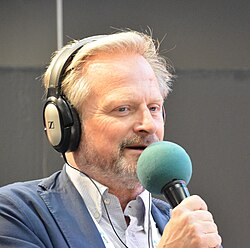
Feature VANDALORUM – June 11 - August 28, 2016
Maskinöversatt — ännu ej granskad.
Sivert Lindblom is one of our most renowned sculptors, specializing in public art installations in close collaboration with architects. The two bronze horses at Blasieholmstorg in Stockholm are perhaps his most famous work, but if you start looking, you'll find his works everywhere. He is currently showing a comprehensive retrospective exhibition at the art gallery Vandalorum in Värnamo, and Karsten Thurfjell has been there.
"A modernist would NEVER have dared to hang works so densely!" is the first thing I think. The exhibition hall at Vandalorum is completely crammed with artworks that fill the floor, reach up towards the ceiling, hang from it, lean against the walls, yes, CLIMB the walls. One could call it a pure salon-style hanging, if it weren't about so much more than just paintings. Perhaps it's not particularly important whether Sivert Lindblom is a modernist or not. In any case, he is the perfect age: born in '31, educated in the '40s, '50s, and '60s in sculpture, technology, and architecture. He first worked as a young man for Sigurd Lewerentz and then for almost 20 years with Peter Celsing, two legendary architects who were truly in the thick of it when the country underwent its most drastic modernization. Yet, looking back at Lindblom's work as a sculptor and creator of numerous groundbreaking embellishments, amidst this eager demolition and construction to create light and air, he truly appears as a jester of classicism, tirelessly whispering into the ears of urban planners about the eternal values from antiquity and the Renaissance that can imbue spaces, if only given the chance. Yes, Sivert Lindblom probably takes up where Leonardo da Vinci left off with all his aesthetic experiments, for it certainly feels like we are in the artist's somewhat enlarged studio, where he continues to twist and turn the room and all the classical fundamental measurements, basic forms, and primary colors, which are exposed to each other in constantly new constellations: the circle, the sphere, the pyramid, the triangle, the cube, the angles, and the rectangles that sometimes house and frame Lindblom's own body, multiplied as both sculpture and as void, and stylized as the well-known chess piece with its profile silhouette turned all the way around, if you understand what I mean. Otherwise, he has Sweden's best website for those who are curious.
He is perhaps most amusing when he lets his crouched copy sit perched on a shelf up towards the ceiling like another Simeon Stylites. But this pillar saint meditates on the sublime values he perhaps manages to evoke from two blue wall reliefs on either side.
The best part for me is getting to see some of the hundred watercolors that Sivert Lindblom exhibited at the Royal Academy of Fine Arts in 2012, one of the most remarkable projects undertaken in graphic art, and not particularly easy to describe. Peter Cornell calls it "scientific fiction" because they depict, well, let's say stage sets that the artist has filled with many of the elements we recognize on the exhibition floor, all rendered with realistically sharp contours, unmixed primary colors, and strict diagonal perspective.
In addition to the recognizable objects, we also see others: vaguely architectural structures, walls, tools, and artifacts with unknown functions. Something is happening, but exactly what, we will never get an answer to, other than from our own imagination. Sometimes black geometric shapes or pure blobs penetrate the images, as if these architectural puzzles have finally conjured up the dark matter that researchers at CERN are searching for. It almost feels a little dangerous to think too much about what Sivert Lindblom has meditated upon, up there on the shelf.
Karsten Thurfjell, SR Kulturnytt August 4, 2016 at 07:00 3.20 min
LISTEN to the full radio feature which is available on the homepage.