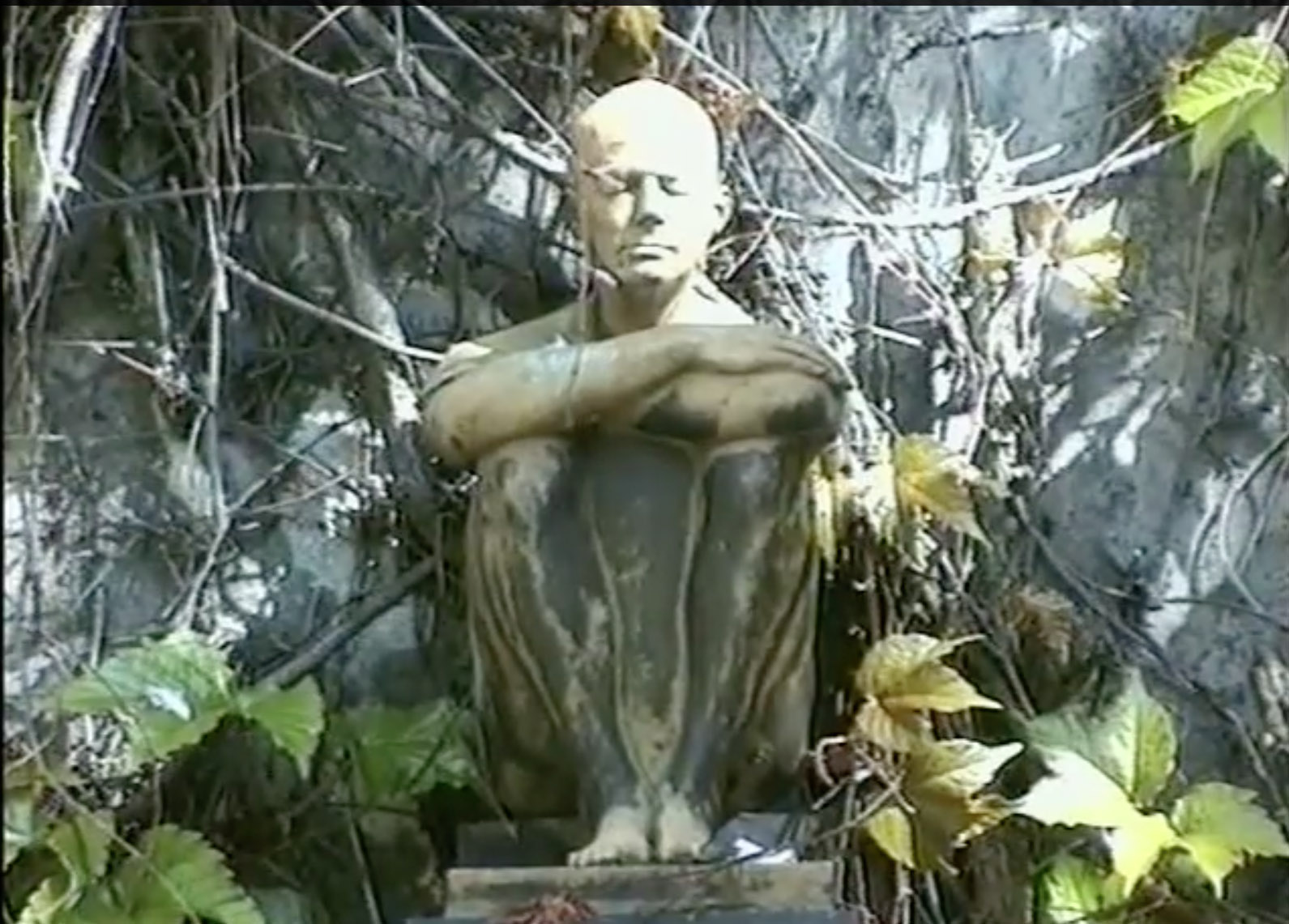
Catalogue text, Live Show, Moderna Museet
Maskinöversatt — ännu ej granskad.
From the catalogue text: … perhaps it is due to the constant presence of the unknown, perhaps the explanation lies in our unconscious anxiety that the objects in our surroundings might suddenly be regrouped into battle lines or treacherous ambushes. Where do all these materialized proposals and actions that we encounter everywhere actually come from? I regret that I cannot trust the obvious explanations that are so promptly and obligingly conveyed. I ask you, when you leave me and return to order, to be on your guard and to report all changes. We, you and I, must be vigilant. But beware of pessimism; any threats should be met with optimism. Optimism lies in the will to see everything. Let us learn to see, and by that I also mean the form whose content is unknown, or rather whose content is the unknown. All forms are forms for encounters between us, and in these encounters, you and I take form. It is this form that is decisive. It is what our efforts concern. You suddenly understand that it has always been the same intention that has characterized your work throughout the years. As if direction, speed, and time were predetermined, and one has merely performed the movements that equilibrium required. Chance has governed but not determined the direction. That doesn't sound good, because art is free, they say. But I assure you: art is not free either, but it has a goal. Through models and descriptions, we can make reality emerge, and we have no right to shy away from what becomes visible. It is thus our shared life situation that gives form and content.
Art determines reality: without art, no reality, no life, no death. Why do my images look the way they do? I will try to explain: Society contains a multitude of functions that produce its images and give objects their form. These images and forms – those of the engineer, the sociologist, the architect, the biologist, the mathematician – we absorb in different ways with various reservations, positively or negatively, with a range of different emotions. We can speak of a multitude of ingrained behaviors in relation to image and form. There is also an imprinting of art's form and methods that I find troublesome. One does not allow oneself to be touched; art is harmless; it hangs on its hook; art makes the unbearable bearable. This imprinting is certainly useful for sales, but was that really the intention? The intention chooses the image method, and if the intention is to make a painting or sculpture, there is no reason to argue, but if the intention is to determine reality, then all methods are available and thus all imprints. It therefore does not feel obvious to unconditionally lock one's image or form in relation to art's images and forms. Instead, it is about finding the method that provides the intention with the best possible help, and by that I mean that the choice is between all of reality's expressions, language forms, image methods, materials, and techniques. It does not concern me that my images may thereby be difficult to define in relation to art's images, nor is it a problem that my forms do not always look like sculptures. The most important thing is not the properties of the images but their relation to reality. In my rooms, there are no solitaires; everything monitors the same reality.
P.S. How is it, really? Is there a good and an evil form, or is the form of reality an innocence that regains its virginity every morning? Or do evil and good respectively take their seat in the nearest available form and make it evil or good? Or is it perhaps that evil can produce good form and good can produce evil form? How is it, really? Are we not victims of a form magic that is certainly convenient but fatally false? A form can easily be removed, but do we really remove the evil with it?
Photo: Magnus Lindblom