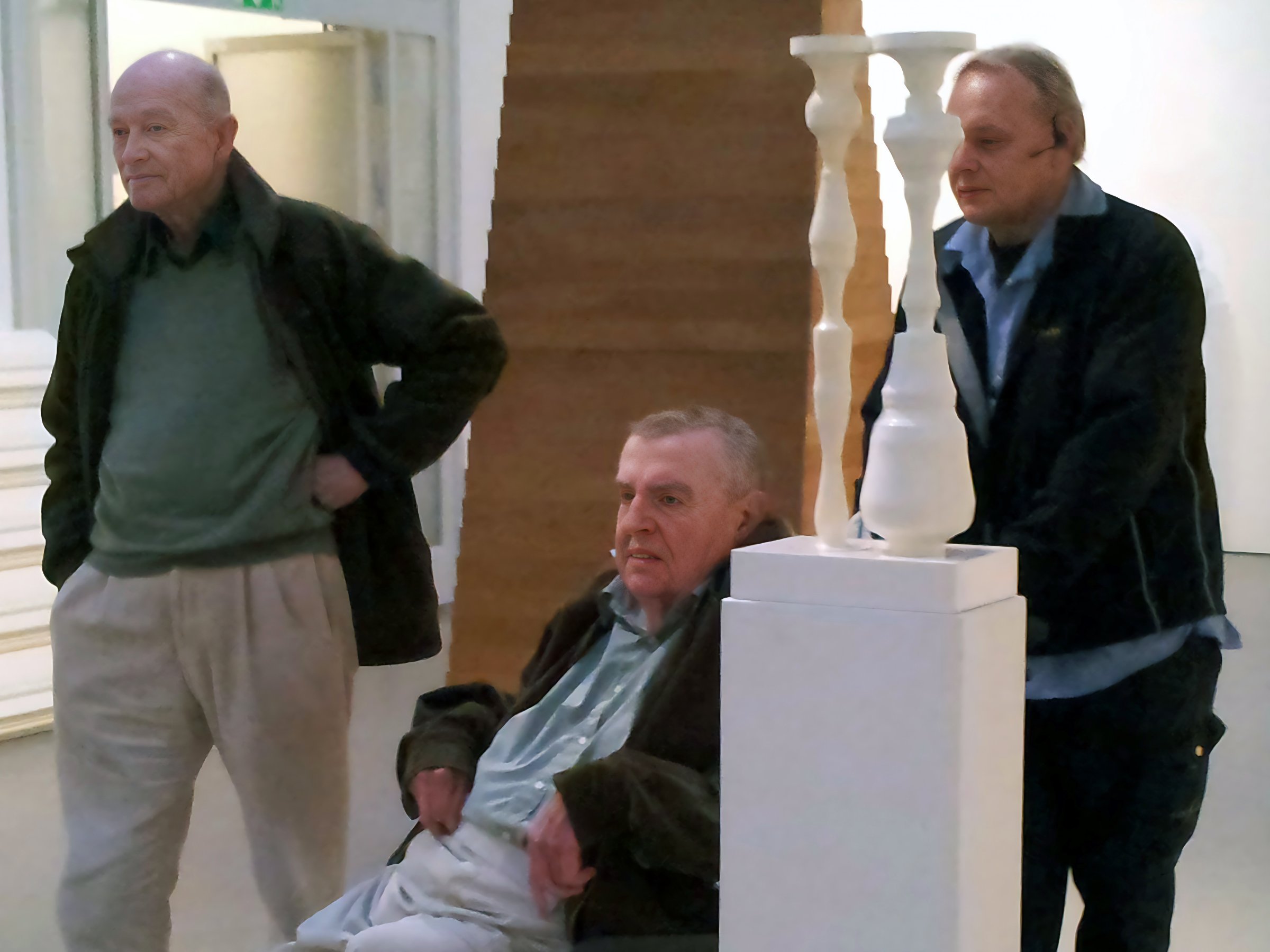
Ulf Linde in Dagens Nyheter 1966
Maskinöversatt — ännu ej granskad.
Ulf Linde in Dagens Nyheter November 23, 1966
… One could put it this way: He who models feels himself working with a homogeneous mass. He has soaked, torn, and kneaded his clay so that he knows it right through – it becomes completely transparent to consciousness, if not to the eye. Sivert Lindblom's early sculptures felt – also to the viewer – very transparent in precisely that sense. They were homogeneous melts.
It is at this point that his new works represent a radical departure. The mere fact that many of the later sculptures are turned makes this clear; the material inside the surface of the turned piece is always unknown – the turner can be surprised by bubbles in the material, for example. (It's like seeing a tin can without a label – one wonders what's inside it.) Sivert Lindblom has wanted to maintain and emphasize that the only thing visible of a sculpture is a complicatedly curved surface. His new sculptures are surfaces that obscure masses of different densities. By lacquering the sculptures, he makes it even clearer: the surface layer is obvious enough – but does one see lacquered wood? Lacquered plaster? Lacquered metal?
Furthermore – by obscuring the mass, the impression of weight and of balanced shifts of weights is also eliminated. The sculptures' plumb lines are "dead" – completely neutral in their mechanical precision; merely by-products of the turning process. In other words, the sculptures become neither light nor heavy – they lack all "imaginary" relations to gravity. One's imagination cannot grasp any specific weight or density. One simply stands before a turned and painted "knob".
But suddenly one discovers that the knob's profile is the profile of a face. When one realizes this, it feels as if a head quickly turned inside the sculpture – a kind of futuristic jolt …
The sculptures thus have a figurative content – Sivert Lindblom's own profile, traced from a photograph, recurs in all the exhibited objects. It is a kind of inverted painting – for if a painting is a flat surface that reproduces curved surfaces in an imaginary space, then here it is a curved surface that "reproduces" a flat profile or projection.
One could also put it this way: When imagination made a cut into his older sculptures, it encountered a material, a mass of a certain consistency. Now, instead, it encounters a projection of a face, a form. Only in a few cases has Sivert Lindblom performed such a cut in "reality", in the sculpture itself. In most cases, the viewer himself, "in spirit", has to saw the sculpture apart to find the image, the silhouette.
It is usually said that sculpture is a more "realistic" art form than painting, as it retains reality's third dimension – which is, of course, missing in painting. The assertion has always seemed dubious to me – it might have suited Mme Tussaud well; she, after all, warned against the unreal, against illusion. In Sivert Lindblom's case, talk of sculpture's "realistic" status becomes pure nonsense. In his sculptures, not only does the dimension of the depicted object become imaginary. The two remaining ones – of the plane – also become imaginary.
In his most interesting and most accomplished works, the profile is completely obscured by the curved surface that constitutes the sculpture. The actually visible form and the interpreted, "cerebral" one, are as different from each other as can be imagined. And if I have understood his works at Buréns correctly, it is precisely this difference he wishes to achieve.
The profile – the self-portrait – is not of any great interest in itself; he could just as well have taken Caesar's profile – or a bottle's – or a Chevrolet's. (That he took his own may have been because his good knowledge of it made it easy for him to check if the form had become precise …).
The entire exhibition is about the gap between the seen and the perceived, between sensory impression and conception – he has filled the entire space with a mysterious psychic void: that from which every thought flashes forth. The white, weightless symmetries in his works have something of the intangibility of memory images, almost completely washed away by oblivion – but a remnant of memory's pattern remains, and suddenly the structure of recognition bursts forth like frost crystals on a foggy pane.
The form, memory's grasp, comes as if from nothing. It is not only the curved surface that gains depth, but also the "now" when one stands and looks. "Form" becomes memory – no measurements to take on a volume that looks a certain way. A sculpture becomes an imaginary object. Again.
From review DN November 23, 1966