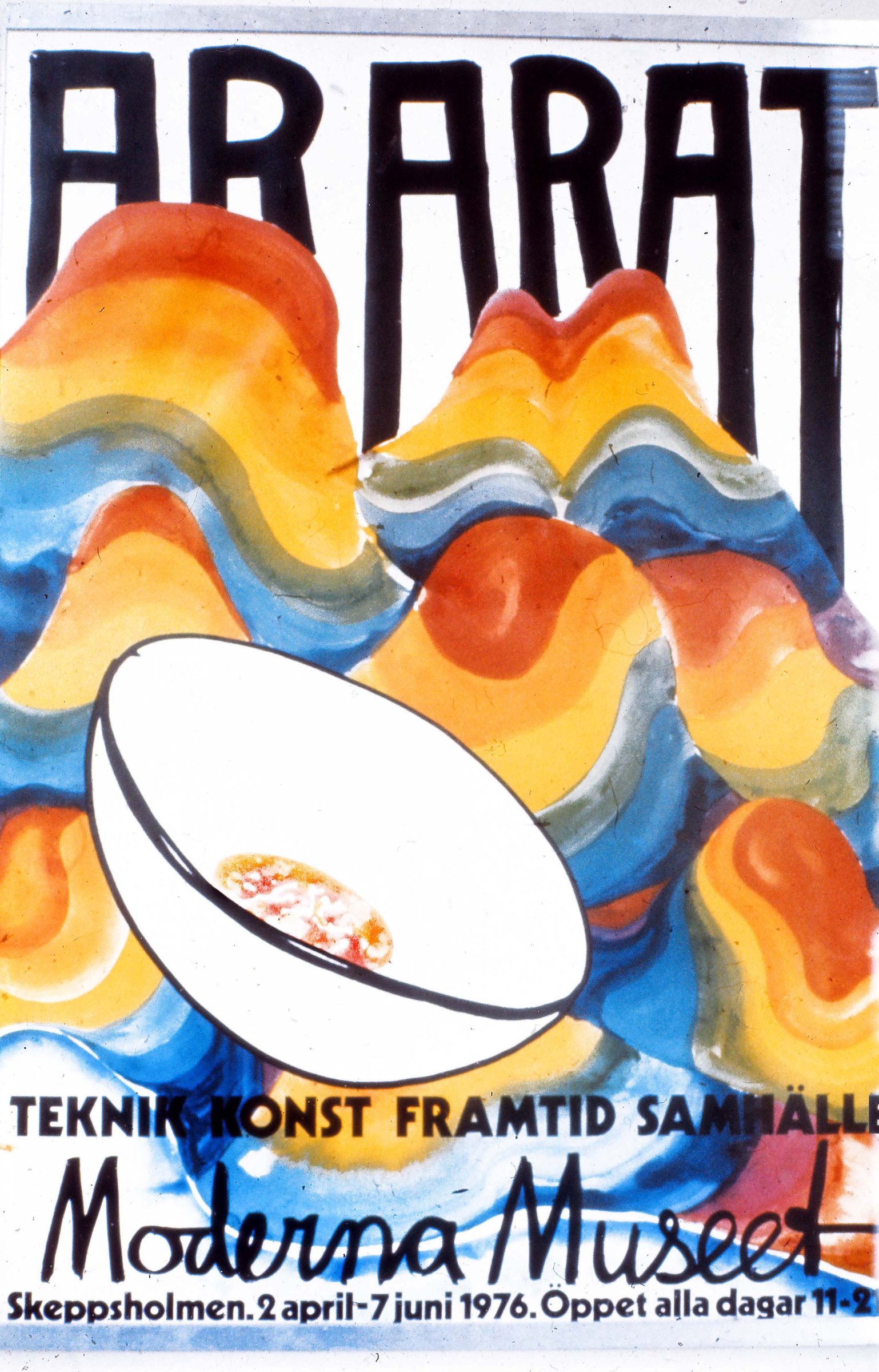
ARARAT was a groundbreaking alternative exhibition about environment, resources, and alternative technology that took place between April and July 1976. The name stood for Alternative Research in Architecture, Resources, Art and Technology. It was shown at Moderna Museet in Stockholm from April 2 to June 7, 1976. It was extended until July 31. The exhibition later, with parts of it, came to represent Sweden at the Venice Biennale the same year.
”The exhibition was based on a fundamental question: what future do we really want to create? The difference between the logical future – a continued development of the society we already have – and the desired future became a central starting point. ARARAT gathered artists, architects, researchers, and engineers in a joint effort to imagine other ways of organizing society and utilizing its resources.
It revolved around the uneven distribution of the world's resources and the need for a different relationship between humans and nature. Recycling, small-scale production, alternative energy sources, ecological agriculture, public transport, and new forms of construction were presented as possible paths towards a more sustainable society. It was thus not about technology as an end in itself, but about how technology could be used to change our living conditions. There was also a strong pedagogical and playful side. Small-scale technical solutions and experiments were displayed in a way that engaged the visitor. One of the most noted examples was the extraction of methane gas from elephant dung from the nearby Skansen. The gas could then be used to heat cold frames and boil eggs. It was both concrete and humorous – but at the same time entirely in line with the exhibition's serious question: how can we use the resources already around us in different ways?
ARARAT was thus more than an art exhibition. It was a workplace, a laboratory, and an attempt to build a model of a different society. Around one hundred people participated, and the different groups formulated their own visions and goals. There was no single definition of what ARARAT truly was. Rather, it was the diversity of perspectives that constituted the project's strength.
Sivert Lindblom belonged to the original working group along with Kerstin Abram-Nilsson, Valdemar Axelsson, Lars Englund, Bo Hall, Lennart Mörk, Hans Nordenström, and Monica Nordenström. For Sivert, ARARAT became an opportunity to work in a way that is close to several central aspects of his artistry: with architecture, materials, space, and human physical movement through a place. Together with Jan Öqvist and Heinz Müllner, Sivert designed the entrance to the inner part of the exhibition, the so-called Vita havet. Visitors were not just to step into an exhibition – they were literally to change their way of moving through the space.
The entrance was designed as a rock face with a man-high opening. Above the opening was the word Ararat, handwritten and pulsating like a first, almost childishly simple spelling. This was followed by a black tunnel whose ceiling gradually lowered. Visitors were forced to bend down before they could enter the black room. It is a strong spatial gesture. First, one had to penetrate the mountain. Then, one had to bend down. On the other side, the black crypt opened up. Straight ahead, like a leaning altarpiece, stood an illuminated cross-section of an earth profile. It showed how thin the life-sustaining layer of soil actually is and how sand and stone take over beneath it. Behind the earth profile was a luminous text, a poem that pointed to this global fact. And behind the transparent earth disc stood a black pillar. On one side hung a spade. High atop the pillar sat one of Sivert's white seated figures, crouched in a meditative posture. Here, several of ARARAT's ideas converged in a single image. The earth, work, humanity, and the responsibility that comes with our use of nature. The spade is a tool for cultivating and changing the earth. The small white human figure sits above it, almost as if in a state between labor and contemplation. Around her was darkness broken by small ultraviolet dots – an artificial starry sky.
Sivert's figure is particularly significant in this context. It is not an illustration of any specific person or story. Rather, it is a human presence in the room. The small body on the black pillar makes the scale noticeable and causes the earth profile around it to appear as both landscape and model. Humanity becomes both small and central at the same time. When visitors left the black crypt, the exit was marked with fiber optics showing two possible paths. If one turned around, one could see what had just been passed. Then a completely different image emerged. Behind the hard rock face and the black crypt was a constructive and joyful sphere built from scrap wood from the exhibition's various constructions. The material suggested a globe – an earth in the making, built from the remnants of the exhibition itself. The contrast was deliberate. The hard, enclosed rock face stood against the open and playful reuse of scrap wood. The black crypt against the lighter construction. Weight against lightness. Destruction against the possibility of building something new from what already exists.
It is also here that Sivert's participation in ARARAT becomes particularly interesting. He worked not only with an individual artwork, but with the very situation in which art is experienced. The visitor became part of the work through their body: one passed through the opening, bent under the lowering ceiling, entered the darkness, and stopped in front of the earth profile. The space guided the movement, and the movement changed the experience of the space. Spatial thinking is central to Sivert's artistry. His sculptures often do not function as isolated objects but in relation to their surroundings. They change our perception of scale, direction, distance, and body. In ARARAT, this thinking took an unusually direct and collective form.
But ARARAT also dealt with something that recurs in Sivert's work: the relationship between the built and the organic. Architecture, earth, humanity, and materials were not placed in separate categories but were part of the same system. The exhibition aimed to show that our technical and economic systems always affect the physical conditions for life. In this context, the earth profile becomes more than a pedagogical object. It becomes an image of a boundary. Beneath the thin layer of soil, there is not an infinite supply of resources, but sand and stone. Life rests on something very thin. And atop this earth sits Sivert's small human figure.
ARARAT aimed to show possible paths towards a future where humanity takes greater responsibility for its resources and its environment. Sivert's entrance made this idea corporeal. Visitors not only read about the future – they passed through a symbolic earth, bent down, entered the darkness, and encountered the image of the thin life-sustaining ground. Each station in the exhibition also had its own loose-leaf sheet with information, which visitors could take with them. Together with a folder made of recycled paper, these sheets became a personal catalog of the exhibition. Visitors could choose for themselves what was important to take with them.
It was a beautiful image of what ARARAT sought to achieve. The exhibition did not provide a ready-made answer. It offered materials, ideas, technical experiments, and possible futures – and then allowed visitors to continue with them themselves. For Sivert, ARARAT was therefore not only a political and ecological project. It also became a concrete investigation into how art can change a place and how a space can change the human way of thinking. It began with a rock face. One passed through it, bent down, and entered the darkness. Inside were the earth, humanity, and the starry sky.
For this entrance room, this loose-leaf sheet was made with a poem by me and a credo on the other side: the text that hung above the earth profile was this:
"Humanity lives in a space. She calls it the biosphere. In this living space, she coexists with individuals, plants, and things. These are created, live, and die. All have their time. Their memory is preserved by those who follow. It doesn't matter who you are; all your sustenance comes directly or indirectly from the earth. Or more precisely, from the few centimeters of the earth's surface that are called humus, topsoil, or arable soil. This membrane, the meeting place of life and death, has an average depth of seventeen to twenty centimeters on the land surface around the earth. One spade deep. This thin layer of earth sustains all plants, animals, and human life." /Jan Öqvist
There is much to write about regarding this epoch-making exhibition, which had nearly a quarter of a million visitors. On weekends during the exhibition period, there was a queue almost down to the Nationalmuseum.
READ JAN ÖQVIST'S description of the ARARAT project: Vision, Analysis, Manifestation – a longer memoir LOOK AT SLIDE SHOW from ARARAT exhibition by Jan Öqvist (approx. 23 min)
Ladda ner
ARARAT SLIDE SHOW – Moderna Museet, 1976 (Jan Öqvist, ca. 23 min)