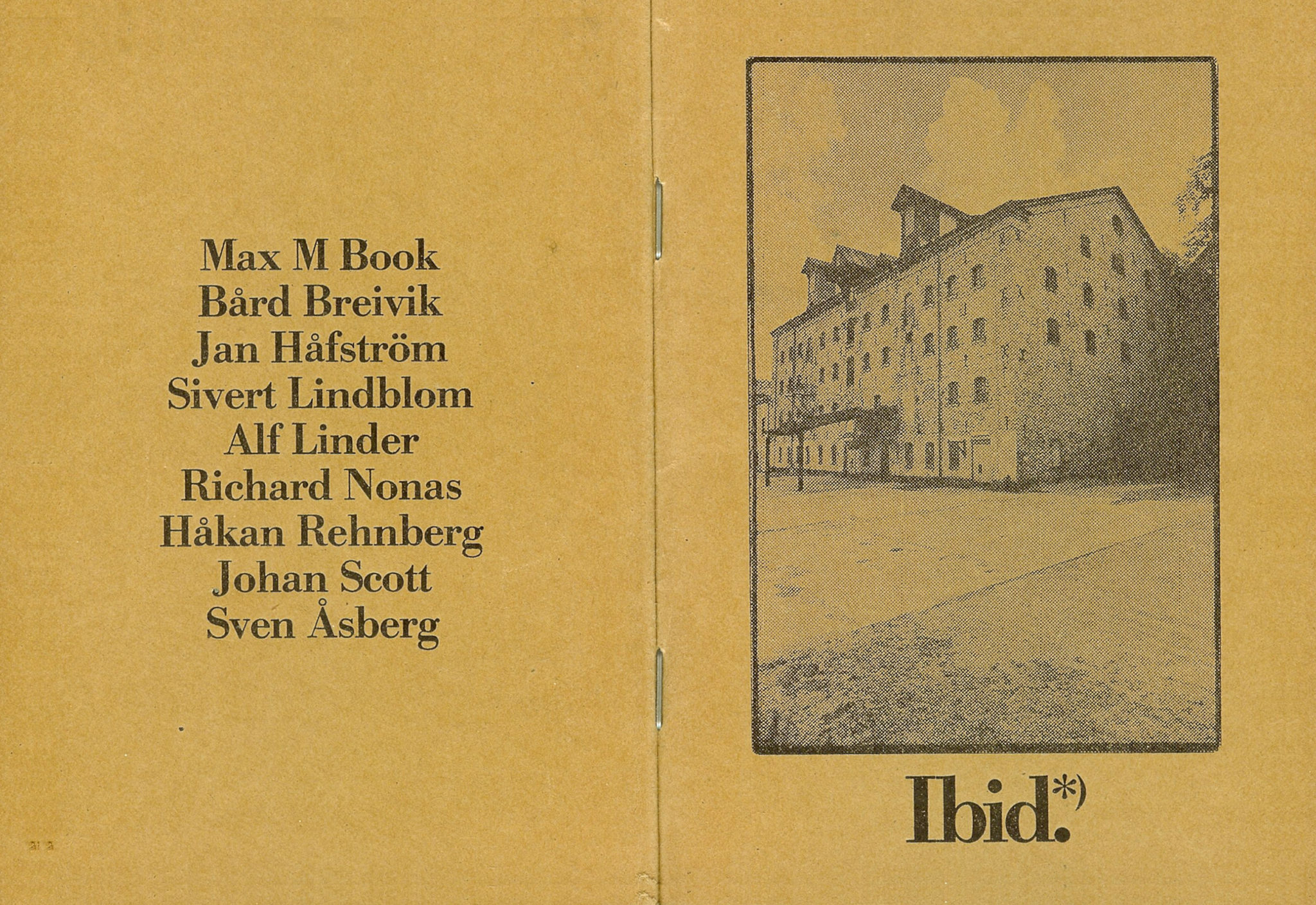
IBID I was a group exhibition that took place over two summers, 1982–83, in the now burned-down linseed oil factory in Danviken at Stockholm's inlet.
IBID I was an unusual group exhibition that took place over two summers, 1982 and 1983, in the old linseed oil factory in Danviken, right at Stockholm's inlet. Among the artists who participated in 1982 were Sivert Lindblom, along with Max Book, Bård Breivik, Jan Håfström, Alf Linder, Richard Nonas, Håkan Renberg, Johan Scott, and Sven Åsberg.
"The name IBID, an abbreviation of the Latin ibidem – "in the same place" – took on an almost literal meaning here. Art moved into an old industrial building, an environment with its own history, materiality, and patina. It was far from the white walls of the neutral art gallery.
For Sivert, in particular, this was an environment with many points of contact with his own artistry. He had a strong interest in architecture and industry and dedicated much time to understanding how materials are processed, refined, and given form. He could see a building not just as a shell around art, but as something that in itself carried forms, proportions, surfaces, and stories.
In Danviken, his sculptures therefore encountered an environment that in many ways spoke the same language as he did. The old factory did not just become a backdrop for the works. Brick, wood, iron, light, and the room's own history became part of the encounter with the sculptures. Sivert's interest in the relationship between the individual object and the space around it found a particularly concrete place here.
It is also something almost typical of Sivert that his art during this period got to encounter a place that had previously been entirely dedicated to production. He gladly moved between art and craft, between the artistic and the industrial, and was interested in the very process where idea becomes material and material becomes form. In the old linseed oil factory, this history was already built into the walls.
Today it is difficult to return to IBID I. The factory no longer exists. It later burned down in a suspected arson attack, and the site has since been transformed by new development and housing along the quay.
What remains are the photographs, the works, and the memory of a time when Sivert and the other artists could take possession of the old factory and transform it into something else – for a brief moment. IBID, "in the same place," has therefore taken on an almost sadly fitting meaning. In retrospect, the name IBID becomes almost poetic. "In the same place" – but the place is no longer the same." /JÖ