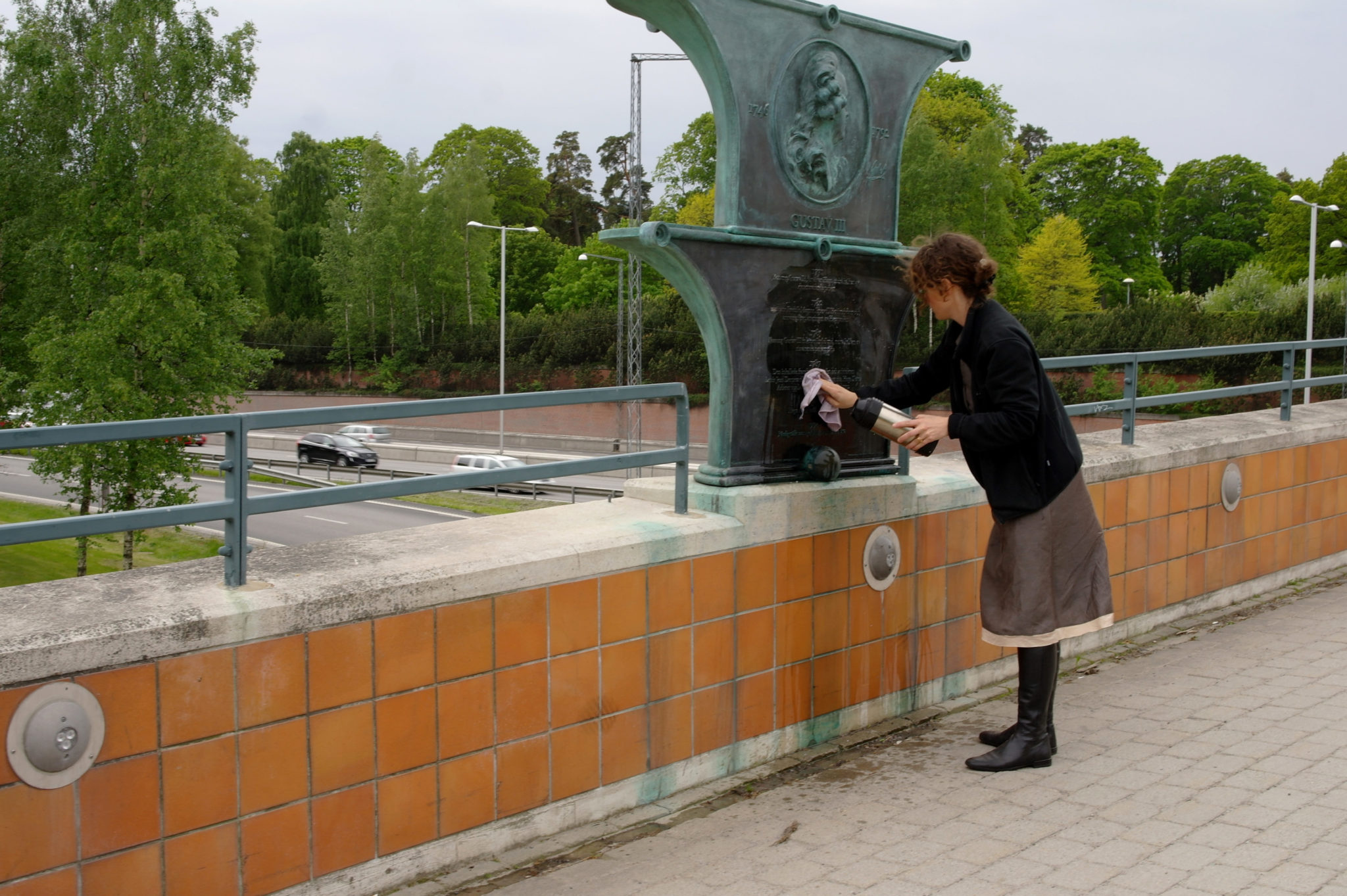
Re-inauguration of Haga Norra Footbridge and the park's sculptural embellishment on May 30, 2015. Four bronze spheres and a large urn, originally installed 1993–1995, had been stolen. Solna City commissioned a reconstruction with enhanced security measures.
The re-inauguration of Haga Norra Footbridge and the park's sculptural embellishment took place on May 30, 2015. Four bronze spheres and a large urn, originally installed by the artist Sivert 1993–1995, had been stolen and other elements had been vandalized with graffiti.
Solna City commissioned a reconstruction and reinstallation with enhanced security measures, including concrete filling, DNA marking, and warning chips.
The ceremony was held in conjunction with the 25th anniversary of the Friends of Haga-Brunnsviken and the 20th anniversary of the Royal National City Park.
BACKGROUND
Previously, there were two bronze globes on each side of Haga Norra Footbridge. All four bronze globes were stolen. Out in the park, near a memorial to Sergel, the large urn was also removed. Given the weight of these sculptures, this theft must have been carefully planned and carried out with the aid of lifting equipment and a truck.
Solna City decided to restore the objects to their original likeness. Their production was carried out with the help of Ulf Ferrius and they were cast by Skånska Klock- & Konstgjuteriet AB in Hammenhög.
To prevent and hinder a new theft, they were remade, filled with concrete, "DNA-marked," and fitted with "warning chips" that activate if someone attempts to move or steal them.
The restoration work and anchoring itself were meticulously carried out with Ulf's expertise.
Upon completion, the restoration of the artistic design was celebrated together with Solna City's dedicated employees.
Sivert was commissioned by the Public Art Agency Sweden and the Swedish Road Administration to design the footbridge over the E4 motorway and two connecting entrance areas at Haga Norra towards what is popularly known as Hagaparken 1993–95.
In this page's gallery, you can see documentation of the restoration and installation of the globes and the urn.
Sivert had chosen cast portrait medallions for four of the silhouette urns that lined the overpass.
These were significant historical figures associated with Hagaparken.
It was the poet Carl Michael Bellman with the lyrics to his epistle No. 64, "Fjäriln vingad syns på Haga" (The winged butterfly is seen at Haga).
"The winged butterfly is seen at Haga, between the frost and down of mists,
Prepares its green shelter, and in the flower, its pavilion;
The smallest creature in marsh and sorrel, just awakened by the sun's warmth,
Is kindled to a new solemn frenzy by the zephyr's breath."
The second is Louis Jean Desprez (1743–1804), a French architect, painter, and stage designer who was recruited to Sweden by Gustav III in 1784. He became the king's principal architect and shaped the aesthetic of the era through magnificent theatre decorations, architectural drawings, and copper engravings.
The third is Fredrik Magnus Piper (1746–1824), who was one of the foremost landscape architects of his time and the first formally trained garden architect in Sweden. He was appointed by Gustav III as planning architect and superintendent for the royal pleasure park – Haga. During the years 1773–1780, he received his education in France, Italy, and England. He also planned the English park at Drottningholm Palace 1781–1810, as well as Bellevueparken in Stockholm (north of Brunnsviken and south of Cedersdalsgatan and Wenner-Gren Center). In 1786, the "Turkish Kiosk" was erected according to his drawings in Hagaparken.
The fourth along Hagabron is, of course, Gustav III (1746–1792). He revolutionized Swedish cultural life by founding several of the country's most prestigious institutions. He introduced a French-inspired golden age for theatre, literature, and art. The king himself acted as a playwright and patron, which led to Swedish cultural life being integrated into the elite circles of the European Enlightenment.
The king left several lasting imprints on Swedish culture: In 1786, following the model of the French academy, he founded "Den Svenska Akademien" (The Swedish Academy) with the aim of cultivating the Swedish language and its literature. In 1773, the Royal Swedish Opera, in 1771, the Royal Swedish Academy of Music and the Royal Swedish Academy of Letters, History and Antiquities, and strongly supported the Royal Academy of Fine Arts (where Sivert himself was elected as a member in 1974 as a representative for artists).
/JÖ
Photographer: Jan Öqvist
⊙ View location⊙ Haga Norra, Solna