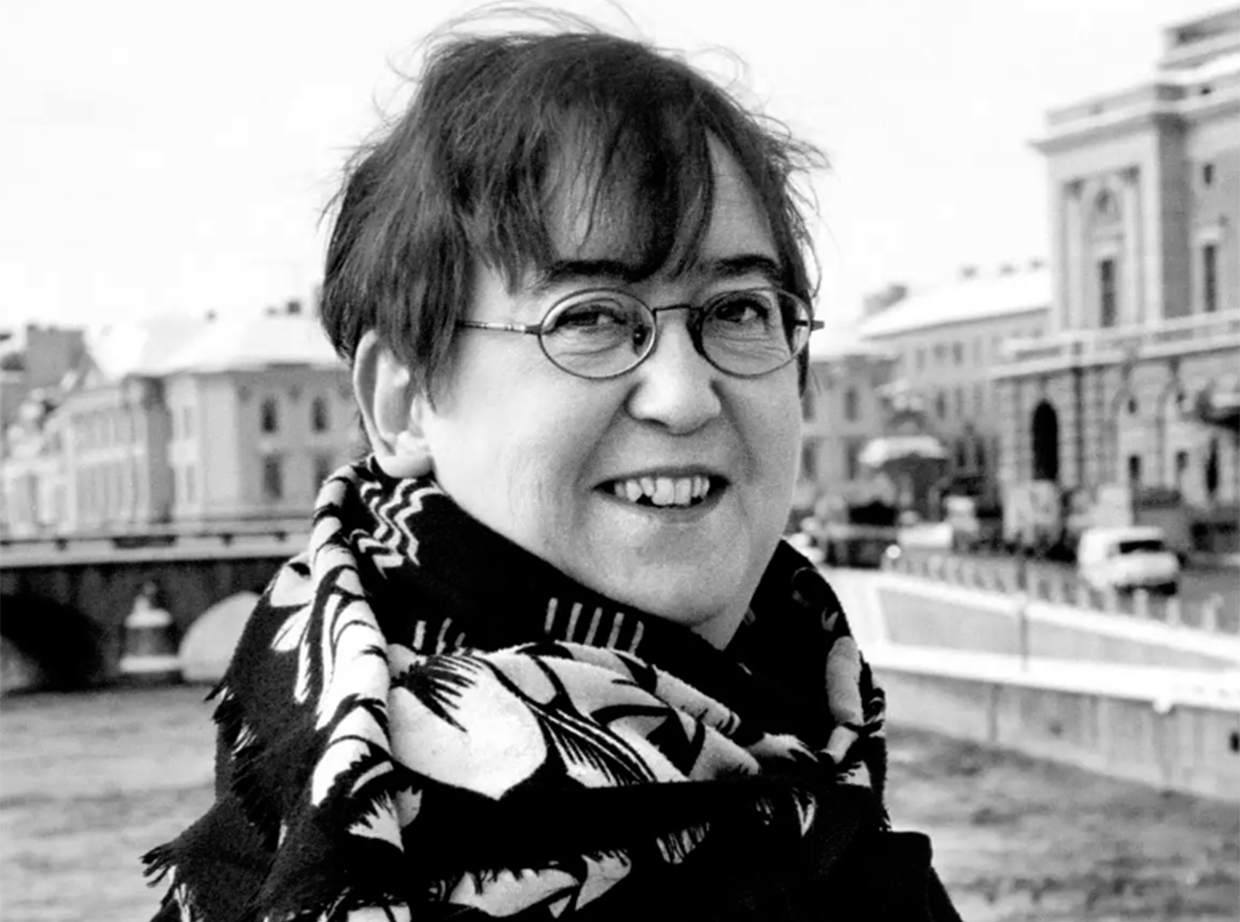
A Conversation with Sivert Lindblom
Sivert Lindblom interviewed by Beate Sydhoff
Beate Sydhoff: In our conversation about your sculptures, you have put forward the concepts of primary and secondary feeling. What do you mean by a form that is not associated with what you call secondary feelings?
Sivert Lindblom: To begin with, I had better explain what I mean by primary and secondary feelings.
The secondary feeling is based on our direct experience and, as a consequence, is purely subjective. The primary feeling, that which is common to us all, can perhaps be explained as a basic structure stamped by biological factors. Its existence, however, is difficult to prove. This primary feeling is assuredly both the goal and the motive power of all creative activity, but it cannot be treated as a means. The primary feeling is thus not directly communicable; it must first be objectivized by some means so that it becomes indirectly communicable.
That the secondary feeling exists is obvious, but it is neither directly nor indirectly communicable, because it is not common to all.
If we regard form as a means of communication, then it should not be associated with secondary feeling at all.
We have to concentrate on the actual language, the form. We have to establish in which plane the form, as a means of communication, functions, and seek in this plane a distinct and precise formulation. To exploit the conscious ego, the intellect, as much as possible, to objectivize one's experiences with the greatest clarity.
BS: Does this mean that your work is "unfeeling"?
SL: In the case of secondary feelings, I hope so. When one avoids these relative aspects, an active emptiness emerges for me that approaches the concept of freedom.
An emptiness that the spectator himself can "fill in" and therefore really be aware of himself. The form of the vessel determines the content.
BS: How did you arrive at these ideas?
SL: The reason was the limitations of the learned, formal conventions. A situation arises in which you can't get any further without extremely strained intentions. It's a sort of paralysis.
BS: You experienced freedom when you discovered that you could utterly reject secondary feelings as a means of achieving it.
SL: The conscious exploitation of one's feelings is to me a paradox. When I realized the consequences of this, I really experienced an enormous sense of liberation, a feeling of maximum opportunity. In a situation like this, observation becomes possible, the arbitrariness of sentiment disappears, and one is no longer concerned with metaphysics but with vision.
BS: Can one find any recurring characteristic in your idea of form?
SL: As I've already mentioned, I was trying to establish how we experience the registration of form and content. My discovery of the two-dimensional in both form and content was decisive for my subsequent work.
BS: What do you mean by two-dimensionality?
SL: Our visual opportunities. I believe that two-dimensionality becomes palpable in the direct observation of how man's senses and intellect function when they comprehend form and content, for instance, the inability of our eyes to register anything other than the surface of the form. If we see a cube, we understand it as a three-dimensional object, but what we see are surfaces arranged in specific positions. A texture is simply a more complicated surface phenomenon. To get a sense of what lies beneath the surfaces, we can draw on our own experience and the experience of others, but it is still impossible to prove anything with our senses; not even a cut made in the object can tell us anything — it simply gives us new surfaces. The formulations of content stand in a similar relationship to their mechanisms. The formulation is also a surface, and what this surface represents is something we can only comprehend by our own experience.
BS: And transferring this argument to your sculpture, what was the consequence?
SL: The consequence was that I could determine where my language could be understood; I could concentrate on working there with the greatest possible clarity, so that the content lay in the visible (as near the surface as possible).
BS: What did this mean regarding the choice of material?
SL: The material suddenly didn't matter; it had only a technical function, serving as support for the surface.
BS: And how does color function on these surfaces?
SL: The color, like the material, is used professionally to specify the surface; it is understood habitually as two-dimensional. The different colors are chosen without any aesthetic evaluation. The objective is to find colors that people register as objective information, as with traffic signs.
BS: You are not concerned about communicating content-related aspects?
SL: What is content and what is form in my works is difficult to handle separately. The content is the form, and the form is the content. The content, the poetical intention, has been given its clearest possible formulation, and I can only provide information on the reading, the way to see it.
As regards colors, I should point out that I am exhibiting the results of my work to a public that, by convention, mixes content dictated by artistic conventions, and they think they are seeing more than they can. For this reason, I have to try to renew their way of seeing and use clarifications, and in this, I've sometimes made use of color; so there are details put in merely to steer the way people see.
BS: How do you want your sculpture to be understood?
SL: A further consequence of the two-dimensionality and the working method arising from this observation is that objects become "immaterial"; they should be understood as thought-steered operations, registrations of thought.
The important thing is to get the spectator to participate in the intellectual adventure, a sort of co-creation in these speculative investigations.
BS: How do you feel about the new "immaterial" sculpture in England?
SL: Technically and formally, I am curious and, in a way, feel related to it, but I find it very difficult to understand the meaning of their work; in my view, they have stopped halfway. There is an aspect of conventional form there that I have no sympathy for.
BS: You said something about speculative investigations. Do these have anything to do with the Bauhaus?
SL: Nothing to do with the Bauhaus at all.
The whole background to the Bauhaus' belief in form and its functions is no longer in the picture. What is entirely obvious just now is that we have no faith in what the Bauhaus meant by form. Idea and intention demand that we choose the form that is most effective as a means of communication, whether simple or composite, clear or unclear, clean or unclean.
BS: The Bauhaus believed in a clean world. Is your idea opposed to theirs on this point as well?
SL: My idea is different; it's not a question of any opposition. I am not trying to prove anything that excludes anything else. This is one of the reasons why the Bauhaus belief has no interest for me. The way in which I work primarily concerns me and my ability to communicate.
BS: Is your art programmatic? Do you have intentions that lead to a specific goal?
SL: I should like to be able to take part in a positive and progressive creation that can develop man's mechanisms and thus permit a more diversified experience of existence—the social function of art.
Konstrevy Nr 2, 1967
Photo: Dagens Nyheter