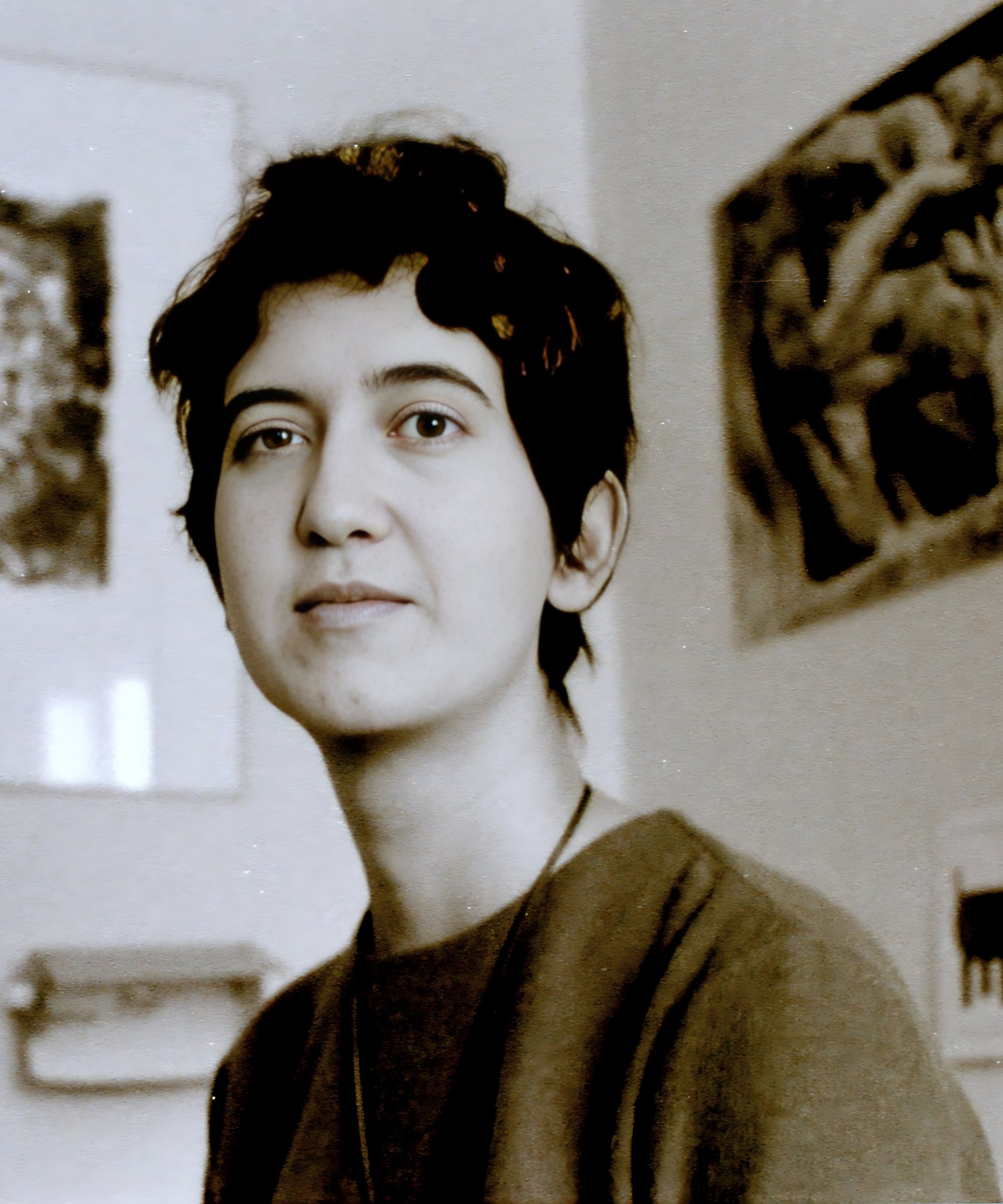
Conversation with Sivert Lindblom
Maskinöversatt — ännu ej granskad.
Conversation with Sivert Lindblom
Beate Sydhoff: In our conversation about your sculptures, you introduced concepts such as primary and secondary feelings. What do you mean by a form not associated with what you call secondary feelings?
Sivert Lindblom: First, I must explain what I mean by primary and secondary feelings. Secondary feeling is based on our direct experiences and is a consequence of them; it is fully subjective.
Primary feeling, that which is common to all, can perhaps be explained as a particular fundamental structure of biological factors. Its existence is therefore difficult to prove.
This primary feeling is certainly both a goal and a driving force in everything that is created, but it cannot be treated as a means. Primary feeling is therefore not directly communicable, but must first objectify itself through some means and thus become indirectly communicable.
That secondary feeling exists is clear, but it is neither directly nor indirectly communicable because it is not common to all.
If form is considered a means of communication, it must not then be associated with secondary feeling. One must concentrate on the language itself, on the form. Ascertain on what level form functions as a means of communication and, on that level, seek precise and distinct formulations. Utilize the conscious self and intellect to the maximum to observe one's experiences objectively, with the utmost clarity.
BS: Does this mean your works are cold, insensitive?
SL: As for secondary feelings, I hope so. If these relative moments are avoided, an active void arises within me that borders on the ideal of freedom. A void that the observer himself can "fill" and, therefore, truly experience. The form of the vessel determines the content.
BS: What is the reason you arrived at these ideas?
SL: The cause was the limitation of deeply rooted conventions about forms. A situation arises when one cannot proceed without resorting to forced intentions. A kind of paralysis.
BS: Did you experience a sense of freedom when you discovered you could reject sensations, secondary feelings as a means?
SL: Consciously exploiting one's feelings is, for me, a paradox. When the consequence of this became clear to me, I truly experienced a great liberation, the sensation of maximum possibilities. In such a situation, considerations and observations become possible: the arbitrariness of feeling disappears; one is no longer dealing with sentimentalism, but with a visual sense.
BS: Can any recurring characteristics be found in your idea of form?
SL: As I have already said, I have tried to ascertain how we experience the registration of forms and content. The discovery of the bidimensionality of form and content was decisive for the continuation of the work.
BS: What do you mean by bidimensionality?
SL: Our visual possibilities. I mean that bidimensionality becomes evident from a direct observation of how human senses and intellect function when they understand form and content, for example, the ability of our eyes to register something beyond the surface of forms.
If we look at a cube, we understand it as a three-dimensional object, but what we see are surfaces joined in specific positions. A "texture" is only a more complex phenomenon than a surface. To form an opinion about what lies behind the surfaces, we can consult our experience, and that of others, but it is still impossible, with our senses, to prove anything: not even a cross-section of the object can tell us anything, but only gives us new surfaces. Substantial formulations are analogously related to their mechanism.
Formulation is also surface and what this surface represents; we can only grasp a concept of it through our experience.
BS: If this reasoning is applied to your sculpture, what would be the consequence?
SL: The consequence would be this — I could decide how my language can be understood and, furthermore, I could concentrate on working with the greatest possible clarity. So that the content lies in the visible, as close as possible to the surface.
BS: What has the choice of material meant?
SL: The material immediately became indifferent and served only a technical function, as a support for the surface.
BS: How does color act on these surfaces?
SL: Color, as a material, is professionally used to define the surface; it is therefore habitually understood as two-dimensional. The different colors, the hues, are chosen without aesthetic evaluations. The aim is to find colors that humans register as real information, for example, like on traffic signs.
BS: Do you not wish to interpret significant moments?
SL: The significant and the formal in my works are difficult to treat separately. The significant is the formal and the formal is the significant. The content, the poetic intention, has had its clearest formulation, and here I can only inform about the art of reading, about the way of seeing.
As for color, I must note that I present this result of the work to an audience that, guided by convention, mixes in content characterized by artistic convention; it believes it sees more than what is truly seen. For this reason, I must therefore renew the way of seeing and employ clarifications, and on such occasions, I have sometimes taken help from color.
There are, however, details that exist only to guide the visual sense.
BS: How do you want your sculpture to be understood?
SL: A further consequence of bidimensionality and the working method that emerged from this statement is that objects become "immaterial" and are to be understood as thought-guided operations, as mnemonic registrations. The important thing is to have the observer participate in intellectual adventures, a kind of co-production in speculative inquiries.
BS: What is your attitude towards the new "immaterial" sculpture in England?
SL: Technically and formally, I am curious and feel somewhat akin, but I have great difficulty understanding the meaning of their works. In my eyes, they have remained halfway. There is a conventional line in the expression of form with which I cannot sympathize.
BS: You just mentioned speculative inquiries. Do they have anything to do with the Bauhaus?
SL: They have nothing to do with the Bauhaus. The entire foundation of the Bauhaus idea about form and its functions is no longer relevant for us.
What is entirely clear now is that we are completely lacking conviction about what the Bauhaus intended for form. Idea and intention require that we choose the most effective form as a means of communication, be it simple, complex, clear or obscure, pure or impure.
BS: The Bauhaus believed in a pure world. Is your idea contrary on this point too?
SL: My idea is different: it is not a contrast. I am not trying to prove something that excludes something else. Incidentally, for this reason, the Bauhaus thesis does not interest me. The way I work applies, first and foremost, to myself and my possibilities for communication.
BS: Is your art programmatic? Do you have intentions that lead to a special goal?
SL: I wish to participate in a positive and progressive creation that develops human mechanisms, making a more nuanced experience of existence possible.
The social function of art.
Konstrevy 2/1967
Photo: Lars Olsson