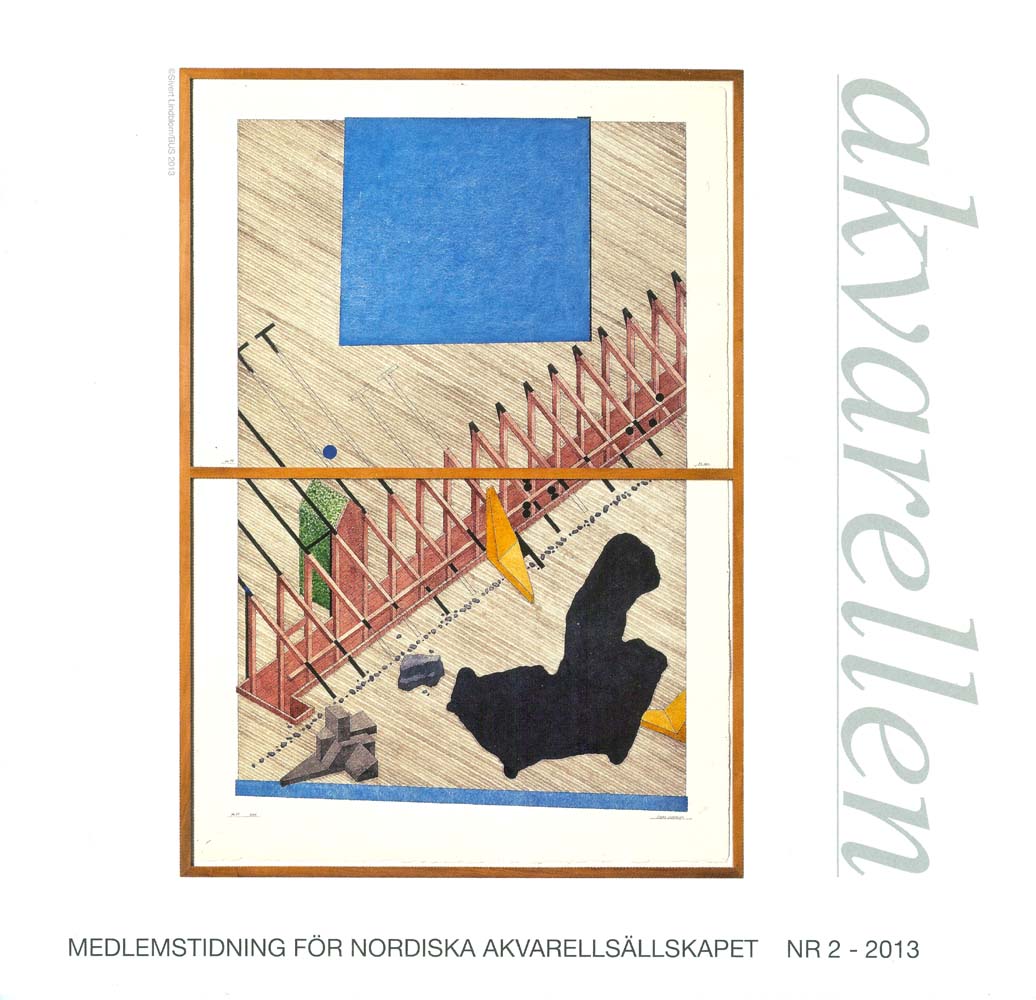
Watercolor No. 2 – 2013
Maskinöversatt — ännu ej granskad.
"Sivert Lindblom is one of Sweden's most interesting sculptors. For a broader public, his art is primarily visible in a large number of public artworks throughout Sweden. Most recently, a fountain in central Eskilstuna featuring a 20-meter-high obelisk, six monumental urns, and a multitude of sculptural details connected to the city's history.
He debuted together with his colleague Ulrik Samuelsson at Norrköpings and Eskilstuna konstmuseer and in Stockholm at Galleri Burén in 1963. Their perhaps most important exhibition collaboration, however, took place in 1974 with the exhibition "Live Show" at Moderna Museet, where Björn Lövin (1937-2009) also participated. The exhibition gained significant art historical importance as it was the first major museum exhibition featuring installations in Sweden. It came to have great significance for Swedish artists, born in the forties and fifties, who were interested in installation and conceptual art. Already at "Live Show," Sivert Lindblom displayed sculptures, objects, constructions, and natural artifacts that interacted in a constructed environmental installation, which in varying ways has been his hallmark as an artist ever since.
Sivert Lindblom primarily defines himself as a sculptor, but the fact is that "watercolor painting" has been a parallel track in his artistry ever since the 1970s. This was also the starting point for his latest solo exhibition "AKVARELLER m.m." at The Royal Academy of Fine Arts in Stockholm. From October 6 to November 4, 2012, Sivert Lindblom exhibited about a hundred watercolors from a series totaling approximately two hundred images, made from the early 1970s up to the present day. The images were presented in an unbroken seventy-meter-long suite along the outer walls of the exhibition halls. On opposite walls and in the room, objects and sculptures were displayed. Most of the exhibited three-dimensional artworks are found in various constellations, incorporated and abstracted into the two-dimensional sceneries of the watercolors.
Watercolor is a significant part of these images, which perhaps should be called watercolored ink drawings, for the drawing in these works is as important a pictorial component as the color, perhaps even the most important, but only together do they form the intended artistic whole.
Sivert Lindblom's images are characterized by a strict technical methodology.
He works on a specially heavy watercolor paper, Arches 640 grams, in the dimensions 56×76 cm. Most often in landscape format, but sometimes doubled in height. The drawing begins with pencil lines which are then filled in to distinct, black ink lines. The drawing is executed on a drawing board in cavalier perspective (parallel perspective). Material and technique characterize the image. The freely applied parallel perspective determines the expression of the space.
Sivert Lindblom uses Winsor & Newton watercolor paints. Of the brand's 96 colors, he chooses to limit himself to about 14 in full pans. The colors are almost never mixed, but variations are achieved in terms of value depending on the amount of water used to dilute the paint. The artist works on dry paper to achieve the precision in the delimitations that he desires. The choice of technique is based on the artistic intention.
The artist is trained in a modernist tradition but is not entirely easy to art-historically categorize. For me, his art represents a kind of avant-garde contemporary classicism, and one of many starting points for the artist's images and installations can be found in the Renaissance. Generally speaking, one can associate the Renaissance with a clear and distinct visual language. A more specific connection is to the garden art of the Italian Renaissance, or more precisely, to contemporary drawings and depictions of these gardens or parks. But the classicist features do not stop at the Renaissance. Associations with Giovanni Battista Piranesi (1720–1778), artist, architect, and archaeologist, provide a link to Neoclassicism. Piranesi's etchings with dystopian, incomprehensibly winding dungeons and architectural images of Roman ruins somehow have a contemporary counterpart in Sivert Lindblom's difficult-to-define unsettling cultural landscapes. But the similarities lie more in the content than in the form, as images that convey cultural critique.
Theatrical stage designs and stage machinery are another conceivable parallel world to Sivert Lindblom's representations. From a store of objects, different worlds are formed on stage. The hidden mechanics of the stage machinery push out and pull in set pieces, guided by the potential plans of the director, artist, or demiurge.
Both the associations with Renaissance symmetrical parks and their map images, the stage-mechanical engineering of theater, and architectural and construction drawings connote meticulous planning. However, Sivert Lindblom's order is partly illusory and rather aims to emphasize the opposite: the disordered, enigmatic, and illogical as a contrast to scientific objectivity. One could say that his art always contains a dualism or struggle between two opposing forces in existence. In antiquity, it was associated with the gods Apollo and Dionysus. The sun god Apollo stood for clarity, order, and enlightenment, while the wine god Dionysus represented orgiastic disorder, exuberance, and unpredictable darkness. These contrasts are presented in Sivert Lindblom's images both directly and indirectly. What one first sees in the images is the well-ordered. But upon closer inspection, the order gradually begins to crack and reveal an underlying, hinted chaos.
The Apollonian trait in the images is primarily connected to the drawing's parallel-perspective construction. An axonometry that shies away from the complexity of reality. The coloring also has an Apollonian trait, in that the colors are used more as signs of material than to give the appearance of materiality. However, the poetic tone of the watercolor paint, its transparency and airiness, still stands in Dionysian contrast to the precise coolness of the drawing.
The artist's images refer to two additional visual worlds that feel Dionysian because they belong to an Eastern spiritual tradition, in contrast to a Western scientific one. The first of these is Japanese garden art, particularly the Zen Buddhist garden. In Sivert Lindblom's work, Zen is present in the raked gravel, originally a symbol of ocean waves, and in the stones, which represent islands in the sea. The second is Japanese polychrome woodcuts, whose contrast between a precise black outline and the transparency of color on rice paper bears expressive similarities to Sivert Lindblom's images.
The most interesting traces of the struggle between order and chaos are found in the pictorial elements I choose to call 'irritations'. These deviations are due partly to the inherent sources of error in the technique and partly to artistic choices. When drawing with ink or painting with water-saturated watercolor, one sometimes spills. Unwanted, sometimes difficult-to-remove, spots arise from time to time. In this case, Sivert Lindblom chooses to embrace chance. If a blot lands on the reserved paper surface around the image area itself, he chooses to neutralize the mistake by circling it, thereby both delimiting and incorporating the error into the image. Chaos is subdued by being acknowledged.
In other cases, when paint blots land within the image area, he chooses to paint over them. Sometimes they are hidden by black, circular surfaces, sometimes by angular, black shapes. However, not all black shapes in the paintings are painted-over mistakes. The black masks of the mistakes form an independent pictorial plane in the parallel perspective, which is sometimes entirely arbitrary but sometimes creeps close to the order of the perspective grid without being fully incorporated into it. In some of the images, the 'irritations' spread out and become larger organically shaped surfaces. Dionysian sabotages, which at any moment seem capable of completely erasing order and causing the ultimate pictorial storm."
Håkan Bull