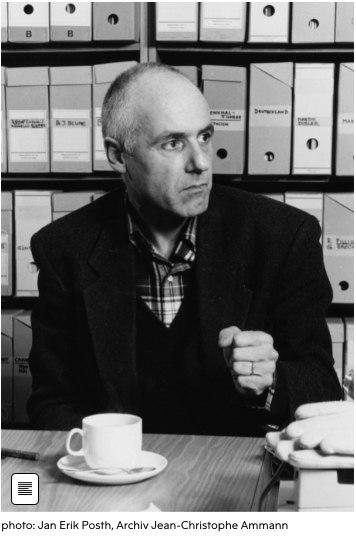
Catalogue text, Live Show II, Art Museum Luzern
Maskinöversatt — ännu ej granskad.
SIVERT LINDBLOM
Sivert Lindblom, born on November 1, 1931, is a sculptor. In the early sixties, he created sculptures from wood and plastic. Among other things, they looked like the balustrade supports of a Renaissance terrace: He created entire series of them, arranged in rows, alternating between a narrow and a wide element.
Upon closer inspection, it became apparent that the isolated forms showed a human profile, whereas in the series sculptures, the outline of the human body was formed by the negative space. It was always his own profile, his own body outline. The sculptures were anonymous, smooth, and repellent. They were a perfect metaphor for the 'coldness' of his ideas, for a kind of enriched emptiness that could not be explained from within, but only outlined from without: through a form that a) revealed nothing original in terms of invention, b) was mechanically produced, and c) was characterized by an equally lapidary color scheme. In line with the zeitgeist, these works were all too quickly seen as an expression of plastic euphoria, for instance from the perspective of contemporary English sculpture.
When Lindblom broadened his perspective at the end of 1960, it suddenly became clear what the "coldness" of his ideas entailed. It seemed as if he was looking into a world that he perceived very precisely, without understanding it. It seemed as if he saw objects without recognizing their meaning. He did not empty the object of its meaning; he saw it without meaning. His perception in individual moments simultaneously corresponded to the neutralization of a gaze prejudiced by knowledge. Is this a method (of a structuralist nature) or is the connection meaningless? It seems to me that both sides influence each other.
To the extent that Lindblom sees the world of things stripped of their meaning, to that extent he (re)constructs them, imbuing them with meaning. But this meaning-creating act of connecting appears conceivably helpless. Are the branches tied with ropes to square beams — part of his vocabulary since early 1970 — not overly obvious metaphors? They are, if one draws one-sided conclusions from them: anticipating the insight, as it were, without including the cross-connections that relativize this insight.
The meaningless connections and relationships are only relevant in comparison to meaningful ones. That is to say, they are meaningless to the extent that the meaningful ones, in accordance with their ideology, have become pawns in a rhetoric of meanings for their own sake. Lindblom reveals nothing; he creates the equivalent counter-world. Associative processes do not occur. For the objects are not connected content-wise as opposites; the meaning-creating connection is contradictory in itself, because it negates the coherence of perceptual processes. Such an approach seems to leave every possibility open to chance. Therefore, Lindblom has created a kind of vocabulary: basic elements, situations, perspectives, which form the starting point for the constitution of a 'world'. They appear as landscape excerpts in ever-new constellations. The nature of the excerpts points to an infinite landscape. The precision with which his watercolors and spatial objects are created is less an aesthetic moment than a handling for the articulation, the assembly, the relating of forms, situations, and perspectives. Precision is the reality of the gaze that constitutes the reality of forms and associations. — On the occasion of the exhibition "Live Show" (1974, Moderna Museet, Stockholm), the sculpture of a sitting man with drawn-up legs and closed eyes (the artist himself) demonstrated the mental character of the environment.
Jean-Christophe Ammann (1939–2015) Exhibitions: Gal. Burén, Stockholm 1963/66/68; 34th Venice Biennale (Swedish Pavilion) 1968; Kunsthalle Nürnberg, Kunsthalle Düsseldorf, Kunstverein Stuttgart, 1970; Gal. Gimpel & Hannover, Zürich 1971 Photo: (https://en.wikipedia.org/wiki/Jean-Christophe_Ammann)