Foreword to Exhibition, Galerie Burén
Maskinöversatt — ännu ej granskad.
SOME REFLECTIONS ON ART … from Determinantan
In modern society, a person's interindividual relationships play a decisive role in their life. These relationships fundamentally involve people comparing themselves to one another, and their activities are dedicated to defending their positions relative to each other or gaining an advantage over one another. For this reason, interindividual relationships can always be interpreted using a disequilibrium system.
We can perform a thought experiment and imagine a society where interindividual relationships no longer exist. A person's situation in such a society would seem somewhat peculiar to us. We cannot quite imagine what this person would fill their life with, or where they would direct the activity that is now directed towards other people. But the circumstance that we cannot find a solution in such a situation, that our imagination does not stretch that far, does not imply that there would be no goal for activity in this fantastic society: our thought experiment is far from meaningless.
In today's society, a person's life largely consists of continuously comparing themselves with others. But such an activity presupposes some kind of reference system, some scales of comparison, and a value system. What do these scales consist of? What constitutes their source?
There are scales of comparison based on conventions that are not supported by immediate reactions, such as those provided by, for example, exact scientific thinking, music, literature, art, or religion. The societal system constitutes an example of a system built on unconditional conventions. This societal system forms a field where people can compare themselves with each other, thereby stimulating interindividual activity. Different societal systems are, of course, built on different scales of comparison. But however they might be constructed, they always have a determinative aspect.
In society, there also exist scales of comparison that are not arbitrary but are based on conventions conditioned by human immediate reactions. There can be different opinions about what these reactions fundamentally are, for example, in thinking, music, or art. There are those who assert their objective character and claim that they correspond to specific stimuli in the external world. Others believe they are subjective, that they have no counterpart in the external world, and that the alleged stimuli are the creations of the observer.
Every person carries within themselves the sum of their life's experiences in the form of "the mass of the forgotten". This mass exists latently in every person, but with each confrontation with reality, certain areas of it are activated.
"The mass of the forgotten" differs among different people; it can vary significantly in some individuals. If such people – one might reason – are confronted with a stimulus, their reactions will be partly different, consequently subjective to some extent, because their different latent experiences assimilate the stimulus in different ways. This reasoning, in its extreme form, leads to the conclusion that different people's reactions to one and the same stimulus can be entirely different, consequently entirely subjective. But if there is no longer any objective sector in the reaction to the stimulus, this means that the latent experiences have completely transformed the stimulus during the assimilation process. In this way, the observer, in reacting, "creates" a "subjective" stimulus which then in turn affects them. This reasoning is based on a misunderstanding, for it bypasses the problem of communicability. A person's experiences cannot be conveyed directly. When two people observe a red spot, they agree on its name; they also willingly accept the assumption that the red spot evokes analogous experiences in them. However, they can never convince themselves that their experiences are truly identical.
A non-objectified experience in a person lacks meaning from another person's point of view. If, according to the reasoning presented, the reaction to the stimulus contains at least a certain objective sector, it has thereby been objectified only partially and consequently incorrectly, but we can still attribute some meaning to it from another person's point of view. If, on the other hand, it has no objective sector and is thus entirely subjective, it has not been objectified at all, and we cannot attribute any meaning to it.
It appears as if even artistic experiences within art are reactions to some kind of external stimulus. Such an opinion can be justified as follows. These reactions are, regardless of their objective or subjective character, immediate human reactions. If these reactions have been taken as the basis for scales of comparison and systems of conventions, these conventions must be conditioned by something. Society has, based on these reactions, constructed "The Institution of Art" with its organization, system of positions, titles, and hierarchies; a multitude of movements, coteries, and styles. And furthermore, people's comparison of themselves with each other using these movements and styles, their constant struggle against each other, intense polemics and battles. Art has become a field for interindividual power struggles and has been endowed with a determinative character.
Let us assume that reactions to art are subjective. In that case, the field for interindividual activities constructed by society on the basis of these reactions would be meaningless in a double sense from this society's point of view. Firstly, because we would not be able to attribute any meaning to these subjective reactions, for they would be in principle incommunicable; secondly, because we could not build any scales of comparison with incommunicable processes as a basis, and consequently could not attribute any meaning to the interindividual activities within art, nor to the field for these activities, for this would be deprived of its reference system. This view can, in all likelihood, be formulated in a more general way.
Every time society creates a system of conventions conditioned by immediate human reactions, and supported by these conventions builds an institution and within its framework creates a field for interindividual activities – these reactions have their source in stimuli in the external world. The determinative aspect of an institution resting on immediate reactions simultaneously constitutes both a guarantee and proof that the source of these reactions is stimuli in the external world. If our aesthetic experiences in art constitute reactions to stimuli in the external world, what then are these stimuli? I do not know, of course. I do not even know how one could answer this question. We have our ordinary language. Music has its own; we can even write in this language. Presumably, art also has its own language.
To identify a stimulus within art, to say what this stimulus is, is equivalent to objectifying it. But it is precisely the painting, drawing, sculpture, or building that constitutes the objectification of such stimuli. A stimulus objectified in this way is described using the language of art, whereas we would prefer a description using our ordinary language. For such a description to be possible at all, we must have access to a vocabulary that translates one language into the other. It is not only that we do not possess such a vocabulary; we fundamentally do not even know what art's own language looks like or how it should be perceived. Let us instead present some analogies with other expressions of human creativity.
In nature, lines generally do not exist, perhaps only in exceptional cases: everything that reaches us via our sense of sight is light waves – combinations of colors. Every depiction of reality using lines is equivalent to the modeling of reality; every drawing constitutes a model. Precisely for this reason, drawing is always more or less a discovery, just as every model of reality is, to a greater or lesser degree. A drawing of a human face made with a few strokes that highlight an essential characteristic of the person in question; a drawing that captures a specific movement of a person or an animal; a drawing that presents things to us from an entirely new and hitherto unknown perspective – everywhere we trace a moment of surprise, reminiscent of the leaps of thought in exact thinking that unexpectedly lead to a solution.
What characterizes the development of art in recent times is a tendency towards questioning. Everything imaginable is questioned in every possible way: the means of expression, perspectives, proportions, the figurative aspect, etc. In principle, questioning should be fruitful. In the exact sciences, it constitutes a creative factor in development. But in questioning, it must be motivated; it must stem from a situation that leaves no other alternative. It constitutes a powerful, radical means that in science generally leads to groundbreaking discoveries. If, for example (in physics), we assume that inertial mass is equivalent to gravitational mass, we immediately arrive at the conclusion that such a world cannot exist in our ordinary space. If we then wish to maintain our assumption, we are forced to question the validity of our ordinary Euclidean geometry and use another, non-Euclidean one, where the world implied by our assumption can be described in a contradiction-free manner. In art, however, one often seems to question for questioning's sake, sometimes to justify a theoretical thesis, not infrequently for the sake of effect. For the most part, this is the result of the infiltration of determinative activity into the artist's creation. It causes, in all likelihood, a great deal of disorder, misunderstandings, failed experiments, and doomed movements.
It is said that art can be representational or non-representational. What does that mean? Let us conduct a thought experiment. We consider the following four series of things: 1. All monochromatic colors ordered by wavelength, with the distance between each wavelength equal to the human eye's discrimination minimum (smallest observable difference). 2. All combinations of these colors. 3. Paint layer thickness up to 1 mm with a step unit of 0.01 mm. 4. Millimeter paper 1×1 m. Within the area delimited by each millimeter square, the color should be homogeneous and the paint thickness constant. Let us now form all permutations of this set. These permutations can encompass the entire set or an arbitrary subset. The number we will obtain will probably be of the order of magnitude we get when expressing intergalactic distances in kilometers; it will nevertheless be a finite and precisely defined number. Each permutation will form a painting. The accuracy of the depiction determined by the stated conditions – the size of each square, the eye's discrimination minimum, the paint layer's step unit – will probably lie within the limits of our usual depictions; it can, however, be increased by reducing the square size and increasing the number of permutations. This accuracy, however, has a limit defined by the discrimination minima of our sensory organs. Thus, only a limited number of depictions of reality exist. If, in accordance with an established rule, we numbered all these permutations, Mona Lisa, for example, could be assigned a certain number. Another permutation would yield a modern non-figurative painting, which would also receive another specific number.
The universe is not limited – at least not the prevailing image of the universe for us today, which is based on arithmetic; from the two numbers 0 and 1, we can construct an unlimited number of combinations. But if the universe is unlimited, is it then justified to assume that among the finite number of its depictions, there are some that lack counterparts in this universe? It does not seem unlikely that even non-representational painting depicts reality. A painter, confronted with the diversity of the universe and having to depict one of its fragments, must choose. They must choose between an unimaginably large but still finite number of permutations. How do they make this choice?
In thermodynamics, the concept of "entropy" exists, referring to an experimental law concerning heat losses in thermodynamic processes. This law can be generalized and, in its generalized form, teaches us that energy in the universe is constantly dispersed, that matter is constantly disorganized. In some contexts, the concept of entropy is used as a measure of organization. This principle, however, does not apply to certain biological processes: there, a process opposite to entropy occurs; matter organizes itself. One can also say that entropy there is negative.
Is not what underlies the impulse guiding the painter in their choice related to the principle of entropy, or rather, to its biological negation? Is it not, when we have already learned the technical language of art, when our "mass of the forgotten" no longer resists its assimilation, when we have thus reached a certain level – is it not that which then stimulates our aesthetic sensibility, which causes one painting to seem better to us than another, that which is striking and fascinates us in some paintings and awakens disgust and protest in others, is not all this in some way an expression of the very process that organizes something within us, a measure of the resistance that the artist's creation offers to the principle of entropy?
Instead of dividing art into representational and non-representational, which does not seem particularly essential, I would prefer to speak of the degree of "organization" in a work of art, in "electronic art". It may be precisely computers that, based on a formal study of the aforementioned set of permutations, will someday in the future be able to reveal many mysteries concerning our reactions to form, color, moments of surprise, and other factors that determine our aesthetic experience.
Ethologists have discovered that the stimulus which evokes a series of instinctive movements in an animal, sometimes organized into a complex and prolonged behavioral pattern, can be simplified. Through successive simplification, they eventually arrived at the simplest model that can still trigger such a pattern. They called this model a key stimulus. The male of a certain fish species, for example, which defends its territory during the mating season, can attack a piece of cardboard painted red on the underside instead of a real rival. One can imagine that artists often behave in a way similar to ethologists' methods. Among the multitude of impressions conveyed by our sensory organs, they seek the essential, that which stimulates aesthetic sensitivity and at the same time – with the help of potential moments of surprise – also intellectual sensitivity.
What is the truth in a work of art? What is the real in it? According to some views, it can be photographed reality or reality as humans truly perceive it, or perceived reality, deformed by disturbances in perspective, proportions, and light; according to others, art is true if it does not depict external reality at all but draws its content from itself and creates its own language that develops independently of the external world. But perhaps "truth", "realism", and "reality" are not concepts that can adequately represent the tendencies of art? What concepts, then, could describe its tendencies? Or, which amounts to the same thing: what is the "key stimulus" that evokes the experience of a work of art in humans? It is quite unimportant whether art will ever find it. Nor is it essential whether such a thing exists at all. The essential thing is the search itself. Precisely there, in the mentality of artists, in their endless attempts, penetrations, and theorizations, in this psychic caressing of a work of art in the making, in the emotional aura surrounding the creative process, it is easy to trace a profound kinship with the search within the exact sciences. There is nothing strange in this, and it would, on the contrary, be peculiar if it were otherwise. There is only one human being and only one universe that they try to penetrate.
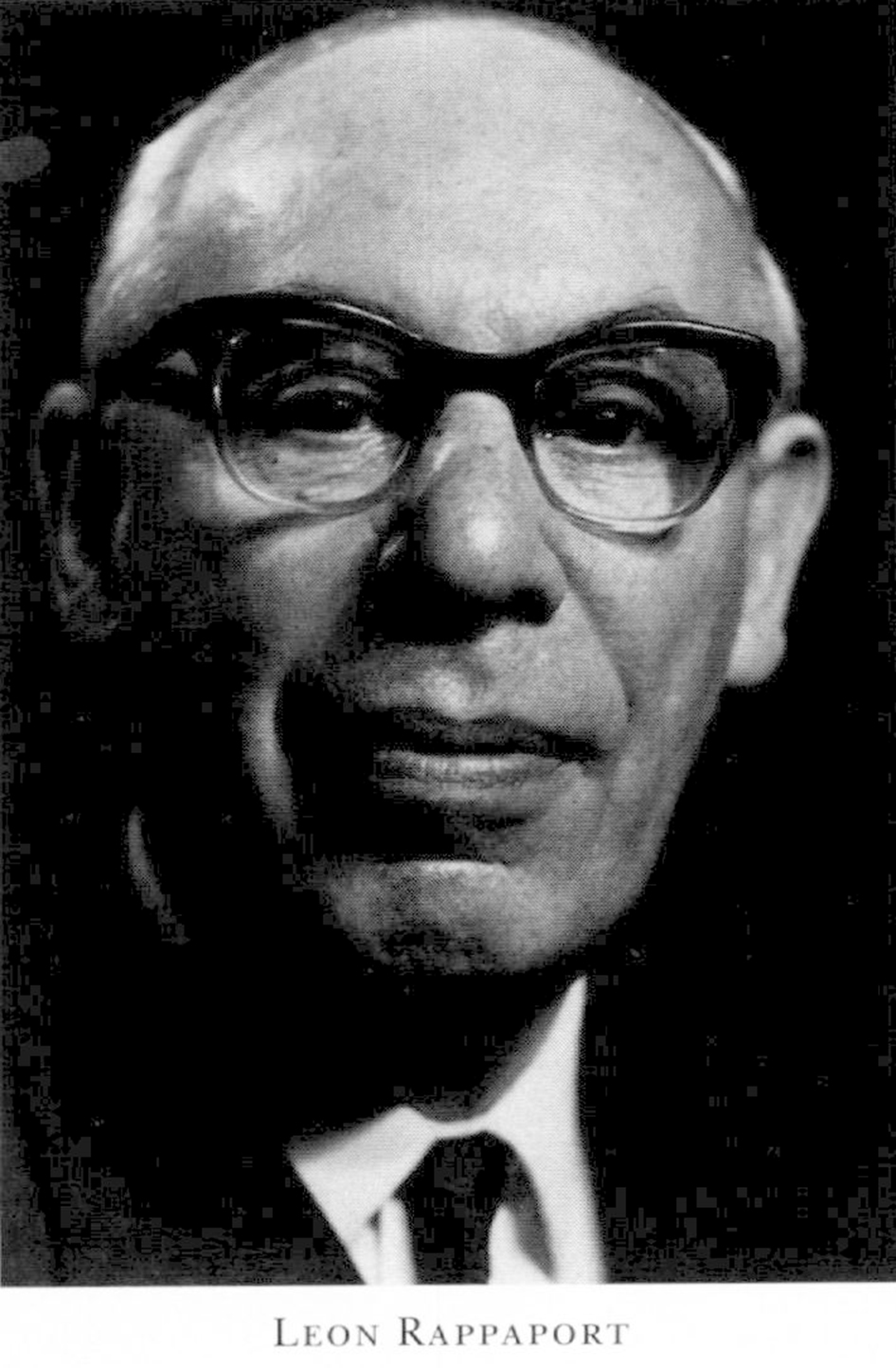
Sigtuna, November 1, 1963 LEON RAPPAPORT
READ MORE ABOUT Leon Rappaport https://sok.riksarkivet.se/sbl/Presentation.aspx?id=7544