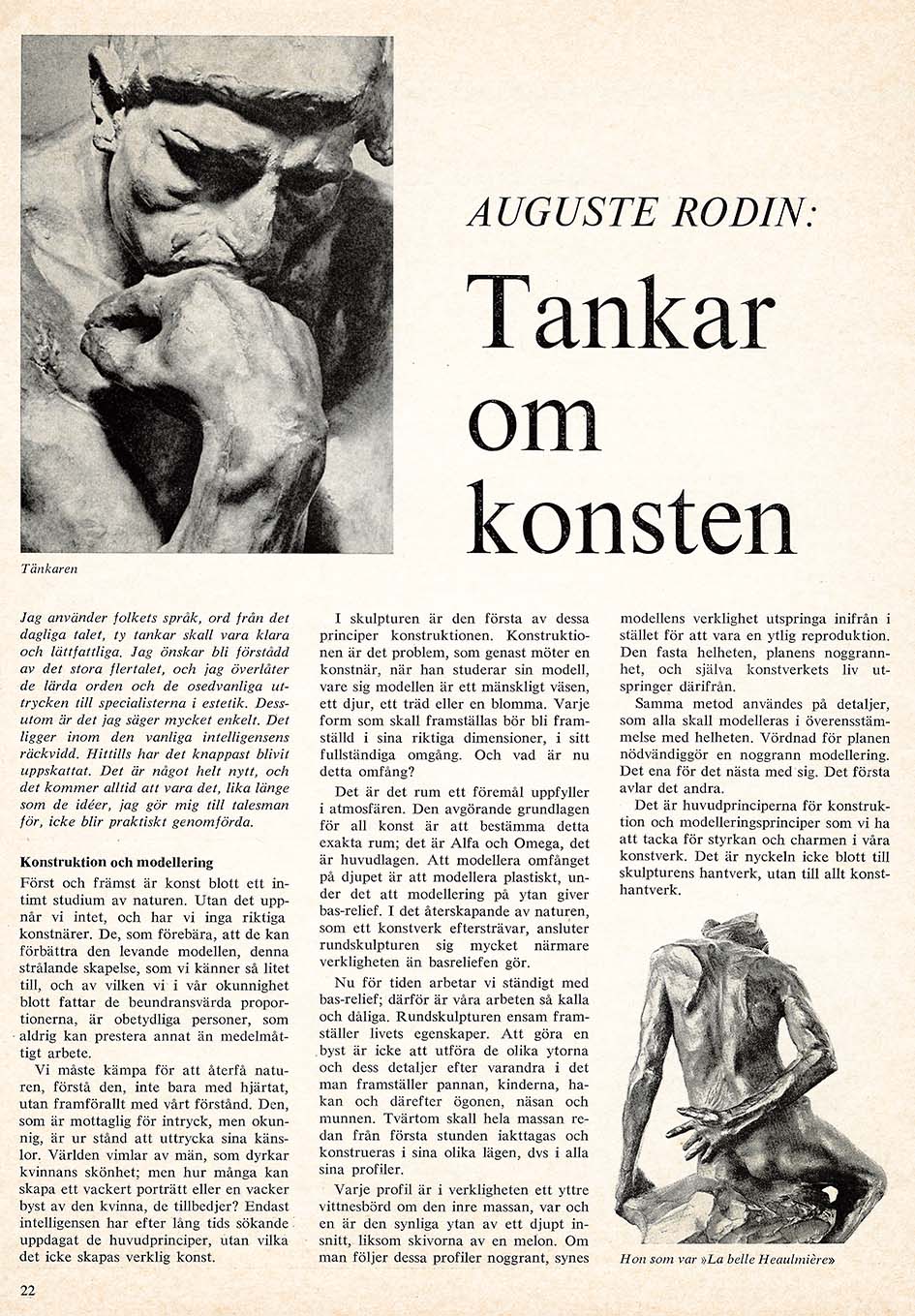
Thoughts on Art — Auguste Rodin
Maskinöversatt — ännu ej granskad.
I use the language of the people, words from everyday speech, for thoughts should be clear and easy to grasp. I wish to be understood by the great majority, and I leave learned words and disparaging expressions to the aesthetics of specialists. Furthermore, what I say is very simple. It is within the reach of ordinary intelligence.
Construction and Modeling
First and foremost, art is merely an intimate study of nature. Without it, we achieve nothing and make no real connections. Those who pretend they can create the living model — this brilliant creation, of which we know so little, and of which in our ignorance we only grasp the main proportions — are insignificant individuals who can never achieve anything but mediocre work.
We must feel in order to rediscover nature, with it, not only with the heart, but above all with the eye. It does not come naturally to notice nature because one starts from a completely different point of view.
These laws of art were brought to me, not by a celebrated sculptor or an authorized teacher, but by a decorator, an unpretentious craftsman, a small plasterer from the surroundings of Blois, Constant Simon. We found each other at a decorator's workshop. I was working on ornamental sculptures, vases, and wreaths. Our models were leaves and flowers that we picked in the garden. I began to seek a deeper expression. Constant Simon said to me: »You are working incorrectly! You are approaching all these leaves with the surface facing outwards. Turn them the other way around, and the encounter will arise. Execute them in depth and not in relief. Always work in such a way that the surface always appears to be the boundary of a mass. Only then can you achieve the shimmer of beauties.«
I understood him immediately. Since then, I have discovered much else, but that principle is always mine. I am a craftsman. Constant Simon was just an unknown craftsman, but he knew the principles and had that little spark of genius found in the great decorators who worked in Château de la Loire.
In sculpture, the first of these principles is construction. Construction is the problem that immediately confronts an artist when studying their model, whether the model is a human nude, an animal, or a flower. Every form to be represented should be rendered in its correct dimensions, in its correct volume. And what is this volume?
It is the space an object occupies in the atmosphere. The decisive fundamental law for all art is to determine this exact space; it is the Alpha and Omega, the fundamental. To model truly in depth means to model plastically, while modeling on the surface yields a bas-relief. In the recreation of nature that a work of art strives for, sculpture in the round suggests itself much closer to reality than does bas-relief.
Sculpture in the round alone represents the qualities of life. To create a bust does not mean executing the various surfaces and their details in order. On the contrary, the entire mass must from the outset be addressed, unified, and constructed in its various positions, i.e., in all its profiles.
Every profile is in reality a testimony to the inner mass — each one is the visible surface of a deep inner life content. The solid whole, the precision of the planes, and the very life of constructiveness spring from there.
It is to the main principles of construction and modeling that we owe the strength and charm of our artworks.
The Traditional Law of Ancient Art
This is neither mysterious nor difficult to understand. It is completely commonplace, highly prosaic. Others may wish to say that art is emotion, inspiration. That is merely literature, anecdotes for the amusement of the uninitiated.
Sculpture is simply the art of depressions and continuations. One cannot avoid it. Undoubtedly, the artist's sensitivity and particular temperament play a role in the creation of a work of art, but the most important thing is to master daily work — which can be acquired through labor and experience. The most important thing is to respect the laws that are the fruitful law of art, and which should apply everywhere.
In olden days, the law was carefully passed on, from master to journeyman, from apprentice to master. In all art craft workshops — sculptors, painters, decorators — every master produced. It is the masters we should follow, for I find that my work constantly led me in the footsteps of the great masters, my predecessors.
The article is taken from Konst och Kultur, 1945. The illustration is Rodin's own artwork. Photo: Ilse Schneider-Lengyel.
READ THE ARTICLE in the images. Open the image in a new window. Click on the magnifying glass to make it easier to read. Then return to the page by closing the window!