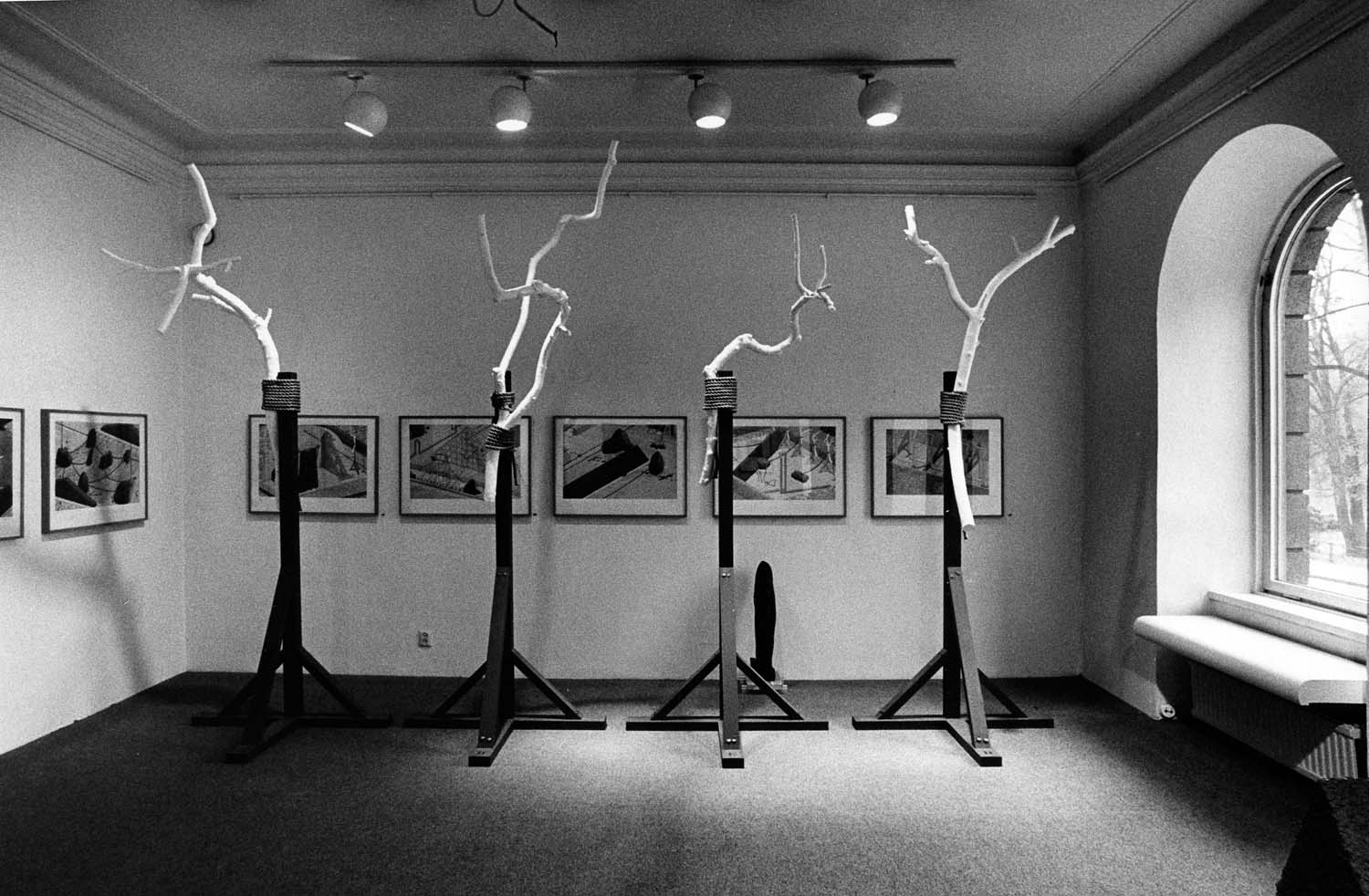
Here, Sivert presents his tree constructions for the first time, together with his watercolors. The trees can be perceived both as a poetic elevation of nature and, in their opposite, as an actual fate in the tree's history. The living and the processed meet in the same object. Peter Cornell has later described how Sivert's art allows fact and fiction to coexist, while Jan Öqvist emphasizes how the objects acquire their meaning through the viewer's own mental processing.
Proposed Measures "At first glance, the white-painted branch looks like an impossible, bandaged graft on an unrecognizable tree trunk in grey-black. Is it an aesthetic restoration we see – or a concession to decay? The sturdy rope holding the two parts together suggests an external force, something that has compelled together what doesn't truly belong. But precisely this incompatibility also becomes artistically productive. It is in the tension between the parts that the form emerges.
The title Proposed Measures appeals to our imagination. What needs to be addressed? Is it the tree, the construction, the decay – or perhaps our way of seeing? The title sounds almost administrative, as if the object were a problem awaiting a practical solution. But no solution is ever offered. Instead, the measure transforms into a question.
Sivert rarely wrote explanatory texts for his works. It is therefore interesting to revisit the words he used in connection with Akvareller m.m. at Konstakademien in 2012. There, he described his work as a processing of memories and experiences of how forms and voids charge spatialities, contexts, and situations. For him, the watercolors were not pure depictions, but rather the result of a prolonged investigation into how spatial forms and objects influence each other.
This perspective also opens up the tree constructions. They can be seen as memory images rather than as images of trees. It is not necessarily the tree as such that is at the center, but rather the experience of its form, its materiality, and its transformation. A branch has been broken, a trunk has lost its recognizability, and two parts have been bound together. Nature has become construction – but the construction still bears traces of the living.
In this way, Sivert moves between reality and imagination. What appears to be an actual intervention in a tree can simultaneously be a mental image of repair, loss, or change. His objects exist in a liminal space where the concrete constantly opens up to something else. Perhaps this is why the word 'measures' becomes so charged. A measure presupposes that there is a problem. But where is the problem? In the tree? In the construction? In the decay? Or in our own desire to order, repair, and give meaning to what we see?
Here lies a central aspect of Sivert's artistry. He gives us an object that is concrete enough to be recognized, yet strange enough to evade a singular interpretation. We see a branch, a trunk, and a rope. We see an intervention. But at the same time, we begin to imagine what happened before and what might happen after. The object becomes a stage for thought.
This is close to the movement also present in his watercolors. There, constructions, objects, voids, and spatialities reappear, which do not tell a definite story but nevertheless seem to bear traces of something that has happened or is about to happen. Sivert himself describes these images as a kind of mental constructivism, where memory processes experiences of forms and voids.
Art, for Sivert, is therefore more than an aesthetic or creative activity. It affects our gaze. It makes us pause before something we might otherwise pass by. It changes the relationship between the object and the viewer and allows the concrete to become a starting point for something that can no longer be held onto.
Proposed Measures can be read precisely in this way. A measure is a recommendation or a plan to solve a problem. But here, the problem remains undefined, and the solution is absent. What remains is the tree, bound together and transformed, and our own idea of what should be done.
All art in some way involves a transgression of boundaries between imagination and reality. Sivert's trees demonstrate this with unusual clarity. It is an actual object, but also a construction of thought. It is nature, but simultaneously an artifact. It is decay, but also care. It is damage, but perhaps also a repair.
Ultimately, the question is not what the tree depicts, but what it makes us imagine. And perhaps that is where Proposed Measures truly begins. Not in the object, but in the viewer's head – feed your head." /JÖ