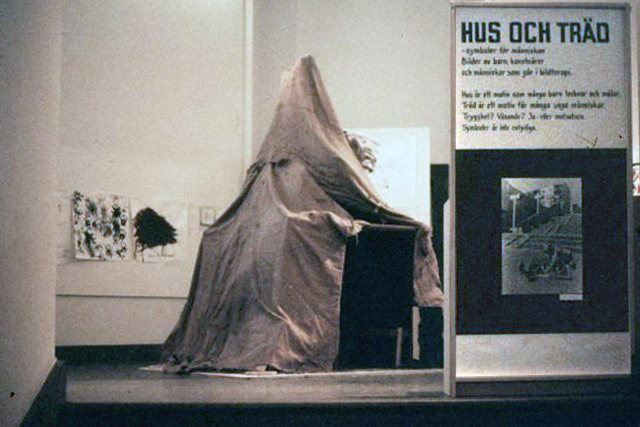
The exhibition "Houses and Trees – Symbols for Humanity" was shown at Göteborgs Konsthall between September 16 and November 19, 1978. The idea for the exhibition came from Jan Thomaeus.
This was a unique group exhibition that focused as much on art therapy and psychology as on pure art. It explored how the motifs of houses and trees function as universal symbols for humanity, its development, problems, and life situations.
The exhibition did not only feature works by established artists. To highlight the function of art therapy, it also included images created by children, patients, psychiatrists, and art historians.
Among the participating artists was Sivert Lindblom, along with Lena Cronqvist, Jan Håfström, Sven Ljungberg, Palle Nielsen, K-G Nilson, Helmtrud Nyström, and Philip von Schantz, among others. But the exhibition did not only feature works by established artists. Children, patients, psychiatrists, and art historians also contributed images, making the exhibition more than a traditional art presentation. It became an investigation into how humans use images to understand themselves and their surroundings.
"The house could be seen as an image of security, the body, or the self, while the tree could be associated with growth, roots, and vitality. But the symbols were never unambiguous. A house could just as easily imply confinement as security, and a tree could encompass both life and vulnerability. It was precisely this openness that made the motifs so useful in the exhibition's encounter between art and psychology.
In Sivert's art, there are several clear points of contact with these questions. The house and architecture reappear in his work not just as motifs, but as ways of thinking. He was interested in how a form delimits a space, how a body or an object relates to its surroundings, and how we ourselves are affected by the spaces we inhabit.
Even when Sivert does not depict a house, something architectural is often present. His forms can be perceived as models, fragments, or spatial constructions – something that both encloses and opens. The abstract form can thereby acquire a human charge without representing a human being.
It is also here that the tree motif gains an interesting resonance. In the exhibition, the tree is associated with growth, roots, and vitality, but also with its opposite. In Sivert's work, the material is never entirely neutral. His forms bear traces of genesis, processing, and change. They appear as something that has emerged through a process – not unlike how a simple line or silhouette can gradually develop into a spatial body. The tree can therefore be seen as an image for precisely what characterizes Sivert's work: the movement from something simple and concrete towards a more complex form.
This applies not least to his recurring use of his own profile. The face and body are reduced by Sivert to a simple contour, a line that can then be transformed into a three-dimensional form. What is initially a personal and recognizable silhouette becomes something more general: a body, a boundary, a form in space. In this way, there is an interesting parallel to Houses and Trees, where the concrete motif is used as a starting point for something larger and more elusive.
Perhaps it is precisely here that Sivert's work most clearly meets the exhibition's world of ideas. For Thomæus, the house and the tree were not interesting solely for what they depict, but for what they can mean to a human being. Similarly, Sivert allows his forms to move between the concrete and the abstract. A profile is a profile – but also a line. A line becomes a form. A form occupies space. And space, in turn, changes how we perceive the form.
This makes Sivert's participation in Houses and Trees particularly interesting. His works do not need to depict a house or a tree to address the exhibition's fundamental question: how simple, concrete forms can carry experiences of humanity, the body, security, and our place in the world." /JÖ
From the foreword to the catalogue “When so many small children so often choose to draw and paint houses, it is not arbitrary. Houses mean something important to them. When so many young people choose the tree motif, we have the same reason to pay attention to this. Simplified, we can say that houses stand for security. Trees for growth. Or in both cases, the symbols are not unambiguous … … People of all ages come to art therapy who have encountered problems too great to cope with on their own. Images can be an effective tool for processing such problems. Also in these situations, houses and trees become common motifs. In Christianity, we encounter many examples. The house of God, Christ as the vine. When Christ is born, we bring in a tree: the Christmas tree. By it, we might put up a gingerbread house. In art from all times: with Rembrandt, van Gogh and Hill, with Klee and Magritte. The exhibition is aimed not least at everyone who works with children, young people, and the elderly. It is as much about psychology as about art – if one wishes to use such fine words. The den we built as children: under what heading does it belong? But it was important to us then, and that is the only significant thing. Now we might shrug our shoulders at it in our adult wisdom. But this is what the exhibition wants to highlight: what can be important to us, but which in a technocratic welfare society risks being overlooked.”
Jan Gustav Thomæus (1918–1991) was a Swedish writer, draftsman, painter, and art teacher. He wrote articles on art in, among others, Vi, Paletten, and Röster i radio, and published several books. He was engaged as an expert by Unesco in India and was for a period active at the Socialpedagogiska seminariet in Stockholm.
Seminar From September 16–20, 1978, a seminar on art therapy was organized, in collaboration with Kursverksamheten and with support from Kulturrådet, featuring lectures by Carlo Derkert, Maj-Britt Wadell, and Jan Thomaeus, who also led several workshops.