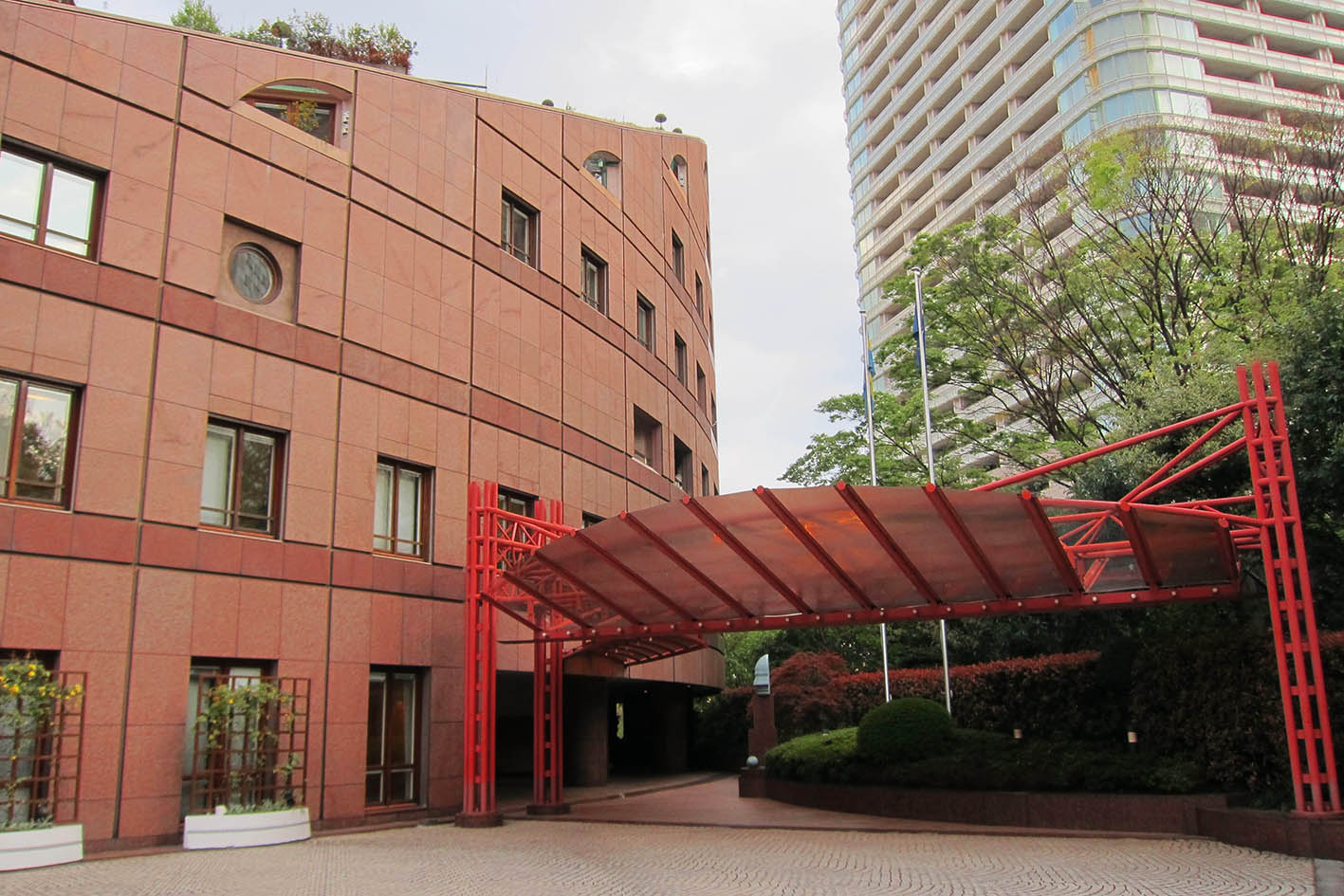
Entrance sculptures at the Embassy of Sweden, 1-10-3 Roppongi, Minato-ku, Tokyo.
The Embassy of Sweden in Tokyo
During the reconstruction of the Embassy of Sweden in Tokyo, Sivert Lindblom was commissioned to design the driveway and the entrance area to the main building.
"The Embassy of Sweden in Tokyo is Sweden's diplomatic mission in Japan and is located in Shiroyama Hills, also known as Shiroyama Garden, in the Roppongi district. When I visited the site in 1970, I experienced the area as a relatively quiet and green oasis in the middle of the city. The plot where the embassy building is located had been donated to the Swedish state in the 1930s by a group of Swedish entrepreneurs. Leading this group was the trading house Gadelius, which had been active in Japan since 1907. With Gadelius as an intermediary force, several of Sweden's major industrial companies, including Atlas Copco, Sandvik, ASEA, ABB, Fläkt, Höganäs, and Uddeholm, entered the Japanese market.
In 1987, the Swedish state sold half of the plot for over one billion Swedish kronor. When I revisited the embassy area in 1993, the surroundings had changed, and its previously secluded character was largely gone. Offices and tall residential buildings had emerged around the area, which altered the perception of the green oasis.
The Entrance and the Sculptural Design
Visitors approach the embassy building through a semicircular entrance reminiscent of a fan. The curved driveway is surrounded by controlled, almost temple-like vegetation. In the foreground, visitors encounter Sivert's urns, as well as a welcoming bodily figure crafted from red Vånga granite. From the stone emerges Sivert's unmistakable profile in green-oxidized bronze.
The figure has come to be called a caryatid, even though the term is not entirely accurate. A caryatid is a sculpted female figure that serves as a column or support in architecture. The term comes from the Greek Karyatis, "maiden from Karyai." The most famous example is found on the Acropolis in Athens, where six caryatids support the roof of the Erechtheion's south portico. The male counterpart is usually referred to as an atlas or telamon.
In classical art, these supporting figures are depicted in various ways. The Greek atlantes can be perceived as strong and relatively unaffected by the burden they carry, while later Roman and especially Renaissance and Baroque atlantes are often given a more dramatic expression, as if struggling with their burden.
It is not easy to know how Sivert himself intended his figure to be perceived. The figure is not a traditional caryatid, nor is its purpose to literally support the building's architecture. Rather, it functions as a sculptural guardian at the entrance – a corporeal yet abstract figure that welcomes the visitor.
The Head as Form and Symbol
I cannot, however, help but reflect on the significance of the head in Japanese art and cultural tradition. Sivert's figure lacks hair on its head and has a strongly concentrated, almost meditative expression. I believe I see a possible resonance between this and the significance that the head and face have held in Japanese visual art.
In traditional Japanese art, the face is often highly stylized. In ukiyo-e, for example, facial expressions are often deliberately restrained and are based less on individual emotional expressions than on idealized and recurring types. The face can thereby convey a sense of timelessness, harmony, and stillness.
Another clear example is Noh theater, where the mask plays a central role in depicting different ages, characters, and moods. Through the mask's tilt and its relationship to light, the expression can change without altering the mask's basic form. The face thus becomes a bearer of something more than an individual personality.
The head and hair have also held special significance in Japanese samurai culture. The traditional chonmage hairstyle, where the hair was shaved on the crown and the rest of the hair was tied up, became a clear social and cultural distinguishing feature. Depictions of severed heads, namakubi, also appear in Japanese art history and could be associated with notions of honor, courage, and death.
Against this background, Sivert's figure can evoke associations with a head that is lifted up and acquires its own monumental significance. However, this should be understood as a possible interpretation rather than a documented intention on the artist's part.
The Sphere and Japanese Symbolism
The three spheres at the entrance also evoke associations with Japanese symbolism. In the Buddhist tradition, hōju, the wish-granting jewel, appears as a symbol of fulfillment and spiritual gifts. In Buddhist tradition, three jewels can also be associated with the Three Jewels – Buddha, Dharma, and Sangha: the teacher, the teaching, and the community.
It is tempting to view the three spheres in this context and wonder if their number might have a symbolic meaning. However, I am not aware of any evidence that Sivert consciously based his work on this symbolism. The association is therefore just that – an association – but an interesting one, especially since the work was created for a place where Japanese and Swedish cultures meet.
A Meeting Between Swedish and Japanese Aesthetics
It is also possible to view Sivert's design in relation to some central concepts in Japanese aesthetics. Sabi is associated with an aged and restrained beauty, wabi with simplicity and stillness, and miyabi with refinement and elegance. Mono no aware denotes an awareness of the transience of things and the feeling that arises in the face of their fleeting beauty.
It is not necessarily the case that Sivert consciously worked based on these concepts. Nevertheless, I believe I see something related in his figure: restraint, simplicity, concentration, and a strong sense of the form's and material's inherent effect.
The red Vånga granite, the green-oxidized bronze silhouette, the urns, and the three spheres together form an entrance design where Swedish sculptural tradition meets a Japanese environment. The work should not be understood as a direct translation of Japanese symbols. The interesting aspect lies rather in how Sivert's simple and monumental forms acquire a new resonance when placed in Tokyo – in the encounter between his artistic language and the cultural environment where the work has come to exist."
/JÖ
Photographer: Sivert Lindblom
⊙ View location⊙ 1-10-3 Roppongi, Tokyo