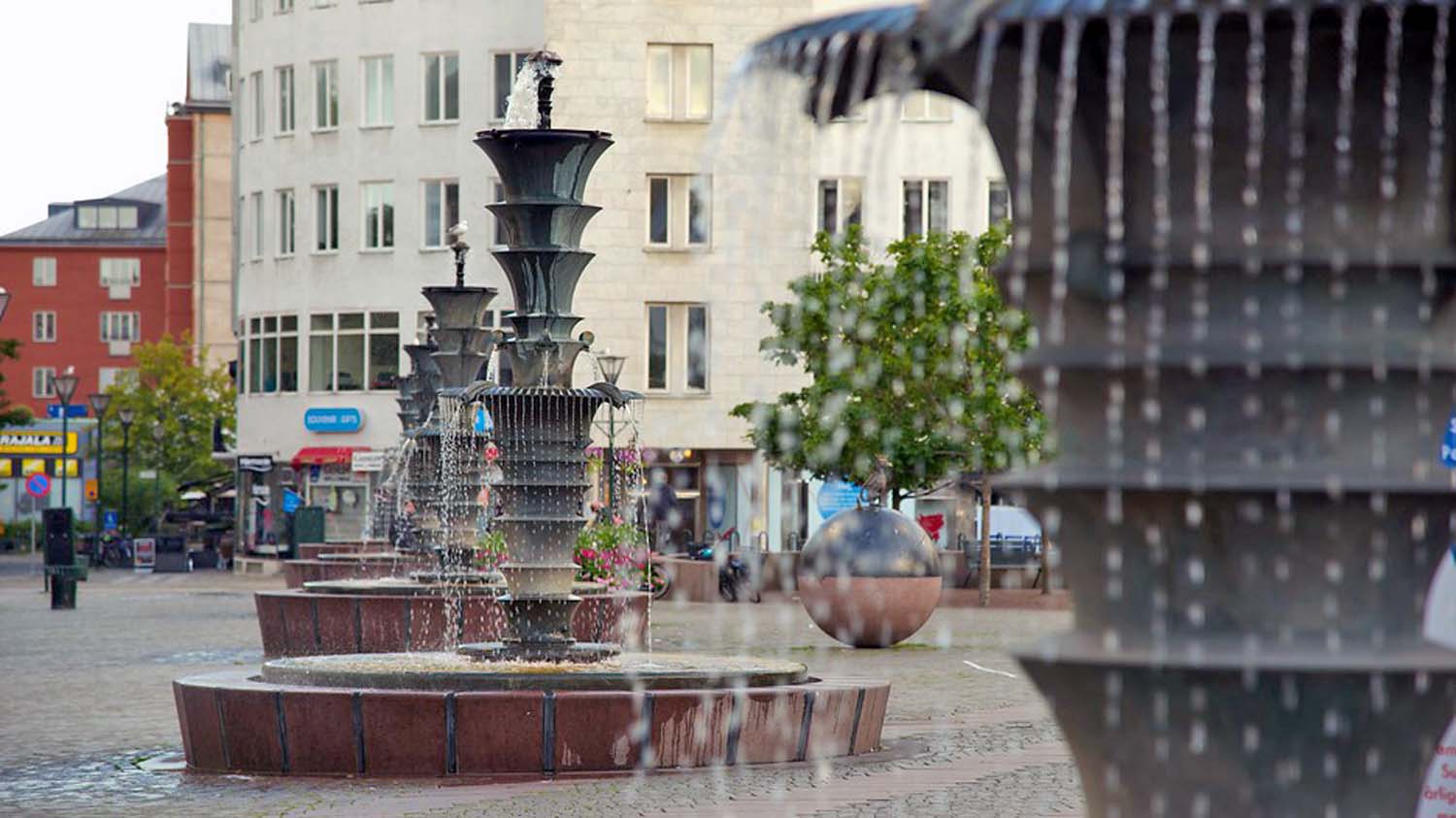
Five bronze plates and fountains with griffin and orb motifs. Heraclitus – Hjalmar Gullberg's quotes on the fountain bases.
At Gustav Adolfs Torg in Malmö, Sivert created five bronze ornaments with griffin and orb motifs, placed on the fountain bases. The work is one of the more poetically complex public artistic creations that Sivert has realized. The combination of sculpture, water, fire, and text creates a multifaceted and multisensory experience, where the artworks interact with the square's architecture and urban space.
The fountains were inaugurated on June 12, 1999, and constituted the final part of the new design of the renovated Gustav Adolfs Torg. On each fountain base is a quote by the pre-Socratic philosopher Heraclitus, whose philosophy revolves around change, transformation, and the constant movement of existence. Heraclitus is, among other things, associated with the maxims "Everything flows" – in Greek "panta rhei" – and "You cannot step into the same river twice."
The Competition Proposal
In October 1994, Malmö City invited three artists to submit proposals for sculptures and water features at Gustav Adolfs Torg. The competition brief was formulated as: "Fountain with artistically designed water feature."
Of the submitted proposals, the jury recommended Sivert Lindblom's proposal for implementation with the following justification:
"With classically beautiful forms, Sivert Lindblom's proposal enriches Malmö's most beloved square and thereby creates the conditions for the square's renaissance. The jury is convinced that the implemented proposal strengthens the square's symbolic value, as well as the city's identity."
The justification also highlighted how Sivert had based his design on the urban space as a whole and allowed the fountains to become an integrated part of the square's architecture:
"In the design, Sivert Lindblom based his approach on the urban space as a whole and allowed the fountains to become a part of the square's architecture, where the square space determined the outer form."
The fountains form a termination of the square's surface to the east. They are made of bronze and measure 3.8 meters from basin to highest point. Water is ejected from three different levels and in three different ways. It overflows the basin's softly rounded bronze edge and behind a granite coping that surrounds the basin.
The inwardly sloping coping is 24-sided and consists of cross-hammered red Vånga granite. Between the stones, narrow segments of finely polished black granite, diabase, are inserted. The bottoms of the basins are covered with clinker tiles whose pattern gradually changes and twists as one moves past the fountains.
During the summer, the fountains spray water. In winter, the water feature is replaced by a gas flame that flickers along the edge of the uppermost, large funnel formation. In this way, the work's expression changes with the seasons, allowing water and fire to become two recurring elements in the design.
The Orb and the Literary Motifs
The fountains are complemented by a large orb, 1.5 meters in diameter, whose lower half is made of red Vånga granite and upper half of bronze. The orb constitutes a central symbolic element in the installation and is richly decorated with literary, astronomical, and heraldic motifs.
On the surface of the orb are water-related texts by two authors: the Greek philosopher Heraclitus and Malmö's own beloved poet Hjalmar Gullberg. Also present are freely rendered constellations associated with water, including the constellation Aquarius.
The orb bears two poems:
"Kissed by the sun on the mouth
in a green quarter
I spring from the well
to please you
I fall into the well
and am seen no more."
– Hjalmar Gullberg
"For souls, it is death to become water
for water, it is death to become earth
but from earth comes water
and from water, soul."
– Heraclitus
Additionally, on the orb are two allegorical figures, depicted in different moods and with varying life attitudes – an "optimist" and a "pessimist". The figures add a human and existential perspective to the work's broader themes of life, change, and transience.
At the top of the orb sits a freely designed griffin, seemingly watching over the square and the city. The griffin's head connects to Malmö City's coat of arms and simultaneously functions as a symbolic crowning of the orb and the entire artistic creation.
The orb was placed in the square on September 30, 2000, thereby completing Sivert Lindblom's public art installation.
The Square's Renewal
Sivert's five fountains became the concluding part of the new design of Gustav Adolfs Torg. Malmö City's Street Department, together with Vision Recording TV AB, produced a short film about the square's history and renewal titled Torg i tiden (Square in Time), approximately 23 minutes long.
The first phase of the square's renewal was inaugurated on May 16, 1997. At the inauguration, His Majesty King Carl XVI Gustaf planted one of the seven maple trees that would form a royal grove in the square, as a 50th birthday present to the King.
The later part of the film, from approximately 13 minutes and 30 seconds, describes the creation of Sivert Lindblom's five bronze fountains with running water and flames. The fountains were inaugurated on June 12, 1999, in the presence of, among others, Jörgen Faxe, chairman of Malmö Förskönings- och Planteringsförening, and Malmö Municipal Board chairman Ilmar Reepalu.
Malmö Förskönings- och Planteringsförening has been active for more than 125 years and has, through its activities, adhered to three guiding principles: "Beautify, care for, and preserve." The association's purpose has been to further develop Malmö's cultural heritage and work for beautification through, among other things, plantings and artistic embellishment – with the ambition of making the growing industrial city greener, more beautiful, and healthier.
Sivert Lindblom's fountains at Gustav Adolfs Torg thus unite art, architecture, literature, and the city's history. Water, fire, granite, and bronze interact with the literary and symbolic motifs, giving the square a design that changes with both season and light.
Client/Developer: Malmö kommun and Malmö stads gatukontor.
Architect and artistic advisor: architect Sven-Ingvar Andersson, city gardener Gunnar Ericson, and Jörgen Faxe, chairman of Malmö Förskönings- och Planteringsförening.
Casting and patination of the bronze sculptures took place in collaboration with Ulf Ferrius and Skånskakonstgjuteriet.
Photographer: Jan Öqvist
⊙ View location⊙ Malmö