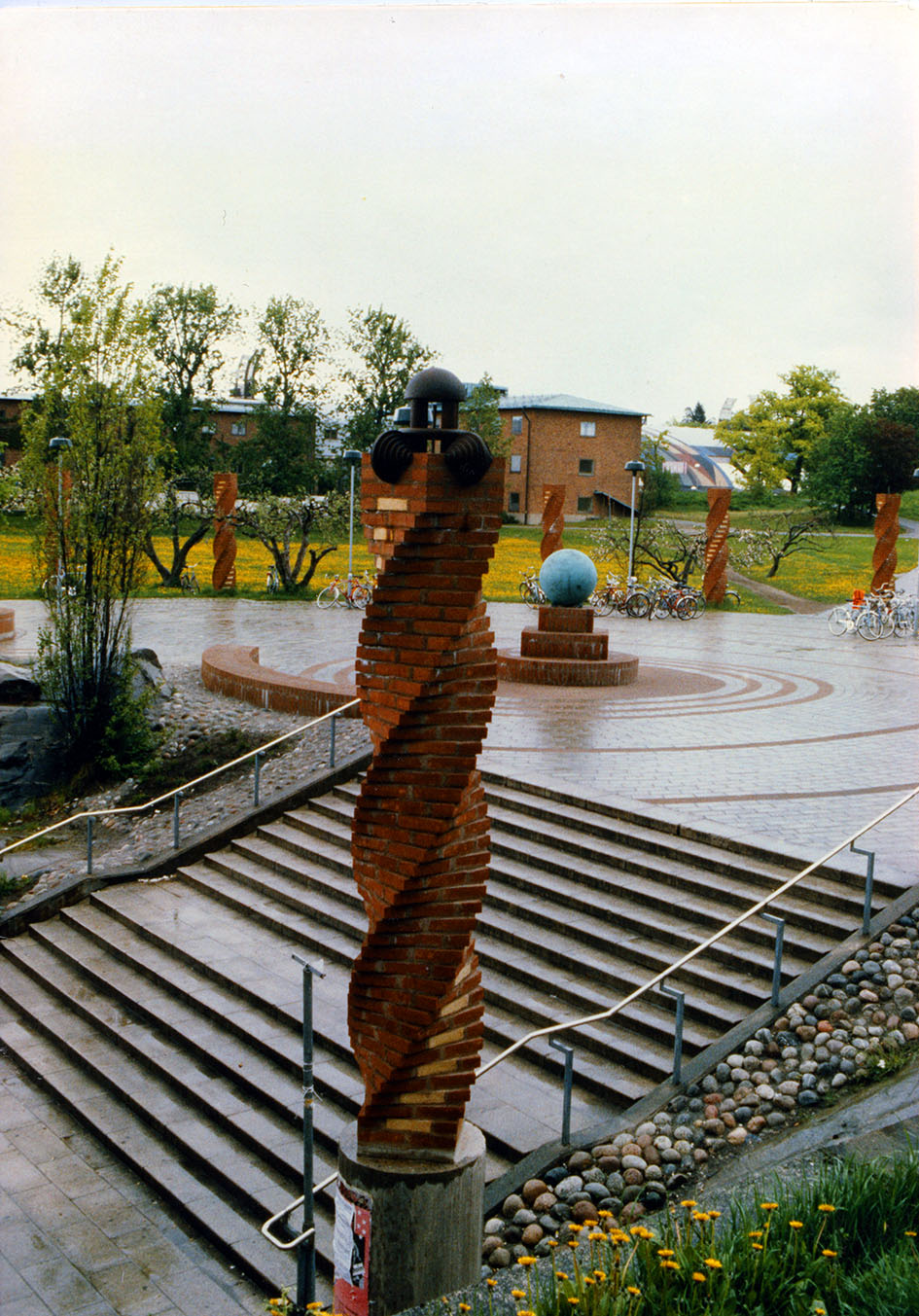
Column rows, allegorical sculptures, and integrated artworks on the Frescati campus. Visitors and students encounter an elevated sphere already at the subway exit. Thereafter, directions emerge, pathways through the campus area with the twisted columns of multicolored brick serving as initial directions to the various institutions.
"It is easy to imagine that antiquity should have been left far behind when Stockholm University in the 1970s left the inner city and moved out to Frescati on Norra Djurgården. From the city's stone facades and historical layers to a new campus landscape characterized by modernism's straight lines and functional ideals.
But antiquity followed.
It remains at Frescati – sometimes visible, sometimes hidden – and appears in the most unexpected places.
Perhaps that is precisely why Sivert's art fits so well here. His sculptures move between the recognizable and the abstract, between myth and modernity. In his hands, the ancient figures do not become museum relics, but living forms that continue to speak to our own time.
The commission at Stockholm University's campus in Frescati was one of the most extensive in Sivert's career. Together with Marianne Lindblom, he developed a cohesive artistic program for the area during the years 1987–1991. Column rows in brick, cast iron, and bronze form parts of a larger scenography, together with four allegorical sculptures: Adam, Eve, Hercules, and an abstract figure.
Here are man, the hero, and the seeker.
Hercules is one of antiquity's great figures. Son of Zeus and the mortal Alcmene, demigod and hero, he became famous for his superhuman strength and his twelve great deeds. In Sivert's work, the anatomical perfection of the classical body is not retained. Instead, the figure has been simplified and broken down to its most characteristic features. The enormous wooden club is enough for us to recognize him.
Achilles, in turn, reminds us of human vulnerability. He was the foremost warrior of Greek mythology and the main figure in Homer's Iliad. Almost invulnerable, he still had one single weak point: his heel. From there comes the image of the vulnerability that can exist even in the strongest.
The abstract figure, however, does not yet seem to have been named. As if it is in the midst of a searching movement, on its way towards something that cannot yet be defined.
This is typical of Sivert's relationship with antiquity. He does not reproduce it – he reshapes it. The classical sculptural tradition remains as a memory in the works, but meets a modern world of forms and an architecture belonging to a completely different era.
And perhaps Frescati was, from the beginning, a place where these eras could meet.
Antiquity before campus
When the university's operations moved out to the Academy of Agriculture's old experimental field, traces of an older world already existed here.
Blom's house stood here, built in antiquity-inspired Empire style. Villa Bellona bore the name after Bellona, the Roman goddess of war. Antiquity was thus present long before today's campus began to take shape.
The name Frescati itself also carries the memory of Italy. Together with the nearby Albano, the name dates back to Gustav III's Italian journey in 1783–1784. The model was Frascati outside Rome, the ancient town in the Alban Hills where the Roman statesman Lucullus traditionally is said to have owned a magnificent villa.
Also at Frescati, there is a villa connected to this period. The oldest building on campus was erected in the 1790s in neoclassical style according to drawings by Louis Jean Desprez. Here there was also an obelisk. The obelisk itself is gone, but the foundation remains – as a material memory of something that no longer exists.
Perhaps this is how antiquity functions at Frescati. It is rarely complete. It remains as fragments, allusions, and names. As forms that are recognized without immediate explanation. As an echo rather than a reproduction.
A modern Olympus
This is also how antiquity emerges in Sivert's and Marianne's installation – "Terrakotta".
Right next to the Universitetet subway station, a place opens up that almost feels like a stage. Twelve twisted brick columns form a ring around a bronze sphere. One stops and begins to wonder: What is it exactly that we are seeing?
A possible interpretation is that the sphere represents the Earth and that the twelve columns refer to the twelve Olympian gods – the pantheon that populated Olympus in Greek mythology.
Perhaps that is why the place takes on the character of a stage set: a kind of modern Olympus, built of brick, bronze, and air.
The trees around the work can also lead one's thoughts back to the classical world. The oak was Zeus's sacred tree. It is a small detail, but at Frescati, it is precisely such details that make the landscape begin to speak.
Here, by the subway, we thus seem to have ascended to the world of the gods.
But if we continue along the pathways towards the university, the narrative changes. Olympus is left behind. From the world of the gods, we move towards that of humans.
From gods to humans.
Along the path towards Södra huset, we encounter more of Sivert's sculptures. One of them depicts Hercules. The body is abstracted, almost dissolved, but the wooden club still remains. It is enough to awaken the memory of the hero.
It is a strange shift. Hercules is no longer the perfect ancient body in marble. He has been reduced to a few forms: a silhouette, a gesture, an attribute.
What remains is not the historical Hercules, but the image of Hercules – and perhaps also our own conception of him.
Further on, Terrakotta concludes with constructions that evoke ruins. Here, something seems to have broken. The columns, forms, and fragments suggest a world that both existed and has already been lost.
But the ruin is, at the same time, the beginning of something new.
Perhaps this is where Sivert's interest in antiquity becomes most interesting. Antiquity is not used to create an illusion of the past. Instead, it becomes a language to speak about our own time.
The old figures are given new bodies. The old symbols are given new contexts. What was once myth becomes form, and the form once again becomes open to interpretation.
Several eras in the same place.
At Frescati, therefore, several eras meet in the same place: the 18th century's Italian dream, the 19th century's neoclassicism, the 20th century's modernist campus, and Sivert's contemporary interpretation of the classical tradition.
History does not lie in straight layers one after another. It penetrates them.
Perhaps one can therefore see Frescati as more than just a place where a university happened to be built. It is a place where conceptions of antiquity have survived through centuries – sometimes as buildings, sometimes as names, sometimes as ruins, and sometimes as sculptures.
And when one walks there today, it can be difficult to determine where antiquity ends and our own time begins.
Sivert's interest in antiquity also extended far beyond Frescati. It reappears, among other things, in his scenography for the Medelhavsmuseet and in the work with the placement of the San Marco horses at Blasieholmstorg.
"For Statens fastighetsverk and Akademiska hus, Sivert and Marianne received the commission to design the campus area. This became their project "Terrakotta". The sculptural design consists of brick, cast iron, bronze, and Vånga granite (Vånga granite, or Oppmanna granite, is a red granite found in the three old quarries in Gullyckeskär, two kilometers from Oppmanna towards Vånga in Skåne). Paving of concrete slabs and paving bricks."
1. Column circle in front of the entrance to the subway station
2. Column row between Allhuset and Ahreniuslaboratoriet
3. Three sculptures with allegorical motifs
(Project manager was Gösta Wallmark)
Jan Åman conducted an interview with Sivert for Humanistiska Föreningen, Stockholm University 75 years.
Statens konstråd has, for its annual publication 22, had Inga-Maj Beck describe the design,
Nina Weibull has written about Sivert & Marianne's designs on Centralfältet
and
another doctoral text on the subject is by Elis Wibacke's publication – "Traces of Antiquity at Stockholm University".
In: Medusa. Swedish Journal of Antiquity, ISSN 0349-456X, Vol. 46, no 3, p. 26-33
https://liu.diva-portal.org/smash/record.jsf?pid=diva2%3A1996985&dswid=-5784
Photographer: Jan Öqvist
⊙ View location⊙ Stockholms Universitet