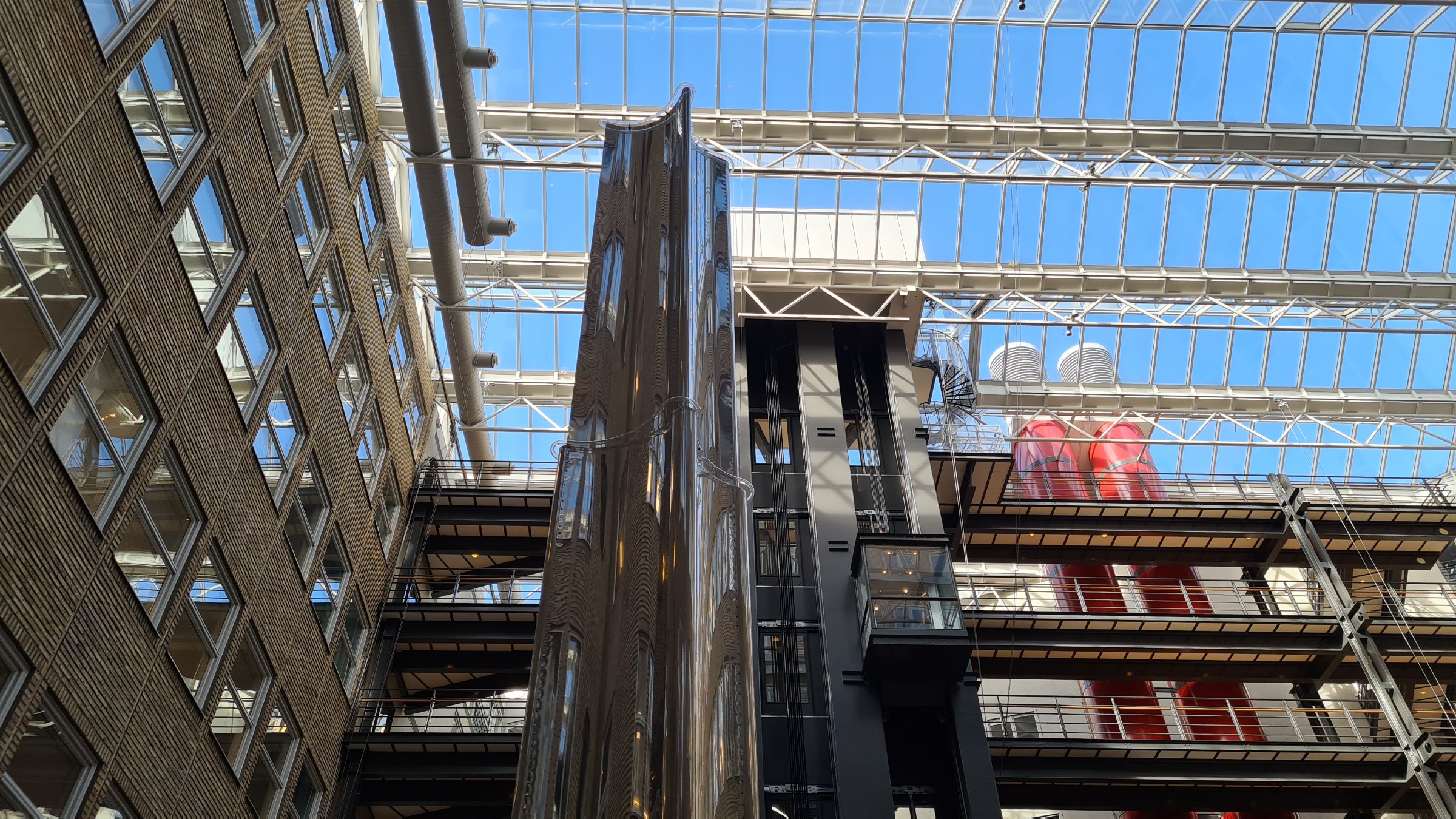
"The Source with accompanying obelisk" at the entrance to the atrium itself, the inner courtyard, between the two building structures, is intended as a reminder of what circulates and will circulate through the activities in the various buildings.
Regarding the history of the obelisk, there is a conversation I had with Sivert in 2023 which is reproduced here.
"The Source" with obelisk in Bonnierhuset's atrium, Torsgatan 21, Stockholm (1995, 2024).
Bonniers fastigheter commissioned this installation from Sivert to be permanent in the atrium that arose in the space when Bonniers konsthall was added.
In 2021, it was decided that a renovation of "The Source" would be carried out as water damage had been discovered. This was implemented in 2023, and the neon lighting was replaced with LED lighting.
An obelisk primarily symbolizes the sun, divine presence, eternal life, and immortality. Its tall, tapering form, ending in a point (a so-called pyramidion), served as a link between earth and heaven, and its shadow was used to track the sun's path and keep time.
The conversation with Sivert on January 12, 2023, about his fascination with obelisks:
Sivert Lindblom – "The Source" – the obelisk in Bonnierhuset, 1994
During a conversation with the sculptor Sivert, prompted by the repair of the obelisk inside the large atrium of Bonnierhuset due to a water leak, I asked him where the idea – the inspiration – for such a grandiose obelisk in the light court originated, and why it is called "The Source"?
Sivert himself is quite reticent about his motives, which does not prevent him from having well-thought-out reasons and explanations for his proposals.
He told me that it was Jeanette Bonnier who took the initiative (1993) and invited him to design the large connecting space with an artistic visual marker – a focal point – that met one upon entering the large room and was simultaneously a vista – a node – visible from the windows on each floor.
(On the same occasion, artists Jan Håfström and Harald Lyth received other artistic embellishment commissions in the office building.)
– An obelisk in stainless steel is not something you see every day. Why did you choose that material?"
– The Egyptians' obelisks are carved in stone, even the obelisk that stood on Slottsbacken, which we have in memory of Gustav III's gratitude, is made of Stockholm granite – they are perceived as physically heavy, like nails or needles against the sky, and have a pyramid at the top."
In archaeology, the pyramid-shaped topmost stone on a pyramid or an obelisk is called a pyramidion. It was usually covered in gold so that the sun's rays reflected in it. This is the case, for example, with the Luxor Obelisk over Ramses II, which stands in the middle of Place de la Concorde in Paris. It is made of pink granite and culminates at the top with a golden tip.
– Your obelisk has no golden pyramid at the top? Furthermore, the obelisk has bowl-shaped sides …?
– The idea was that the light from the skylights and the reflections from the surroundings would be channeled down to "The Source". Instead of a solid experience, I wanted to create a lightness, almost transparency, by having the polished steel not only become recognizable reflections of what is around it, but a kind of "stewardship of light" down into the atrium – not a monument."
– I know that, in connection with the artistic design involving the two bronze horses you placed in Blasieholmstorg, you had studied the ancient hippodrome in Istanbul and there noted the two obelisks that once served as turning points for the competing horse teams.
– The light court itself in Bonnierhuset is elongated, and wherever one is in the room, the obelisk serves as a visual turning point.
– I have noted that in the opposite part of the room, next to a railing, you have placed a large pot that I almost perceive as a foundation for a removed obelisk?
– That is a correct observation. Originally, the truncated pillar was intended to serve as a "visual counterweight" to the steel obelisk on the other side of the room. Now it has become a place for a flowerpot. Very few of the Egyptian obelisks remain in the country – they now stand in other places with a different history than their original one.
– Now I wonder a little why you have called your installation "The Source"?
– It might sound far-fetched … but light is the source of all life we know. The obelisk is a tribute to light.
– You have created a water pond at the foot of the obelisk and something resembling a funnel where water originally flowed down towards the collecting sculpture on the lower floor … the vessel that you then allow to overflow into an even larger pond?
– I wanted to break the silence and add a gurgling sound of running water to the atrium as a reminder that we humans largely – approximately 75% – consist of water in motion.
– Then, finally, I must ask you about the large steel sphere that we can reflect ourselves in …
– I wouldn't call it a sphere … for me, it's a globe – a spherical model of the Earth – or of some other celestial body or of the celestial sphere. The globe serves the same purpose as a map, but unlike maps, it does not distort the surface it shows, except by using scale. The only thing that is distorted when we look at the shiny globe surface is the image of ourselves.
– Is your globe a funhouse mirror?
– No, rather an opportunity for inspiration … to see ourselves in a much larger context … something that encompasses us all … and what this is … it is up to us to discover and create from.
By Jan Öqvist
January 12, 2023
In the spring of 2020, the obelisk that King Gustav III had erected and placed at the top of Slottsbacken as a thank you to the burghers of Stockholm was renovated, as it was in such poor condition from the 18th century.
https://www.sfv.se/uppdraget/byggprojekt/renovering-av-obelisken
Obelisks appear in several of Sivert's artistic embellishments and proposals in various urban spaces – sometimes as landmarks, sometimes as markers, sometimes as signposts, and sometimes as topics of conversation. Regardless, they all have a well-thought-out and rooted history stemming from Sivert's vision of a past that converges with a present. Some were realized, others ended at the drawing board. Images exist, but the dimensions are currently unclear (they would surely have asserted themselves in size and choice of material).
Obelisk – model 1992 for SEB's headquarters in Rissne was never realized. It would have been a magnificent golden landmark, a gleaming node visible in the model made for the proposal. It is quite typical for Sivert, as it has a transition at the base – the four "wedges" tapering from the top each stand on a pyramid-shaped podium. The golden light collects at the base. The obelisk was not erected. Today, SEB has divested its headquarters in Rissne.
A smaller variant was erected in the middle of a fountain adjacent to the entrance to the underground garage.
Obelisk in the middle of the city block Svärdet. In the inner courtyard stands a spiral-shaped obelisk of multi-colored fired brick, surrounded by three large attendant spheres.
On Stockholm University's campus, obelisks reappear both as landmarks, frames, and endpoints.
Photographer: Jan Öqvist
Film
"Källan" med obelisken om kvällen
⊙ Bonnierhuset, Torsgatan 21, Stockholm