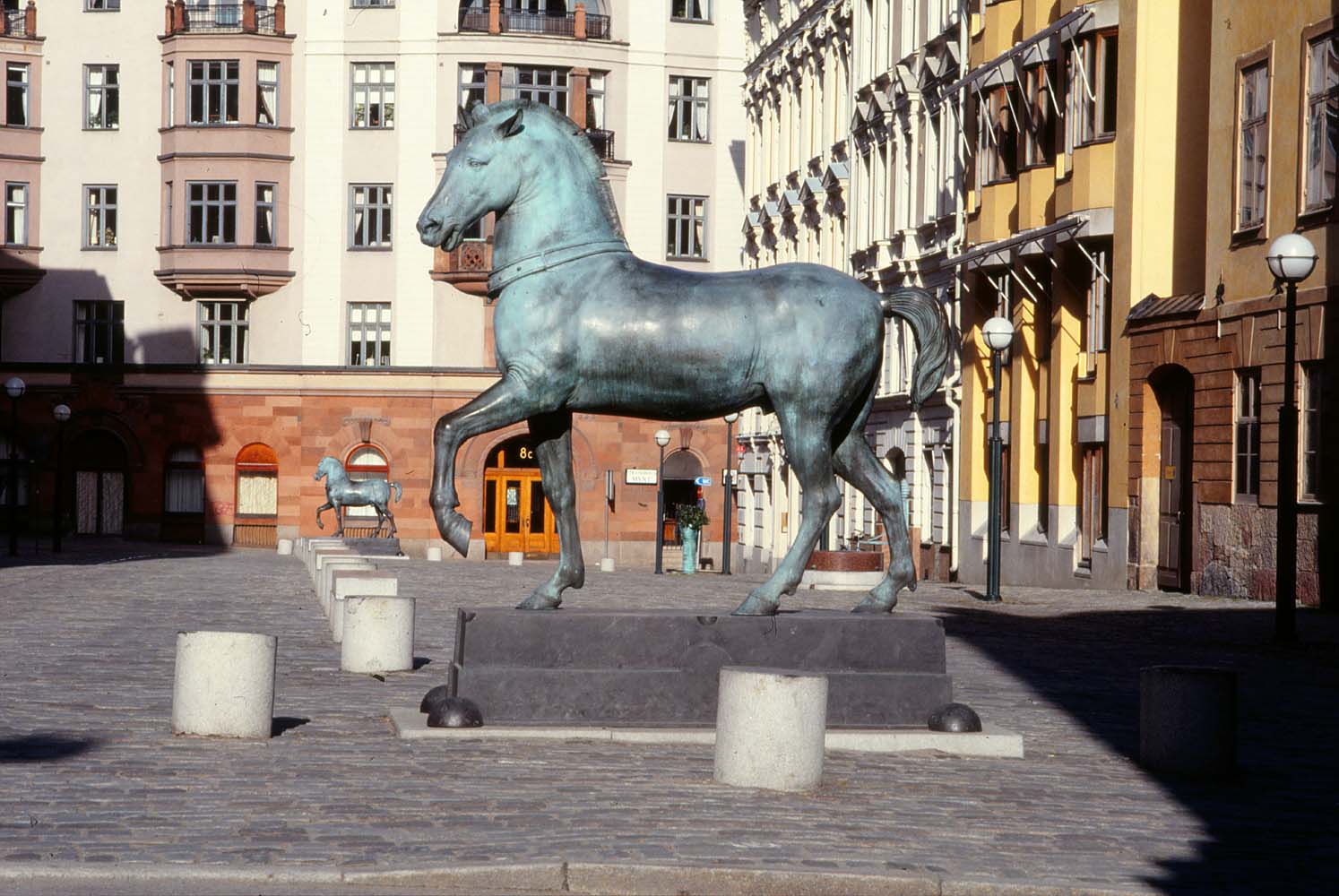
The sculpture installation at Blasieholmstorg consists of two full-scale bronze horses, placed on separate raised plinths at Blasieholmen in central Stockholm. The horses are copies of the famous San Marco horses in Venice – one of art history's most renowned sculpture groups, originating from antiquity. In the square, in addition to lampposts designed by Sivert, there are also a number of bronze urns and a stylized horse trough outside the gate that previously led to a stable.
Across the square is the entrance to the Fersenska Palatset, whose courtyard is staged with a number of symbolic elements that relate to the Greek idea of the four elements. These are placed on a geometrically patterned, stone-paved floor.
The work was inaugurated in 1989 and is one of Sivert's most famous public works – an artistic staging of the square and its surrounding urban space.
It is, therefore, a matter of copies of copies. Sivert has also altered the horses' relative positions. By turning them so that their gazes are directed down towards the street, he creates a dialogue with the surrounding urban space: one horse looks towards Strömkajen and the other towards Kungsträdgården. In this way, Sivert has transformed the ancient quadriga and made it the starting point for a contemporary artistic expression.
"Blasieholmstorg is one of Stockholm's most representative places. The square is located next to the Nationalmuseum and offers views of Kungsträdgården, Skeppsholmen, Strömkajen, Nybrokajen, and Djurgårdskanalen, among other places. The origin of the square's name is not definitively established. One theory is that since 1670, the name has been associated with the city clerk Blasius Olsson, who was also a shipowner and reportedly gained renown in the area."
Source: Stockholms gatunamn, Stockholmia förlag.
From Venice via Copenhagen to Värmland – and on to Stockholm.
The Venetian bronze horses, also called the Byzantine horses, came to Rottneros Park in Värmland as part of founder Svante Påhlson's visionary work to create a unique sculpture park in the mid-20th century.
The story of how copies of these world-famous ancient sculptures ended up in Värmland is interesting and can be summarized as follows:
The Inspiration from Copenhagen
Rottneros Park had a close collaboration with and drew inspiration from Ny Carlsberg Glyptotek in Copenhagen. The Glyptotek had exact plaster casts of the original horses, whose prototypes are found in St. Mark's Basilica in Venice.
The Casting of 1959
Using the Glyptotek's copies as a model, Svante Påhlson had the horses cast in bronze in 1959. The practical craftsmanship and the bronze casting itself were carried out by the renowned Herman Bergmans Konstgjuteri in Stockholm, which has been responsible for the casting of many of Sweden's most famous public sculptures.
"The two well-known bronze horses that have stood in Blasieholmstorg in Stockholm since 1989 are precisely these horses from Rottneros Park. It is, therefore, these Rottneros horses, which Herman Bergmans Konstgjuteri used as a model, that later found their place in Blasieholmstorg.
Through this initiative, the horses found their place in the park environment and became part of the magnificent collection of classical and Nordic art that Svante Påhlson built up. The collection was created to enhance and reflect the environment surrounding Ekeby in Selma Lagerlöf's Gösta Berlings saga.
And eventually, Stockholm also got to share in these horses – in the form of this sculpture installation which has become part of Blasieholmstorg's identity and contributes to creating one of the city's most distinctive and beautiful urban spaces."
/JÖ
Photographer: Jan Öqvist, Magnus Lindblom
Film
Stockholms läns museum … om Blasieholmstorg
⊙ Stockholm