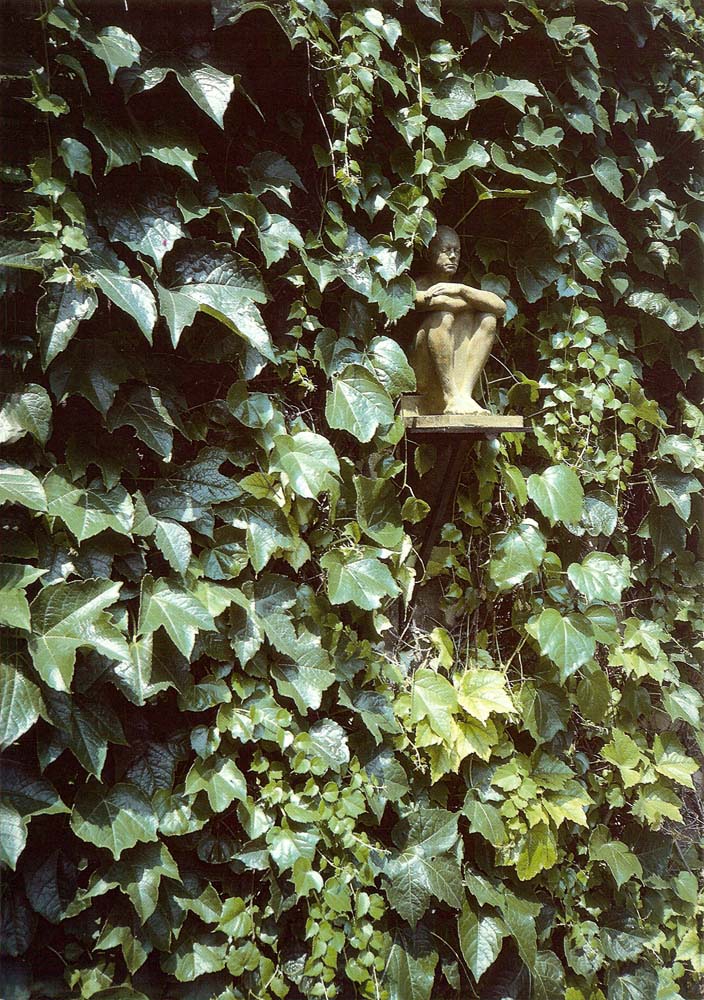
Sculpture of "sitting Sivert" on a wall with surrounding vegetation at Institut Suédois, 11 Rue Payenne, Paris.
In the courtyard of Institut Suédois, 11 Rue Payenne in Paris, there is a wall sculpture by Sivert. The sculpture is placed in an environment where the vegetation constantly changes with the seasons, while the sculptural form remains unchangeable. The encounter between the fixed, geometric figure and the living vegetation creates a contrast between the permanent and the ephemeral.
Institut Suédois, also known as the Swedish Institute in Paris, was founded on January 20, 1971, and officially inaugurated by then Crown Prince Carl Gustaf in April of the same year. The cultural center is run by the Swedish Institute and aims to promote Swedish culture and strengthen cultural relations between Sweden and France.
The Institute is located in the heart of Paris' historic Marais district. The building dates back to the 1560s and has undergone several renovations over the centuries. Today, Institut Suédois houses, among other things, six guest residences for researchers and cultural workers and serves as a vibrant meeting place for Swedish and French culture, with art exhibitions, concerts, film screenings, and language courses. It also features a Swedish café with an adjoining courtyard.
The Tessin Collection
An important part of Institut Suédois' activities and identity is the Tessin Collection, also known as the Tessin Institute's art collection. The collection constitutes the cultural center's permanent art historical exhibition and comprises more than 600 paintings, from the 18th century to our time, as well as thousands of books and other cultural-historical objects.
The Swedish state took over responsibility for the collection in 1963. Today, it is managed by the Swedish Institute and Nationalmuseum. The Tessin Collection is a significant collection of Swedish art in France and originates from the ambition to highlight the historical and cultural connections between Sweden and France, from the 17th century onwards.
Against this background, Sivert's wall sculpture in the courtyard takes on a special significance. It is situated in an environment where Swedish art and culture are presented in a French historical context. The fixed sculpture and the changing vegetation simultaneously form a simple yet expressive image of the passage of time – where human artistic form endures while the surrounding nature constantly shifts.
/JÖ
⊙ 11 Rue Payenne, Paris