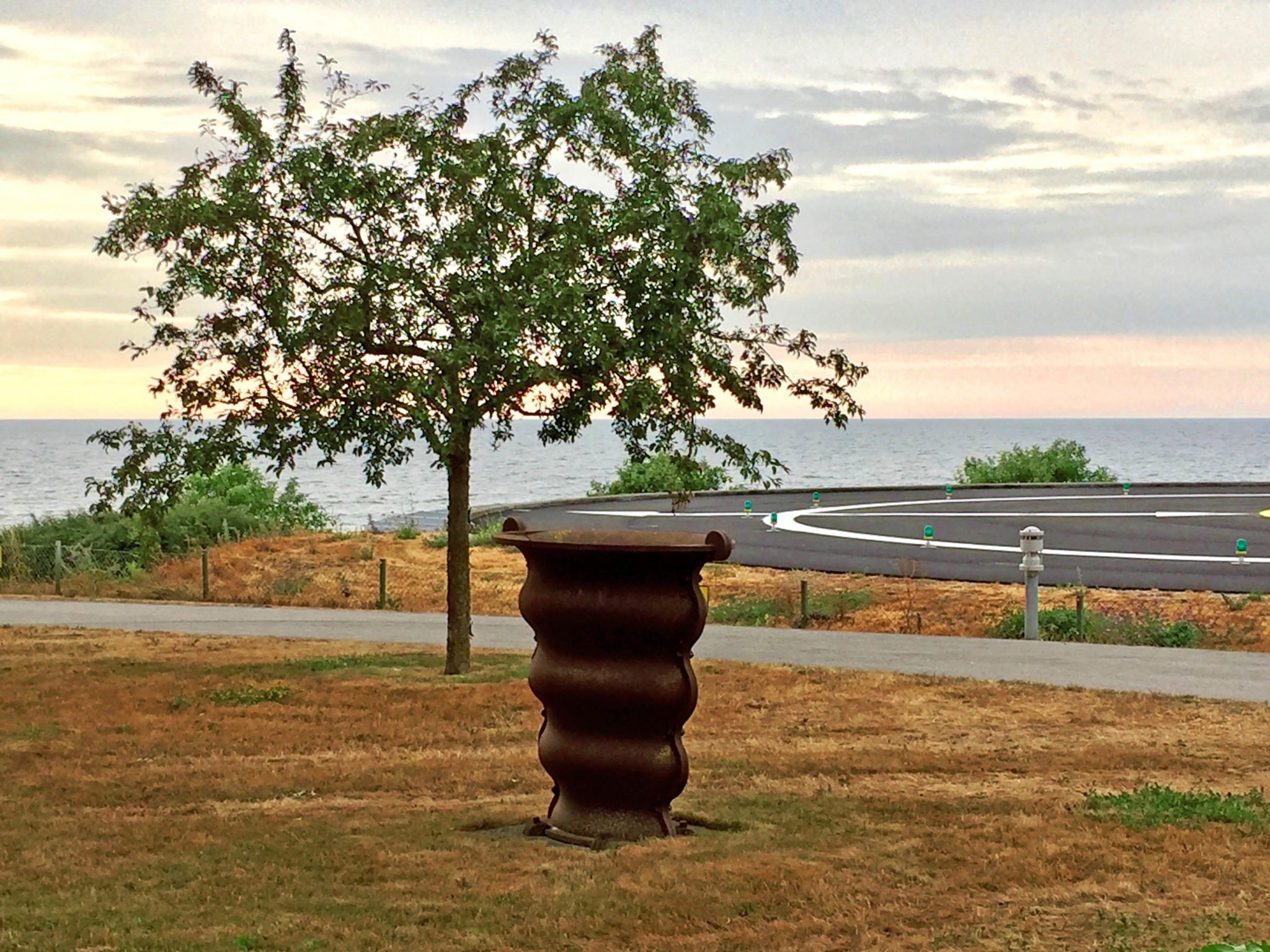
Sculpture at Visby lasarett, S:t Göransgatan 5, Visby.
On the lawn outside Visby lasarett, on the north side of the hospital by the helipad, stands a freestanding urn by Sivert. It is part of the series of recurring urns that Sivert has placed in various locations around Sweden.
Similar urns can be found, among other places, in front of Landstingshuset in Stockholm, around the reflecting pool in the northern part of Kungsträdgården, and at the entrance to Trädgårdsföreningen in the so-called Bältesspännarparken in Göteborg, where the urns are arranged in a long arc.
In a presentation of public art on Gotland, produced by Gotlands Museum, the urn at Visby lasarett is described:
”On the north side of the lasarett, by the helipad, stands a magnificent urn made of iron plate. The urn, with its classical form, evokes associations of being an architectural element. Perhaps it is the size or the choice of material that elevates the object from a freestanding sculpture to an integral part of its surroundings, in interplay with the lasarett's architecture?”
The urn was cast at Månsarps gjuteri under the direction of Johan Åkesson. Its classical form and monumental scale allow it to be perceived as much as an architectural element as a freestanding sculpture. In its encounter with the lasarett building and the surrounding lawn, it gains a special presence.
"The Urn as Symbol"
Sivert's urns take on different meanings depending on where they are placed and the environment they are part of. In front of a lasarett in Visby, it is easy to draw an association with Hygieia in Greek mythology, daughter of Asclepius, the god of medicine. Hygieia is associated with health, cleanliness, and preventive care and is often depicted with a bowl or urn and a winding serpent.
Hygieia's bowl has become an international symbol for preventive health and medical care. The motif of the serpent and the bowl is recognized, among other places, from Apoteket's logo and Karolinska Institutet's seal.
Sivert rarely leaves behind explicit explanations or analyses of his works, which means that the location and the viewer's own associations play an important role in encountering his art.
Precisely here, at Visby lasarett, the classical form of the urn therefore becomes particularly charged. What might be perceived in another location as a purely architectural or decorative element can here be associated with medicine, health, and care. The sculpture thus changes meaning depending on its context – a recurring feature in Sivert's public art.
/JÖ
Photographer: Jan Öqvist
⊙ View location⊙ S:t Göransgatan 5, Visby