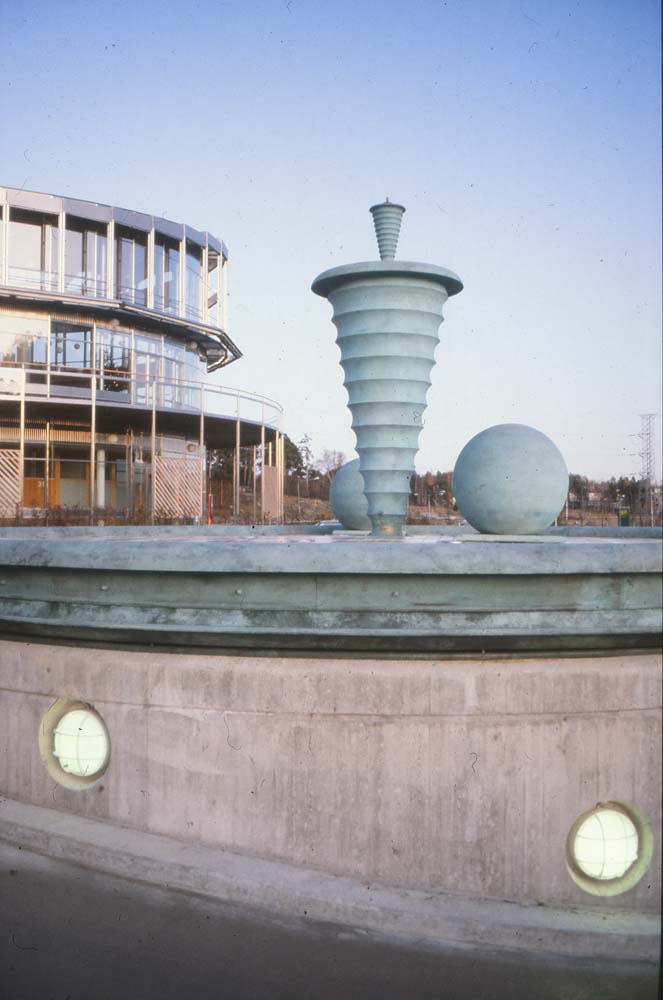
Sculpture group at SEB's head office in Rissne, Rissneleden 110, Sundbyberg
In front of SEB's former head office in Rissne, Sivert's design connected the driveway to the office building with the roundabout that simultaneously marked the entrance to the underground garage. At the center stood a round fountain pond, where water, sculpture, and the traffic environment were brought together to form a unified entrance design.
Sivert's original proposal included a powerfully marked, golden obelisk placed in the middle of the fountain. This part of the proposal was never realized.
A traditional obelisk is a tall, four-sided stone pillar that tapers upwards and ends with a pyramid-shaped top, a so-called "pyramidion". The obelisk originates from ancient Egypt, where it was associated, among other things, with the sun god Ra and with notions of the sun's rays, light, creation, and eternity. The pyramidion could be covered with gold or "electrum" and was intended to catch the sun's first and last rays. The obelisk's vertical form thus came to symbolize the connection between heaven and earth.
Obelisks were often erected in pairs at the entrances to Egyptian temples and could simultaneously serve as monuments to the pharaoh's power, divine legitimacy, and permanence.
Against this background, Sivert's original proposal becomes particularly interesting precisely in a bank environment. He had chosen a three-sided, constructed obelisk that would be entirely golden from top to base and placed on a round, collecting plate. It is tempting to see it as a playful yet apt image of monetary reality: a golden, upright form at the center of a bank environment. Perhaps it was precisely this overly clear symbolism that led to the obelisk never being erected.
The realized design
Instead, a smaller variant of a cornucopia was placed in the middle of the round pond. The form can be perceived as a smaller cornucopia placed within a larger one, possibly with a function as a rainwater collector. In connection with the entrance to the underground garage, two larger spheres were also placed.
Here too, some of Sivert's recurring forms reappear: the vessel or urn, the sphere, and the circular form. The grand and clearly symbolic expression of the planned golden obelisk was thus replaced by a more subdued composition, where water, vessel forms, and spheres interact with the circular traffic environment.
The two spheres can, of course, be perceived as purely formal elements, but they also open up for symbolic associations. Two identical spheres can, for example, be associated with duality, cooperation, or two separate but interacting entities. In a bank environment, one could also see them as an image of relationships and dependencies – between people, companies, or economic actors. However, no such intention from Sivert's side is documented, and the interpretation should therefore be left open.
Today, SEB has closed down its former head office in Rissne. The design can therefore also be seen as an example of how a work of art can live on as a trace of an activity and a place that has changed, even when its original function no longer exists.
/JÖ
Photographer: Magnus Lindblom
⊙ View location⊙ Rissneleden 110, Sundbyberg