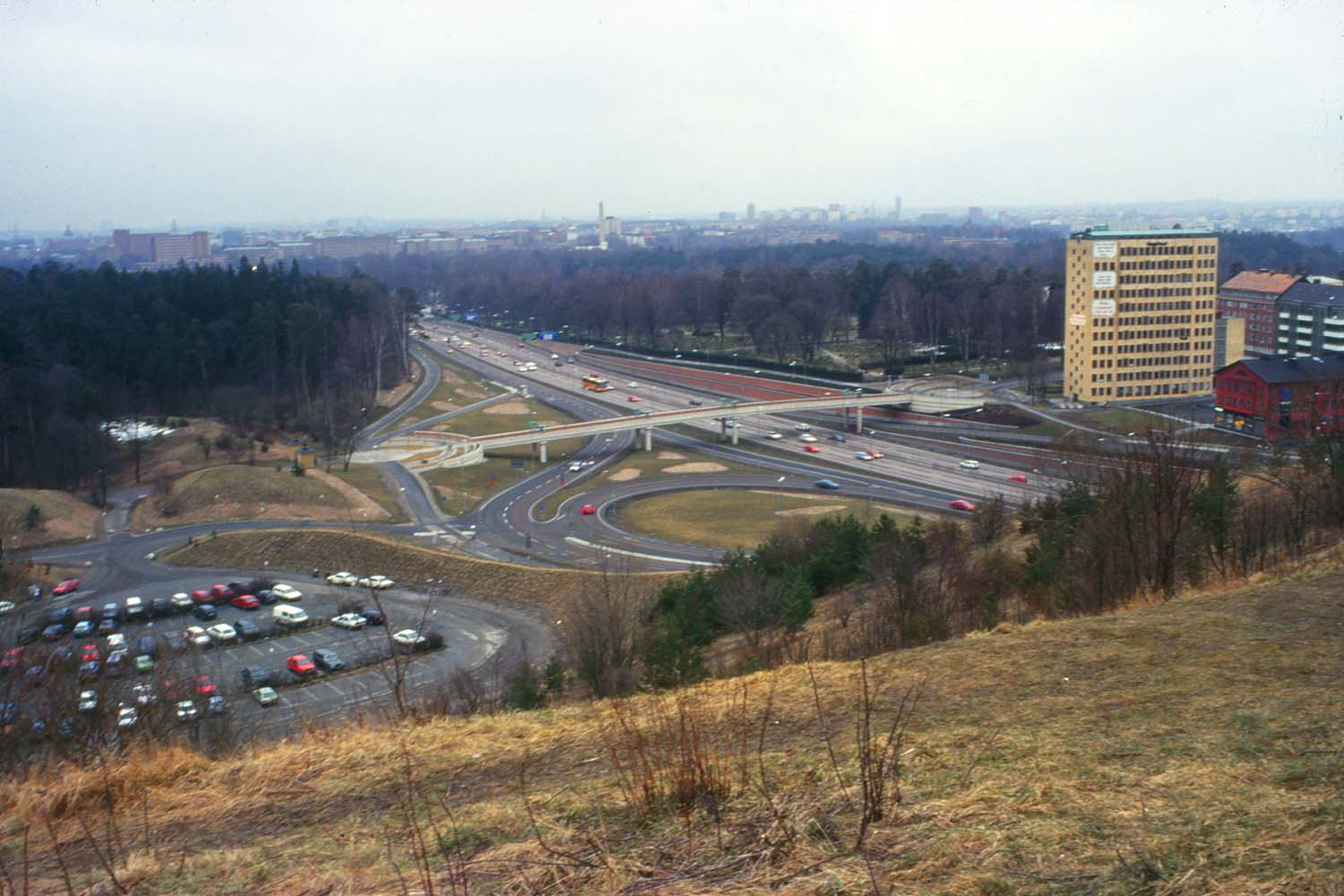
Sculptures on a footbridge at Haga Norra, Solna
"The Swedish Road Administration commissioned Sivert to artistically design the Haga Norra Footbridge in Solna. The footbridge connects the Hagalund area with Hagaparken by leading from Hagalund, via Hagavägen, over the heavily trafficked Uppsalavägen and further towards the park environment. It thus constitutes not only a functional connection for pedestrians but also serves as a spatial and symbolic link between the Hagalund district and the historically significant Hagaparken.
Beneath the viaduct, gently undulating brick walls run alongside the car traffic. In this environment, the robust infrastructure meets a more refined and sculptural idiom. At both abutments of the footbridge, on each side, there are four sculptural elements adorned with reliefs. The royal and poetic references in the relief motifs contribute to giving the place a solemn and historically rooted character.
Along the sides of the footbridge are stylized bronze urns, adorned with emblems and insignia. The motifs relate to culturally and historically significant individuals who have, in various ways, been active in or associated with the history of Hagaparken. The urns thus function not only as decorative elements but also as bearers of the place's historical memory. By reusing one of his recurring motifs – the urn – Sivert integrates the sculptural idiom into a larger narrative about the place, its history, and cultural significance.
At each abutment, there are also two paired spheres of green-patinated bronze. The spheres serve as clear sculptural markers in the transition between road, bridge, and park. Through their paired placement, they reappear as visual markers at the footbridge's entrances and help define the passage between the different environments.
Several of the sculptures on Haga Norra Footbridge were later subjected to vandalism. The original four bronze spheres – two on each side of the bridge – were stolen, as was a larger urn at the Sergel Monument in Hagaparken. The spheres have since been reconstructed and recast under the direction of Ulf Ferrius at Skånska Konstgjuteriet in Hammenhög, Österlen. The production thus connects to the collaboration between Sivert, Skånska Konstgjuteriet, and Ferrius, which also came to characterize several of the artist's later major design commissions.
The newly manufactured spheres are today filled with concrete and strongly anchored in the ground to hinder future thefts. This reinforced anchoring constitutes a concrete example of how public art may need to be adapted based on the experiences that arise at the site where the works are installed. The sculptures are thus not only exposed to weather, the aging of materials, and the natural changes of time, but also to human influence and intervention.
Haga Norra Footbridge thus constitutes a clear example of how Sivert allows sculpture, architecture, history, and function to interact in a public environment. The bridge span becomes more than a technical passage over a traffic route. Through urns, reliefs, and spheres, the connection between Hagalund and Hagaparken is given an artistic and historically rooted identity. The sculptural elements simultaneously function as an integrated part of the place's architecture and as bearers of stories and references to Hagaparken's cultural-historical context."
/JÖ
Fotograf: Jan Öqvist
⊙ View location⊙ Haga Norra, Solna