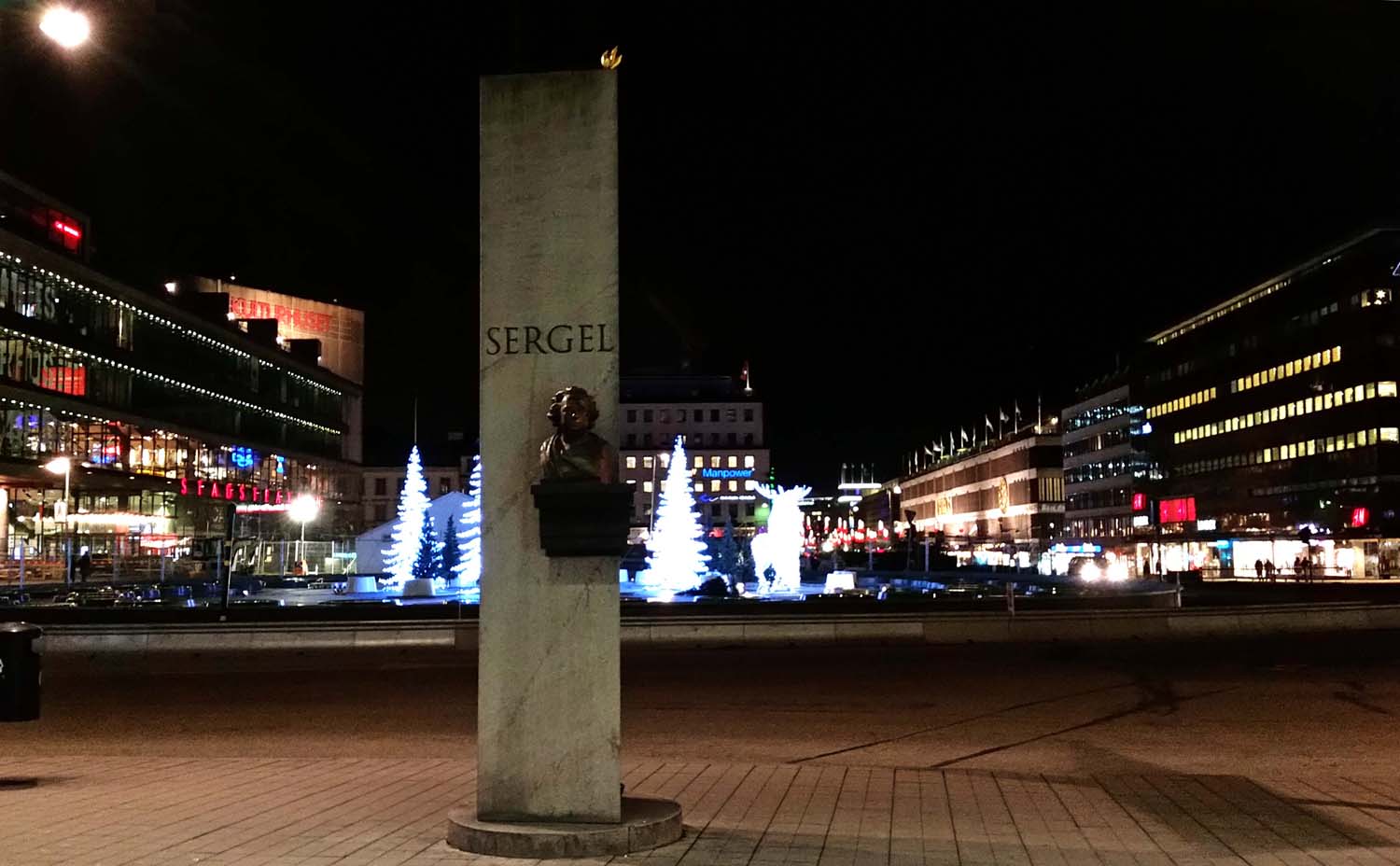
Memorial monument to the sculptor Johan Tobias Sergel at Sergels torg, central Stockholm
In 2002, Sivert received the Royal Academy of Fine Arts' Sergel Prize.
By then, Sivert had already, commissioned by the City of Stockholm and the Culture Administration, created a memorial monument to the sculptor Johan Tobias Sergel (1740-1814), which was placed at the beginning of Sveavägen, in front of the so-called "Sun Stairs," towards Norrlandsgatan, in 1998.
The memorial column is a smaller pendant, a counterpart to Edvin Öhrström's (1906–1994) enormous glass obelisk "Crystal, vertical accent in glass and steel" in the middle of the fountain.
Notice the golden flame burning high up in one corner of the monument. Sivert has surely thought of Sergel's monument to the Enlightenment philosopher Descartes, which is located in Adolf Fredriks Church.
Johan Tobias Sergel was one of Sweden's foremost sculptors and a central figure during the Gustavian era.
Gustav III greatly appreciated his art and called him home to Stockholm in 1787, where he executed a large number of official monuments, portrait busts, and decorations. He was a good friend of Bellman. A social genius and a brooding melancholic. A celebrated artist and satirical provocateur.
As court sculptor and professor at the Royal Academy of Fine Arts, he gained international fame with masterpieces such as "The Faun" and "Cupid and Psyche." Among other things, he gave his name to Sergels torg in Stockholm.
In this context, it might be interesting to visit Adolf Fredriks Church where Sergel designed one of the more remarkable memorial monuments we have in Sweden.
The monument – a sacred work – honors the French philosopher René Descartes (Cartesius) (1596–1650) who, during Queen Kristina's time, was associated with the Swedish court. Following an invitation from Queen Kristina, Descartes moved to Stockholm in 1649 to teach her philosophy and help found an academy of sciences. He contracted pneumonia and died in Stockholm in February 1650. He was buried in the churchyard from 1650–66 before his remains were brought to his homeland.
In the church, there are two sculptures by perhaps the most renowned artist in our country during the church's construction period, the sculptor Johan Tobias Sergel. One is the "Cartesius Monument," where "Truth," symbolized by a globe, is freed from "Falsehood's" veil. King Gustaf III, who followed the church's construction with great interest, initiated the creation of this work.
Anyone who manages to get a little higher up towards the globe will see that Sergel, for surely special reasons, chose to place the torch – the light – above the engraved word Stockholm!
René Descartes was a mathematician and scientist, often called the father of modern philosophy. He is best known for his attempt to build all knowledge on an absolutely secure foundation through systematic doubt, formulated in the famous quote "cogito, ergo sum" (I think, therefore I am).
/ JÖ
Sergel's very simple memorial grave is located outside the church, facing Sveavägen.
The Church of Sweden has a link to the Cartesius Monument:
https://www.svenskakyrkan.se/adolf-fredriks/sergel-i-adolf-fredriks-kyrka
Photographer: Jan Öqvist
⊙ View location⊙ Sergels torg, Stockholm