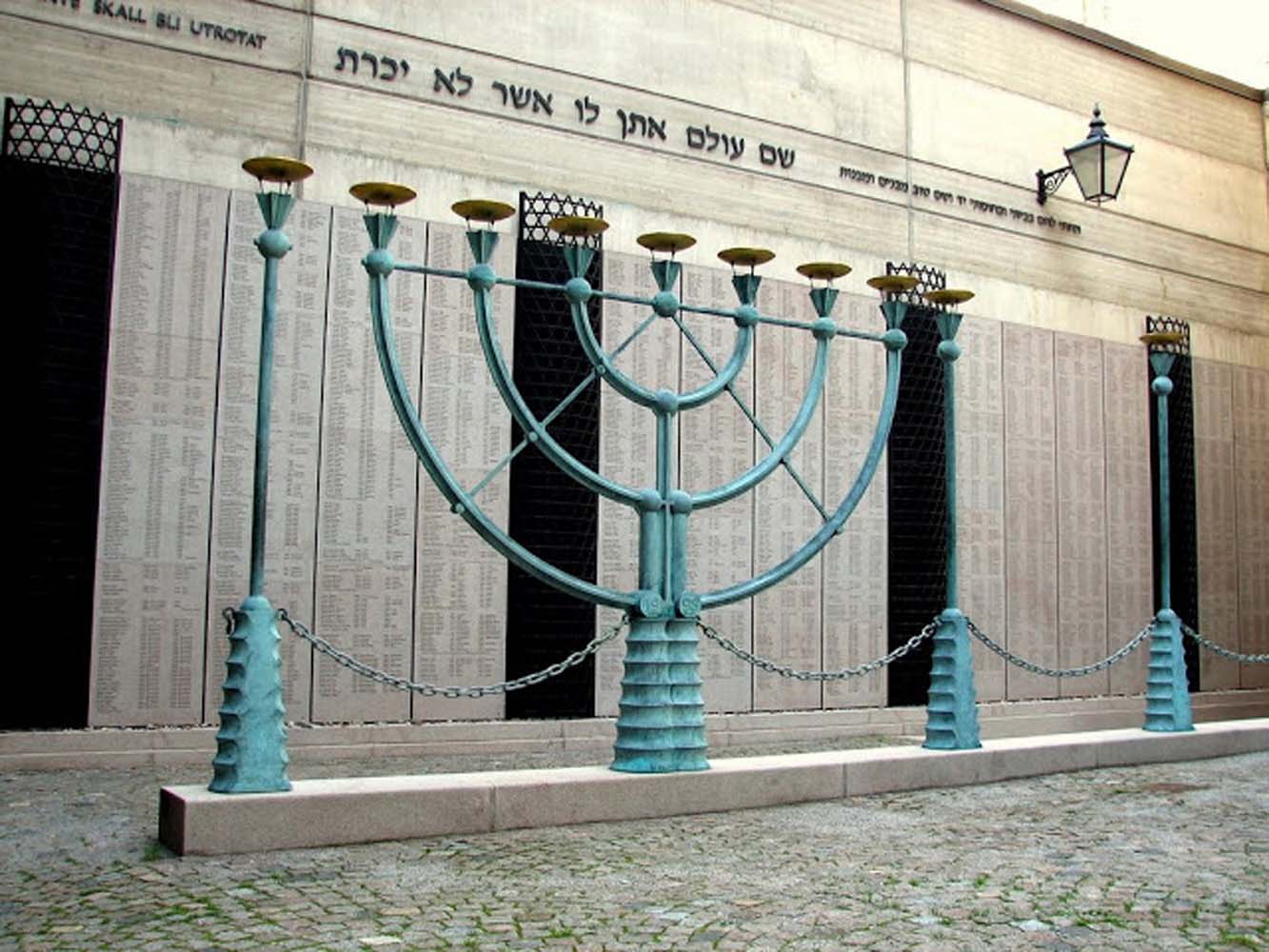
Memorial monument for the Holocaust 1933–1945 at Stockholm Synagogue, Wahrendorffsgatan
At Stockholm Synagogue on Wahrendorffsgatan, there is a memorial for the Holocaust, erected in memory of the people who were murdered during the Nazi genocide and who had a connection to Sweden.
The Holocaust took place during the period 1933–1945. It was Nazi Germany's systematic and state-sponsored persecution and genocide, where Europe's Jews constituted the primary target group, but where millions of other people were also persecuted and murdered. The persecutions began when Adolf Hitler and the Nazis seized power in Germany in 1933. During the Second World War, the persecution developed into an industrially organized mass murder, with a particularly intense scope from 1942 onwards.
On January 27, 1945, the concentration and extermination camp Auschwitz-Birkenau was liberated by Soviet troops. The date has since become the international day of remembrance for the victims of the Holocaust.
The memorial at the synagogue is a work by sculptor Sivert and architect Gabriel Herdevall. In the memorial book "Glöm oss inte" from Hilleviförlaget 1999, the design is presented under the heading "Avskilt och öppet". This very phrasing captures a central idea in the work: the place is both secluded for memory and reflection and at the same time open to the surrounding Stockholm.
Secluded and Open
The starting point for the monument was to create a dignified and secluded place on Jewish ground, but at the same time with contact with the surrounding city. The placement next to the synagogue gives the memory of the murdered a natural home. The monument extends into Aaron Isaacs Alley and further towards Raoul Wallenberg Square, thus creating a physical and symbolic connection between the Jewish and the Swedish.
From the space in front of the synagogue's entrance, where a menorah and bronzed lamp posts function both as landmarks and boundary markers, a sloping path leads into the alley's more condensed space. The walk becomes part of the memorial experience.
Along the path are the names of more than eight thousand people who were murdered during the Second World War. The names are preserved through surviving relatives who were rescued to Sweden. They are sandblasted onto granite slabs and together with rhythmically recurring cast-iron trellises and bollards, they create a sequence that guides the visitor through the monument.
In the western end of the monument, there are additional cast-iron trellises and wild vines. Here there is also a bronze plaque with a text that formulates the monument's message. The design also includes water as a symbol of life, as well as a bronze vessel filled with stones, which connects to Jewish tradition.
Above the monument runs a Swedish and a Hebrew text – a Bible quote. The lighting from the posts and lanterns in the alley gives the place a special glow during the dark hours of the day. The monument then becomes visible also from Berzelii Park and Raoul Wallenberg Square. The light thereby reinforces the idea of a link between the Jewish and the Swedish, between the enclosed urban environment and Nybroviken's open water space.
The memorial monument's spatial idea continues out towards Nybroplan through Berzelii Park. In the ground there are a pair of recessed rails which lead further from the Holocaust Monument towards the adjacent Raoul Wallenberg Square. This stretch has been named "The Path".
The rails connect to the railway transports through which people were taken away to ghettos, concentration camps, and extermination camps. At the same time, the rails take on a double meaning. They describe the straight path towards deportation, while the escape from persecution was often winding, dangerous, and fraught with obstacles.
The Path leads to a large round granite block with inscriptions in 24 languages. The text summarizes this dual experience:
”Flee the murderers. The path was often straight when Jews were taken away to be killed. The path was winding, dangerous, and fraught with obstacles when Jews sought to flee the murderers. The path was often straight.”
Above the text is Raoul Wallenberg's name, which further connects the memory of the Holocaust with the Swedish effort to save Jews from Nazi persecution.
The Connection to Raoul Wallenberg Square
The Path also connects the Holocaust Monument with Raoul Wallenberg Square. The square's renewal was planned in the mid-1990s by Stockholm City Planning Administration under the direction of square architect Aleksander Wolodarski. In the autumn of 1997, Stockholm Art Council was commissioned to create a memorial for Raoul Wallenberg.
The memorial consists of twelve low bronze sculptures without a clear form. They are placed in a group and oriented down towards the gently sloping, stone-paved square towards Nybroviken. In the ground there is also a bronze casting of Raoul Wallenberg's signature.
The connection between the two places is therefore not only historical but also physical. Through The Path, the synagogue's Holocaust Monument is linked with Raoul Wallenberg Square. The visitor can move between the places as through a continuous chain of memory.
Here several levels of memory meet: the people who were murdered, the survivors who came to Sweden, those who helped to save people from persecution, and the Swedish urban environment where the memory of these events is still present.
The memorial thus becomes not an isolated sculpture but an entire spatial process. From the synagogue's courtyard, through the condensed alley, and further along The Path towards Raoul Wallenberg Square, a journey through history is created. The secluded and the open, the Jewish and the Swedish, the local and the European are bound together in one and the same design.
/JÖ
Castings of the component objects (Menorah etc.) for the installation in the Synagogue's forecourt were made at Skånska Konstgjuteriet under the direction of Ulf Ferrius.
Photographer: Jan Öqvist
⊙ View location⊙ Wahrendorffsgatan, Stockholm