1987 · Koreografi
Driftwood — Fragments from Earlier Choreographies
Koreografi: Margaretha Åsberg. Moderna Dansteatern
In 1987, Margaretha Åsberg returned to three earlier choreographies – Sand (1974), Life Boat (1976), and Natten innan (1978) – and compiled fragments from them into a new performance: Drivved. Movements and scenic situations were taken out of their original contexts and assembled into a new choreographic whole.
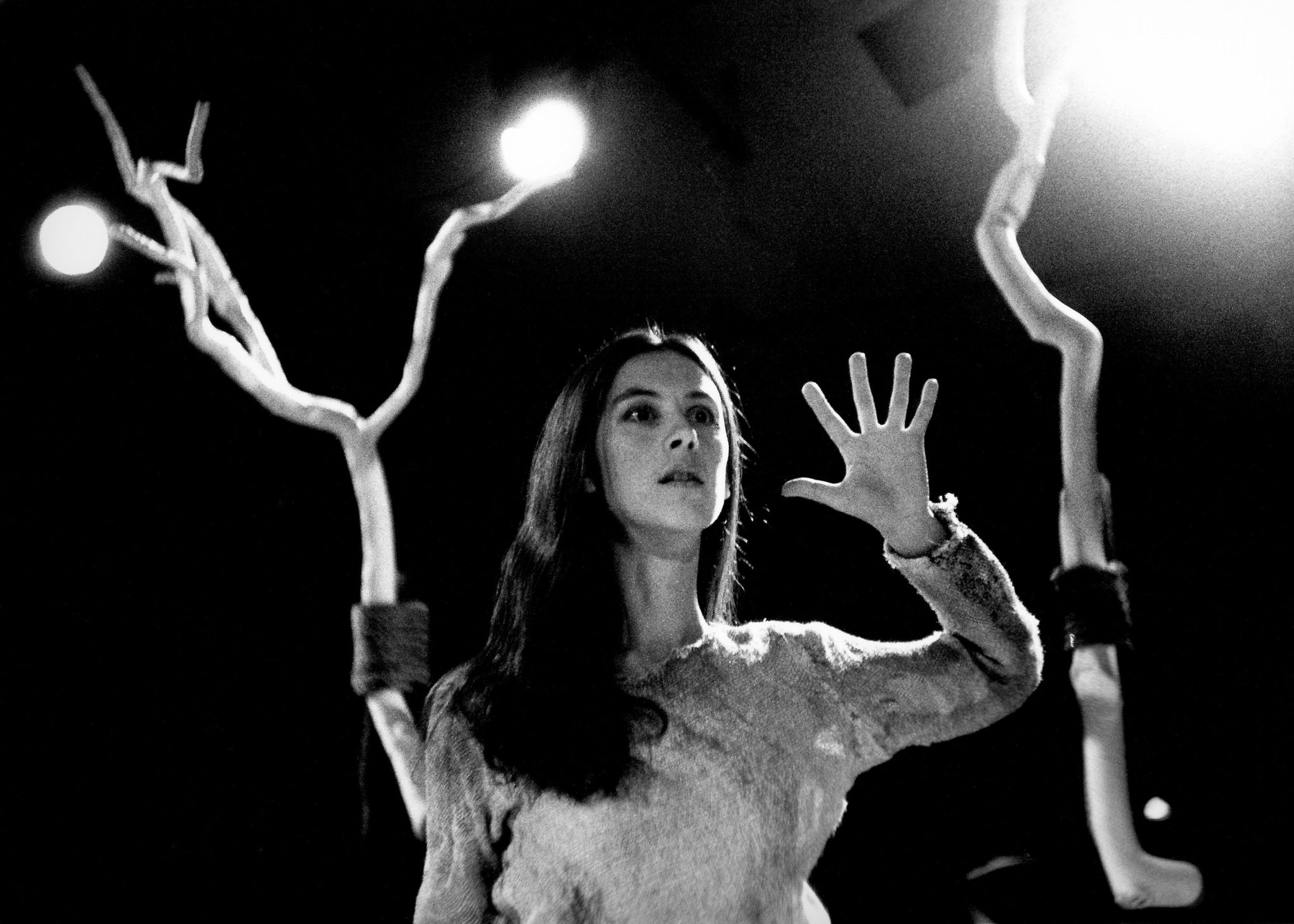
"Sivert's scenography largely consisted of objects he had previously created for Sand. They were now moved into a new context. On grey-painted struts were strongly bound branches painted white. The branches' ramifications and the strut constructions formed an angular yet organic element in the space. In addition to this came a stainless steel pendulum, whose shiny metal and movement contrasted with the painted wood, as well as two long poles equipped with bag handles, with the working title Spänger.
The objects filled the space in a way that made them more than mere scenographic decorations. They created heights, lines, and distances that the dancers had to relate to. The white branches rose from their grey struts like artificial trees or twisted plant forms. The pendulum hung as a movable object in the space, while the long poles could be held, moved through the space, and function as extensions of the body.
Here, Sivert's concrete choice of materials became crucial. Wood, metal, rope, and painted surfaces meet skin, clothes, and movement. The hard and fixed stage material contrasts with the living body. As the dancers moved among the objects, new relationships between body and object constantly arose: to walk around, under, or past; to carry, hold, or balance; to stop when an object blocks the way.
At the same time, the old objects are transformed by being combined with new movements. What in Sand had been part of a politically charged scenic world takes on a different function in Drivved. Lindblom's scenography thus becomes a kind of fragment itself: physical remnants from an earlier work that reappear, but in a new order.
This is close to the performance's title. Like driftwood, the parts of the scenography have traveled from one work to another. They are marked by their previous context but have found a new place in the space. Åsberg works with choreographic fragments; Sivert works with concrete scenic fragments. Together, they allow the old material to re-emerge in a new form.
Drivved premiered on November 6, 1987, at Moderna Dansteatern, with Margaretha Åsberg, Anja Birnbaum, and Cecilia Roos. Moderna Dansteatern had been founded the year before at Åsberg's initiative, who also served as the theater's artistic director in the following years.
In Drivved, Sivert's significance therefore becomes particularly clear: he does not build a space that dance fills – he builds a space that dance must navigate. His branches, struts, pendulum, and poles give the body something to encounter, avoid, use, and relate to. The scenography thus became a physical part of the choreography." /JÖ
Photo: Lütfi Özkök