1987 · Koreografi
Fragment — Serious Trifles, Moderna Dansteatern, 1987
Koreografi: Margaretha Åsberg. Moderna Dansteatern
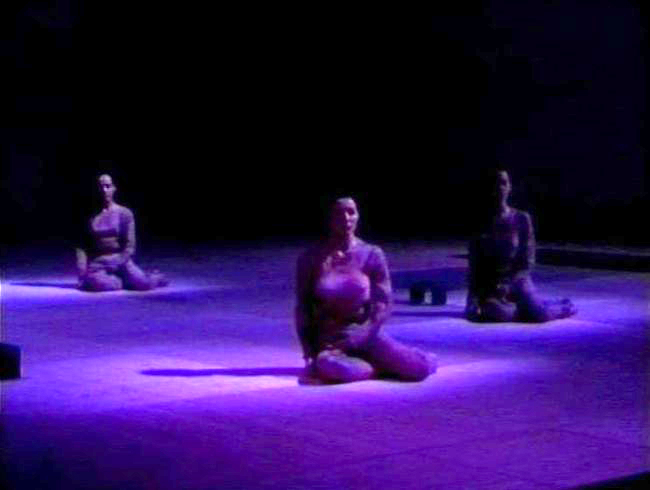
Fragment – Serious Trifles, with Margaretha Åsberg for Pyramiderna at Moderna Dansteatern, consists of two parts and revolves around three deeply human experiences: memory, loss, and touch.
"The performance began in an intensely purple darkness. Gradually the light faded and a stage floor emerged, covered in light and dark rectangles. From this space, three women appeared. Their movements were concentrated and repetitive, moving towards something resembling a ritual – as if the body was trying to remember something that could no longer be held onto.
In this space, the dancers encountered a collection of sculptural objects created by Sivert, Johan Scott, Agnes Monus, and Håkan Rehnberg. The objects became part of the visual fabric rather than a traditional stage design. They marked places, created distances, and gave the body something concrete to relate to. It was a space where memory seemed to have left physical traces.
Sivert's objects thus gained a special significance in the encounter with Åsberg's choreography. His sculptural forms not only stood in the space but became part of the space that the dancers explored with their bodies. The solid materials contrasted with the living and ephemeral: skin against surface, hand against object, movement against stillness.
From the intense darkness to the fading light and further to the slow movements of the bodies, a shift occurred between the visible and that which was disappearing. The objects remained while the bodies passed. In this way, the performance's themes were interwoven: memory that lingered, loss that left an emptiness, and touch that for a brief moment re-established contact.
Fragment – Serious Trifles thus allowed choreography, light, and sculpture to meet in a shared space, where the body moved among the traces of something that had been." /JÖ
"But Margaretha Åsberg also goes a step further when she not only allows physical expressions to take over, but also introduces elements belonging to the domains of religious language, poetry, spoken theatre, and visual art. Together with her dancers, she has thus created a scenic form that goes very far with these experiences, both elusive and anything but easy to handle, which she has chosen to convey. ” BO-INGVAR KOLLBERG UPPSALA NYA TIDNING 1998-05-12"
“In addition to the somewhat fantastic and varied lighting, the dancers' enormous skill, and music, there are also objects by prominent artists from previous productions; among others, these small stool-like objects, or dogs, as their creator Johan Scott calls them; bricks that previously lay beneath these "dogs" are here formed into a small sculptural formation under a warm spotlight and fade out the first part – as if it were a beautifully illuminated tombstone. ” CHRISTINA LUNDBERG LJUSNAN 1998-05-11
In 1987, Margaretha Åsberg compiled a new choreography under the collective name Drivved, built from deconstructed fragments – sections and sequences – from three earlier works: Sand (1974), Life Boat (1976), and Natten innan (1978). The older choreographies were not reconstructed, but broken up and allowed to form a new scenic whole.
"For Drivved, several of the sculptural scenographic elements that Sivert had created for Sand also reappeared, where he had collaborated with Åsberg as a set designer in 1974. Sivert's objects thus became the concrete fragments themselves from the earlier work – material that could be moved into new choreographic contexts and acquire changed meaning.
Among the objects were tightly bound, white-painted branches on grey-painted supports, a stainless steel pendulum, and a pair of long poles with bag handles, with the working title Spänger. The objects were placed in relation to the dancers and became a physical part of the choreography. The branches, supports, pendulum, and poles created directions, obstacles, and extensions of the body. They gave the dancers something to walk around, pass, hold onto, and relate to.
In this way, a clear parallel emerged between Åsberg's and Sivert's work in Drivved. Åsberg broke down earlier movements into choreographic fragments; Sivert allowed earlier scenic forms to reappear as material fragments. The old remained, but in a changed order and with new relationships between body, object, and space.
The title Drivved was therefore particularly apt. The earlier choreographies had left traces that drifted into a new work, while Sivert's objects carried with them the memory of the scenic world where they first appeared. What once belonged to Sand became material for a new choreographic situation." /JÖ
Drivved premiered on November 6, 1987, at Moderna Dansteatern, with Margaretha Åsberg and dancers Anja Birnbaum and Cecilia Roos.
Åsberg was the initiator of Moderna Dansteatern, which was created as an independent stage for modern and contemporary dance in Sweden. She was the theatre's artistic director for nearly two decades. Her international activities included, in addition to the Nordic countries, tours in France, Germany, Italy, and Spain, among others. In 1992, she was appointed professor of choreography at Danshögskolan.
In Drivved, her long-standing artistic work with body, space, and reuse became particularly clear – and at the same time, Sivert's stage design emerges as a material memory: objects that survive a performance and continue to move on through new bodies, new spaces, and new works.
The Swedish Academy awarded Margaretha Åsberg the Royal Prize for 2009. Images: Margareta Åsberg's archive