1976 · Koreografi
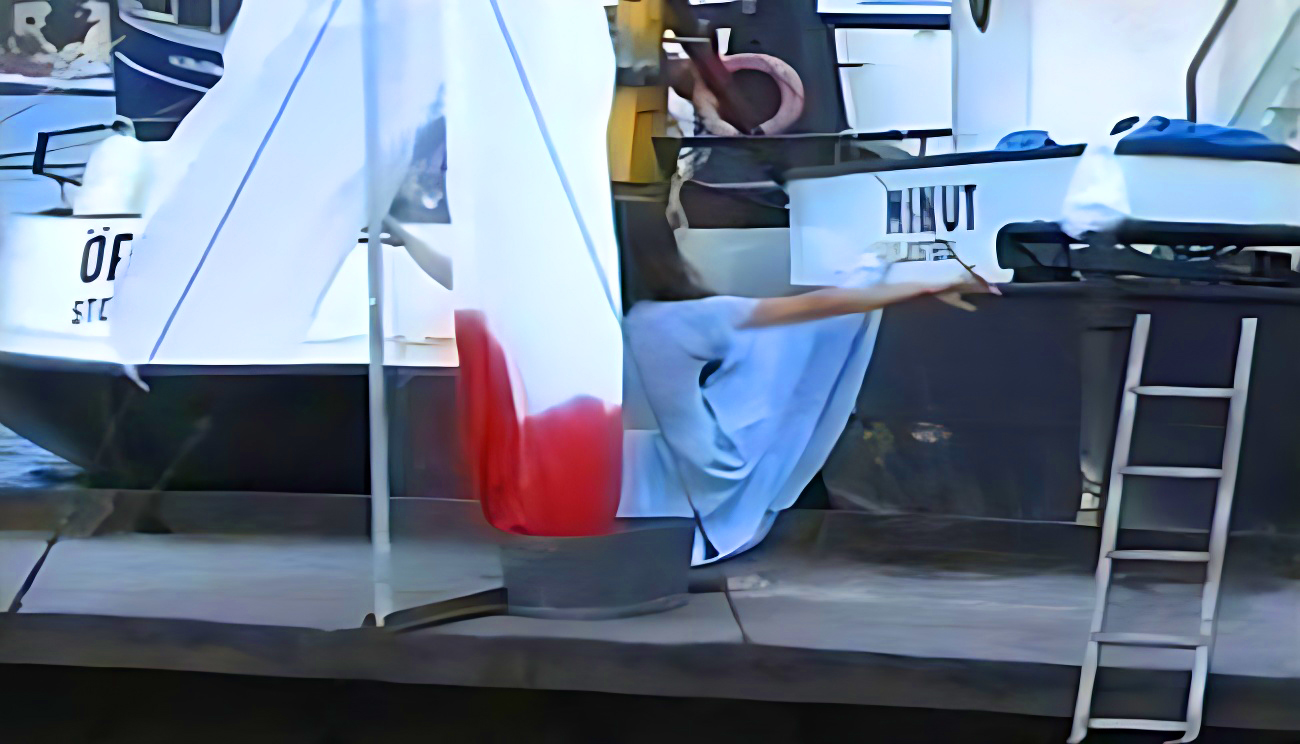
Life Boat, Moderna dansteatern, 1976, 1997
Kajen nedanför Moderna Museet, Skeppsholmen
"A barge is moored at Skeppsholmen. The water separates the stage from the land, and on the quay, the audience sits on tiered seating. In the middle of the barge stands a solitary female dancer – between water and earth, between movement and stillness, between body and emptiness.
In Life Boat, the location itself becomes part of the choreography. The barge sways against the water while the dancer slowly rises on stilts. The body stretches upwards, becoming tall and fragile against the sky. But the movement soon seeks its way back. The feet find the earth, gravity returns to the body, and she begins to dig herself down. What first lifts her then allows her to sink.
From the earth she returns, slowly and almost imperceptibly, until the movement brings her towards the glass pane. Earth comes up onto her body and hands. The damp, dirty, and living meets the cold, hard glass surface. She lets her hand rest against it and begins to write. Letters emerge in the dirt, slowly and gracefully:
“Nothing exists.” The hand leaves the glass, but the words remain. What she just carried in her body has found a surface to cling to. The glass simultaneously becomes a membrane between her and the audience – something that can be touched but not passed through. On the other side are the spectators; on this side, the solitary body remains.
To Steve Reich's repetitive music and with words by T. S. Eliot and Samuel Beckett, the movement glides between different states. Water becomes swaying, swaying to body, body to earth, earth to hand, and hand to writing. One state is born from the other. Nothing happens abruptly; everything slowly transitions into something new.
The music keeps time in motion while the body seems to struggle against it. The earth pulls her downwards, the glass holds her in place, the water beneath the barge continues its own slow movement. The concrete – earth, glass, water, and body – becomes a bearer of something that cannot be held fast: time, memory, absence.
Life Boat premiered on June 8, 1976, and was part of a choreographic series on the theme of time–space–energy, together with Pyramiderna and The Opening of the Mouth. The performance ran until June 13.
The title Life Boat thus also becomes an image of movement: something that keeps the body afloat, but which at the same time constantly moves towards the depths. Life Boat was restaged in connection with a seminar/workshop on postmodern dance of the 60s and 70s, which was part of the festival Talking Dancing. /JÖ
The review "Skapelsen central i Life Boat" by Cattis Grant was published in Dagens Nyheter on September 1, 1997. The text discusses the staging of the performance Life Boat and its thematic focus on creation.
"When Life Boat premiered in 1976, it was described as a movement poem and as such, it sharply broke with the contemporary dance of the time, which was often performed as a political act, stripped of all scenography. Performed in 1997, Life Boat has not lost its relevance thanks to its life theme executed in an imaginative form. This is perhaps why the people having a barbecue on the boat next door are at times glued to the deck, following the performance, as are the boats slowing down in the bay." Cattis Grant, "Skapelsen är central i Life Boat," 01-09-1997, Dagens Nyheter
Regarding the restaging of Life Boat from 1977 to Life Boat 1997, it was written: "In several ways, Life Boat is a very courageous performance. It was courageous in its time because it broke with postmodern conventions in dance. It is courageous today when Margaretha Åsberg – later Anja Birnbaum – dares to meet us so nakedly. There is a kind of relentlessness in the entire idea of Life Boat. One certainly finds oneself smiling at the somewhat heavy seriousness of the symbolically charged actions, but is also struck by the concrete sensuality. The mud is mud, the earth is earth, the grain poured into the sarcophagus is grain – the cycle through all ages." Cattis Grant, Svenska Dagbladet 1997-09-01
An exhibition about the postmodern movement work "Pyramiderna" at Dansmuseet (2001-10-01) provided a rich reminder of Margaretha Åsberg's elective affinities, from "Life boat" – which was performed on a barge at Skeppsholmen in 1976 – to "Allvarsamma bagateller" in 1998. In both, the artist Håkan Rehnberg participated, who, in the company of Jan Håfström, Sivert, and Bård Breivik, dominates the exhibition's catalog with sculptures, objects, and spatial solutions.
A longer article about Pyramiderna can be read in SvD on October 1, 2001. https://www.svd.se/a/fc21d5b6-b9f0-3dfb-819e-78a4b5682dfe/pyramiderna-blir-en-mangbottnad-tidsresa
At Moderna Dansteatern, the spectator enters an empty room that seems to wait in the spirit of Beckett. But T. S. Eliot's words open the performance: “The ending precedes the beginning”."