1974 · Koreografi
Sand — 10 movement poems, 1974
Koreografi: Margaretha Åsberg
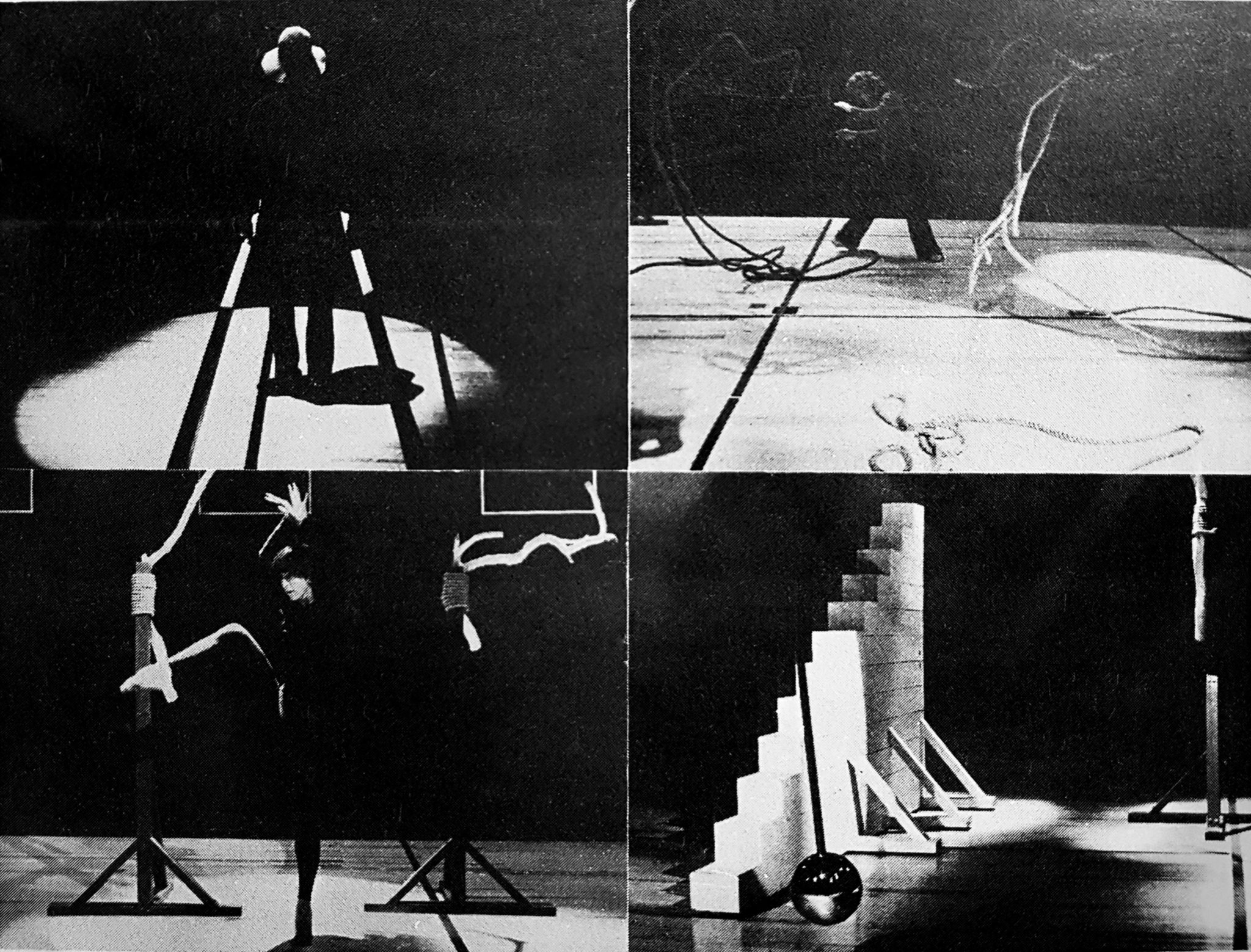
After Margaretha Åsberg left the Royal Swedish Opera, she created her first major independent choreographic production, Sand – 10 movement poems, in 1974. Sivert was responsible for the scenography. The work was performed in Fylkingen's then-premises at Östgötagatan 33 and has been described as the first performance piece within modern dance theater in Sweden.
"Sand emerged from the political shock that followed the military coup in Chile on September 11, 1973. The democratically elected president Salvador Allende was overthrown when the military under Augusto Pinochet seized power. Allende remained in the presidential palace La Moneda, which was bombed, and took his own life before the military entered the building.
For Åsberg, the events in Chile became the starting point for a scenic work about violence, loss, humiliation, and resistance. The ten movement poems approached the experience of dictatorship through body, space, material, and sound rather than through a narrative rendition. The titles – from Under a Neon Cloud and Sand I – The Moment of Freedom to Football Stadium in Santiago de Chile, The Law, Footbridges, Rollers – Rope, Space, Night Work, The Pendulum and The Staircase, and Sand II – together form a fragmentary and poetic image of the landscape of political violence.
A central reference was the Chilean sports arenas that were transformed into prisons and interrogation sites after the coup. At Estadio Chile, where people were held captive and tortured, was also Víctor Jara, the popular singer, guitarist, poet, and political activist. He had been arrested after the coup and subjected to torture. On September 16, 1973, his body was found along with other dead prisoners. The Chilean memory institution Museo de la Memoria states that the autopsy showed 44 gunshot wounds and that he was executed without due process.
The stories about Jara also acquired a strong symbolic charge. According to testimonies, guards had broken his hands and mocked him by asking him to play the guitar. The claim that his hands were cut off before the execution, however, has not been confirmed and should therefore not be presented as an established fact. The central point is the documented torture, captivity, and execution – and the strong symbolism in a musician being subjected to violence against the very hands that were his primary artistic tools.
The role of the USA also belongs to the political background. Declassified American documents show that the CIA and the US government provided economic and political support to Chilean opposition parties and other opposition forces before the coup. Documents from September 1973 simultaneously show that the American administration discussed a possible military takeover and how the USA would relate to a coup. The available documents do not, however, prove that the CIA participated directly in the coup itself.
The scenography became part of this poetics. Lindblom created, among other things, grey-painted shells for chairs with white interiors, white reconstructed trees, and trusses – simple, abstract objects that could change meaning depending on how the bodies moved through the space. Several of these scenographic elements later reappeared in Åsberg's Drivved (1987).
The music consisted of works by Lars-Gunnar Bodin, Sven-Erik Bäck, Sten Hanson, Jan W. Mortensen, and Leo Nilsson. In the performance, in addition to Margaretha Åsberg, the actor Jacob Nordensson and Richard Ljungberg participated.
It is in the encounter between these elements – the body, the objects, the sounds, and the political experiences – that Sand gains its particular power. Chile is not depicted as a historical narrative on stage. Instead, violence becomes something that passes through the space and the body: a weight, an obstacle, a movement that is broken. Sand becomes both that which covers the tracks and that which clings to the body." /JÖ
The 10 movement poems were named: "Under a Neon Cloud" "Sand I" The Moment of Freedom "Football Stadium in Santiago De Chile" "The Law" "Footbridges" "Rollers – Rope" "Space" (later title: A GI YA NI Indian poem) "Night Work" dance to Pablo Neruda "The Pendulum and The Staircase" "Sand II" The 10 movement poems were integrated with music by Lars-Gunnar Bodin, Sven-Erik Bäck, Sten Hansson, Jan W. Mortensen, and Leo Nilsson. Premiere: was in Fylkingen's premises when it was located at Östgötagatan 33. Among the objects included were Sivert's constructed grey-painted "chair shells" with white interiors, a number of white "tree reconstructions," and trusses. The dancers in the performance included Margaretha herself, the actor Jacob Nordensson, and Richard ("Richard the great") Ljungberg.
Some of these scenographic elements would later be included in 2 additional productions with Margaretha Åsberg: "Drivved" (Driftwood) 1987 and "Fragment – Allvarsamma bagateller" (Fragments – Serious Trifles) 1998. This choreography was a "grief processing" after a death in the family. The work contained parts of artistic objects that were included in "Drivved," including Sivert's "Spänger" (Footbridges) (the two long poles with bag handles). With Margaretha were the dancers Anja Birnbaum and Françoise Joyce.