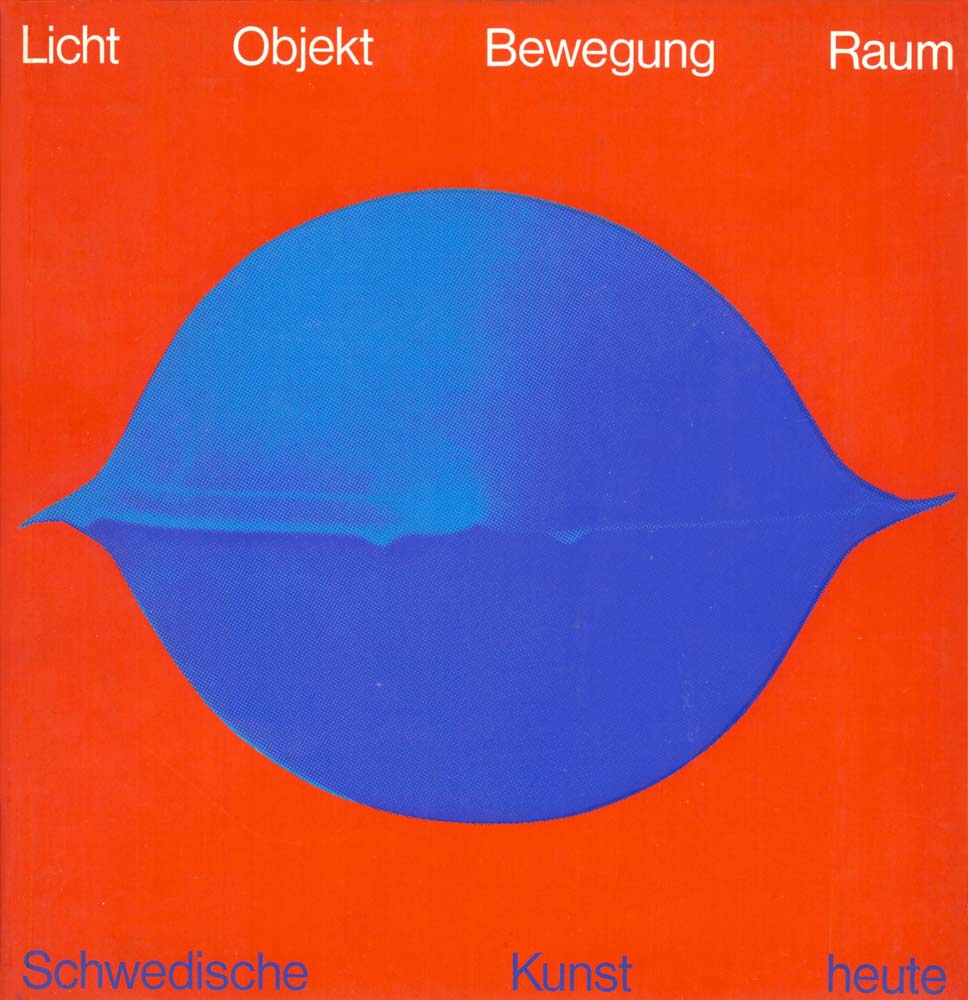
In 1970, Kunsthalle Düsseldorf presented remarkable exhibitions on the theme of space and contemporary Swedish art, including the exhibition "Licht, Objekt, Bewegung, Raum schwedische Kunst heute". Afterwards, the exhibition traveled to other venues such as Städtische Kunsthalle Düsseldorf and Württembergischer Kunstverein Stuttgart. "Light - Object - Movement - Space: Swedish art today" was shown from January 16 to February 22, 1970. This exhibition also included Ulrik Samuelson.
Regarding Sivert's exhibited works, the artist and author Jan Håfström wrote a remarkable reflection that I have translated from German:
"Let me keep my world, my prenatal world." Gunnar Ekelöf
"It may sound paradoxical, but I experience museums as a distinctly modern environment. The meaning of this statement naturally depends on what one understands by the concept of "modern", but I believe it stems from the void around the objects – in an independence they have acquired, separated from the outside world. I wander through the desolate halls and spot one display case after another, filled with dust and debris; bone fragments, weapon shards – each forming its own center in an inaccessible order. The dry explanations on the yellowed labels further emphasize the futility of trying to say anything about one object or another. Yet, this is by no means a state of exhaustion, a surrender to the incomprehensible – no, it is an intimacy, a state of mind where I truly see the *other*; it is there – here beside me: alone, liberated from the hierarchy of the authoritarian system. And at the same time, the museum is a living image of precisely that system, of these pathological, pedantic attempts to assign everything its proper place. The near, the distant, the Christian, the bestial, race, culture, Heidelberg. Nevertheless, I perceive ever more strongly how museums are being "deneuroticized"; the fear we carry of the unknown beyond the Jurassic period subsides, and all these guarantees – these projections of security – can be thrown overboard. On all sides, a sea spreads out. I must repeat it: on all sides, a sea spreads out.
The room where the figures and objects stand is black. At least sometimes I remember it that way: the walls are covered in black wallpaper or framed by stained wood. I saw it as an image of the night, of the underworld, to which forbidden, deviant experiences are relegated. A kind of magic theater (only for "madmen") as Hesse described in *Steppenwolf*. A long corridor with doors leading to different rooms; above each door is an inscription describing what one will encounter: one's first love, possibilities for acts of violence, transformations into all sorts of animals and plants, and so on. A memorable sign reads: “Instructions for building up the personality.” In this room, the “game of life” – as Hesse calls it – is a kind of chess, where the different pieces represent parts of a fragmented personality.
“In the future, you can shape and give life to your life's game exactly as you wish – make it more complex and enrich it; it is in your hands. Just as madness, in a higher sense, is the beginning of all wisdom, so is schizophrenia the beginning of all art, of all imagination.”
R. D. Laing writes: “Physically, we are separated yet together. As embodied beings, we are connected to each other through our relationship to space." We are separated and united by different perspectives, education, background, organizations, loyalty to groups, corporate mergers, ideologies, social groups, and temperament. These social 'things' that unite us are, precisely because of this, also 'things' – social constructs – that stand between us. And what if we could cast off all these necessities and coincidences and bare our naked existence to each other? If everything were stripped away – all clothes, all disguises, all crutches, all makeup, as well as our common projects, the games that serve as pretexts for the events that are to constitute our encounters – if we could truly meet, if such an event could take place – a blissful coming together of people – what would then separate us?”
Here, in this room, I am sometimes filled with wonder. How incredibly little I know about what all these similar faces conceal. It has been said that "every human is a world". It is true – she is a world. A vast storehouse, teeming with... memories, dreams, syllables. An archive containing thousands of miles of magnetic tape: incantations, prayers, winds – things only half-uttered or left unsaid. The fabric of life, hidden behind the so-called exterior. The facade, the uniform, the outward appearance. The false security of history or the welfare state. Who speaks of life here?
The end of Camus's *The Stranger*: twilight; the condemned man hears the factory siren and understands from it that the world is waking – the world he will soon leave. He felt a strange peace; everything was over. For the first time, his life took shape before him. He had killed a man, but in reality, he was condemned for something else – for being a stranger. He posed a threat; his presence in the courtroom became increasingly provocative as the trial progressed. He was a representative of the downtrodden, the anonymous, the violated, the ignorant – of those who lacked a sense of self or context. The jury was unanimous in its decision to reject this moral monster. He had to die because his worldview was that of a child, of an ignorant person. It was this that captivated and enchanted him: this innocence, this feeling of standing on the threshold of another time, another kind of humanity." Jan Håfström