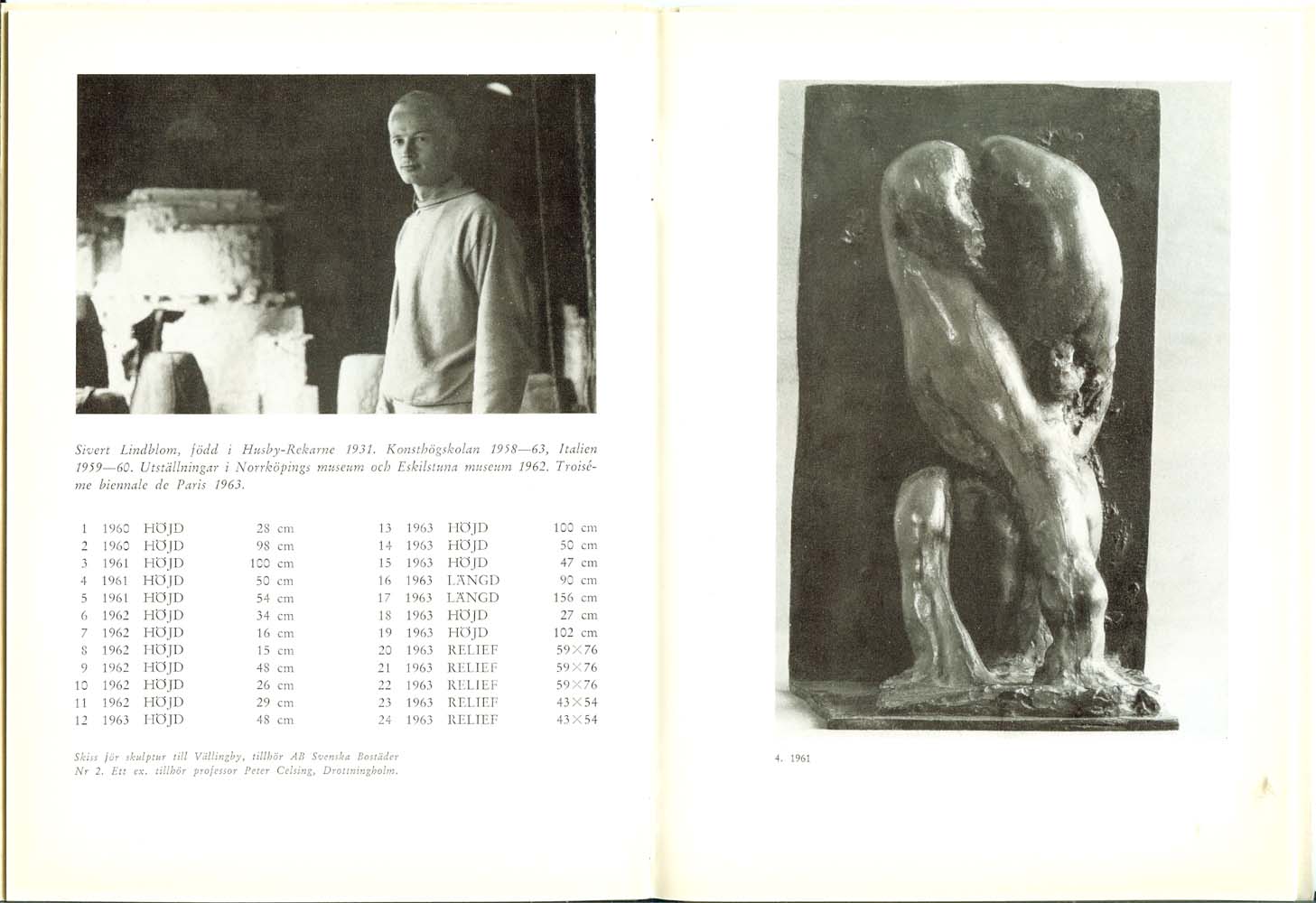
Sivert Lindblom and Ulrik Samuelson considered this exhibition at Galerie Burén in Stockholm in 1963 to be their true debut exhibition. (Even though some of the works had been presented the year before at Vadsbo museum.) Galerie Burén was an iconic Swedish art gallery in Stockholm, run by the legendary gallerist Eva af Burén from 1962 to the 1970s. It showcased prominent Swedish and international contemporary art, including early breakthroughs and memorable exhibitions for artists such as Ulrik Samuelson, Sivert Lindblom, Torsten Andersson, and Marcel Duchamp.
The exhibition catalog was unusually expansive for a debut. The playwright, author, and art critic Arne Törnqvist described the encounter with the two artists from an existential perspective, questioning the relationship between art and the transience of life. Within Swedish "vernissage history," the exhibition received one of the most peculiar, imaginative, and challenging forewords to its catalog, written by the author and mathematician Leon Rappaport.
Leon Rappaport (1900–1986) in Stockholm was a Swedish mathematician and author. Rappaport fled to Sweden from Poland in 1940. He earned his M.A. in Warsaw in 1932 and his Ph.D. at Uppsala University in 1967. His most famous published works are Determinantan I (1961) and Determinantan II (1962). A determinant is a special number that can be calculated from a square matrix in mathematics. "Determinantan" is something as unusual as a philosophical treatise in novel form. Or a novel about people pondering philosophical questions and about creation.
Leon Rappaport argues that what distinguishes humans is the creative drive, which is most evident in the scientist, painter, musician, and poet, but which also exists in the "ordinary" person, in an atrophied and sublimated form, e.g., in the manic collector and in daydreams.
From Determinantan I: "Inter-individual activity has meaning and is purposeful only from the individual's point of view. From the perspective of all people, its meaning seems difficult to grasp." … "The totality of inter-individual activities, which consume enormous amounts of human creative power, energy, and effort, appears from society's point of view to be a meaningless waste." And "...this mystical power" .. "- this power is humanity's lost, misguided creative instinct - the determinant."
In the introduction to Determinantan, the author writes: "This book requires certain explanations – it is difficult, introduces a new concept, and moreover, constitutes only the first part of a larger whole. Its intention is to pursue literature at a pre-scientific stage; the goal is consequently to extract knowledge. It is possible that certain chapters will be entertaining or emotionally engaging for some readers. But even in such cases, their interest and emotion shall serve the main purpose, which is to impart knowledge. The book attempts to understand humanity. Certain disciplines within the border areas of the exact sciences, such as psychology or sociology, do indeed explore humanity; however, their research generally focuses exclusively on its peripheries and does not reach the "whole" human. But what is a whole human? What is it we want to understand about her? The whole human is the creative, or, if one prefers, the active human: both when she solves a complex scientific problem and when she establishes her position among other people; when she creates works of art or is consumed by conflicts with her surroundings; when she collects stamps or dreams; when she is dominated by passion: love, hate, despair, envy, pride, self-love, dignity … "
(Could Leon be referring to the seven passions as a kind of alternative variant of the "Seven Deadly Sins"? I leave that to you, reader of Determinantan. The Seven Deadly Sins are usually pride, envy, and wrath, as well as sloth, greed, gluttony, and lust. They were established in the early Middle Ages by Pope Gregory I as fundamental vices that can lead to other wrongs.) / JÖ / JÖ the text is taken from the book's introduction 1962, 1976 Bo Cavefors förlag, ISBN 91 504 0652 3
SEE CATALOG from the exhibition. Open the image in a new window. Click on the magnifying glass to make it easier to read. Then return to the page by closing the window!