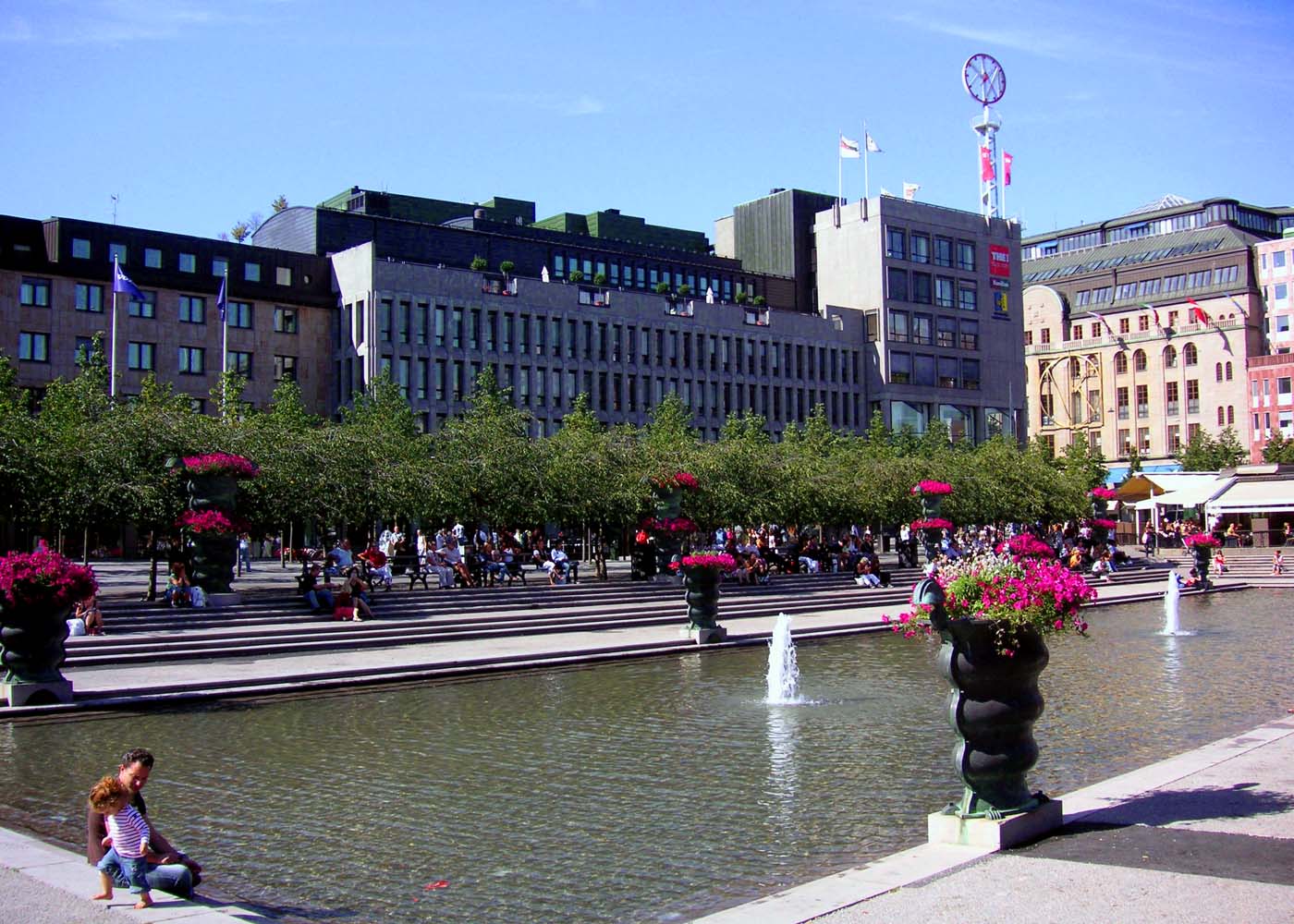
Sculptures – urns – along the water basin in Kungsträdgården's northern part
Kungsträdgården is one of Stockholm's most visited and well-known places. The changing seasons leave their mark on the park, while recurring events throughout the year attract large crowds of Stockholmers and visitors. In many ways, Kungsträdgården functions as one of the city's faces. The elongated fountain forms a natural center and gathers people of all ages around the water space.
"To mark and reinforce this central place, Sivert designed, in a form that can evoke Roman tradition, a series of urns around a kind of impluvium. The urns are planted with vegetation that is replaced according to season and design, which means their expression changes throughout the year.
The urns form double rows: one runs beneath the trees and the other follows the long sides of the pond itself. In the lower row, the placement of the urns has a special connection to water. At the foot of the urns, there are water jets that are activated at various times, forming crossing cascades over the pond. The water thus becomes not merely a decorative element but an integrated part of the artistic design.
At other times, the pond is emptied of water, and the elongated surface can instead function as an arena for various activities and events. The function of the fountain and the pond thus becomes changeable, just like the vegetation in the urns. The place can alternate between a water space, a recreational environment, and an event venue.
The redesign of Kungsträdgården was carried out in 1988 in collaboration with Stockholms stadsbyggnadskontor (Stockholm City Planning Department) under the direction of urban planner Aleksander Wolodarski. The collaboration between Wolodarski and Sivert also resulted in other environmental designs in Stockholm, including the arena created facing Karlbergskanalen between two building complexes in the S Eriksområdet area, in what has popularly come to be called Grubbens park or Grubbens trappa, 2000.
When function meets design poorly
The urns are not merely planters. Through their repetition, placement, and relationship to the trees, water, and the pond's geometry, they constitute an important part of Kungsträdgården's architectural and artistic composition. Precisely for this reason, it becomes problematic when their function as artistic and space-creating elements does not seem to be considered in the practical management of the site.
Today, in several places, the upper row of urns has had waste containers placed next to them – not just one, but several by each urn. This can be perceived as a clear example of how practical needs and aesthetic design sometimes come into conflict. When an urn, originally intended to be part of a cohesive architectural and artistic composition, is surrounded by waste containers, the experience of the place that the artist and urban planner have tried to create also changes.
The question therefore becomes not merely where the city's waste containers should be placed, but how the daily operation of a public environment can interact with the artistic design already present at the site. In Kungsträdgården, this becomes particularly evident because the urns are so numerous and so consistently integrated into the park's overall structure."
/JÖ
Photographer: Jan Öqvist
⊙ View location⊙ Kungsträdgården, Stockholm