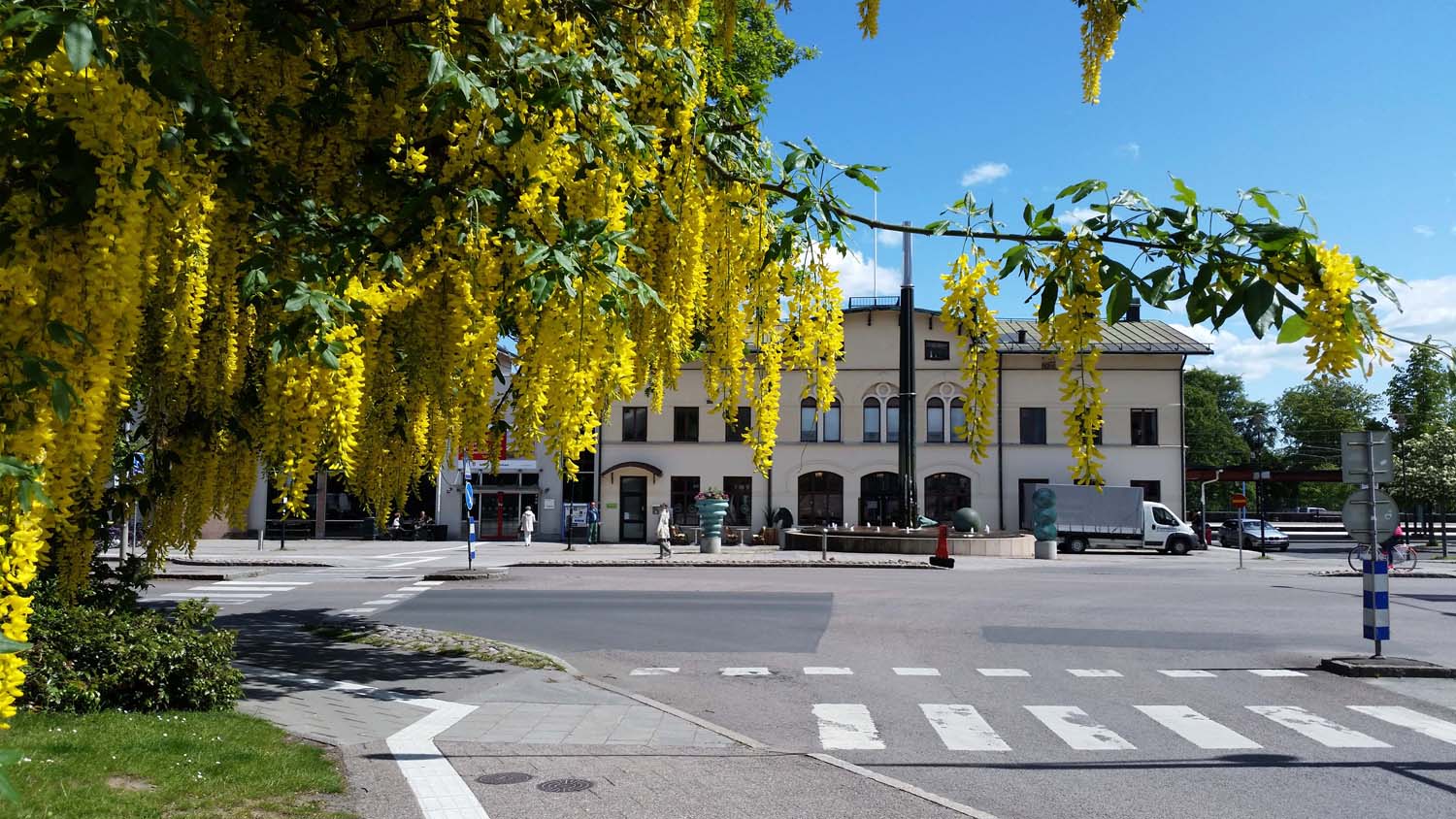
Cavallobrunnen at Resecentrum in Skövde, Stationsgatan
In front of the main entrance of the railway station in Skövde lies a gurgling fountain with a number of sculptural objects that in various ways allude to aquatic life, water, and humanity's need for water. The artistic design brings together nature's forms and human geometric interpretations in an environment where travel – arrival and departure – becomes part of the work's context.
"In the center of the patterned pond bottom, around an upward-flowing 'water source,' stands a cluster of bronze pillars. Together they form a shape reminiscent of an obelisk and culminate high up with an element of reflective stainless steel.
In ancient Egypt, the 'pyramidion' was the four-sided capstone of a pyramid or obelisk. It could be made of, for example, diorite, granite, or limestone and covered with a surface layer of gold or 'electrum' – a naturally occurring alloy of gold and silver – to catch and reflect the sun's rays. The pyramidion could also be decorated with royal titles and religious symbols.
At the top of Sivert's obelisk, I believe I can see the letters 'SL,' as a possible signature.
In the pond lie two enlarged sub-objects in bronze. On the side closest to the entrance, 'the arriving' are met by a reclining bronze object depicting an aquatic creature within a powerful, sculptural shell – like a large water snail. On the opposite side of the pond, where 'the departing' pass, lies a more geometrically shaped object: a large bronze sphere whose content and origin are left open to the viewer's imagination.
The snail's shell can be seen as a result of evolution's design – a protection that, through its structure, has adapted to the organism's living conditions. A possible biological reference is Strombus gigas, a snail species described by Carl von Linné in 1758 and recognized, among other things, by its protruding 'lip.' The name Strombus originates from the Latin and Ancient Greek στρόμβος (strómbos), with meanings such as shell, conch, and snail.
The sphere, on the other hand, represents one of nature's most perfect geometric forms. The sphere has fascinated humanity throughout history and has acquired symbolic meanings in science and philosophy as well as art and religion. In Sivert's work, it simultaneously becomes something enigmatic: what is contained within the sphere's closed form is not given.
Beside the fountain, there is also a lifelike horse head, Cavallo, which has given its name to the artistic design. The model for the horse head is the famous Byzantine horses from Constantinople, a motif world that Sivert also revisited at Blasieholmstorg in Stockholm in 1989.
In Cavallobrunnen, an exciting triangulation thus arises between nature's own forms, humanity's ability to reshape and design nature, and the viewer's imagination. The snail's organic shell, the sphere's perfect geometry, and the horse's lifelike rendered head meet the architectural forms of the obelisk and pillars. These are forms that can both be recognized and simultaneously transformed by their size, placement, and materiality.
What is hidden in a sphere is up to the viewer's imagination. The same applies to the stacked geometric forms outside the pond itself, which can evoke thoughts of wheels in motion, as well as the meaning of the flourishing urn. Sivert thus seems to leave several of the work's objects open to interpretation. The fountain becomes not only an embodiment of water but also a place where nature, cultural history, geometry, and imagination can meet.."
/JÖ
The bronzes were, as many times over the years, cast by Herman Bergmans Konstgjuteri AB under the direction of Leif Schölin and by Skandinaviskakonstgjuteriet under the direction of Ulf Ferrius.
Photographer: Jan Öqvist
⊙ View location⊙ Stationsgatan, Skövde