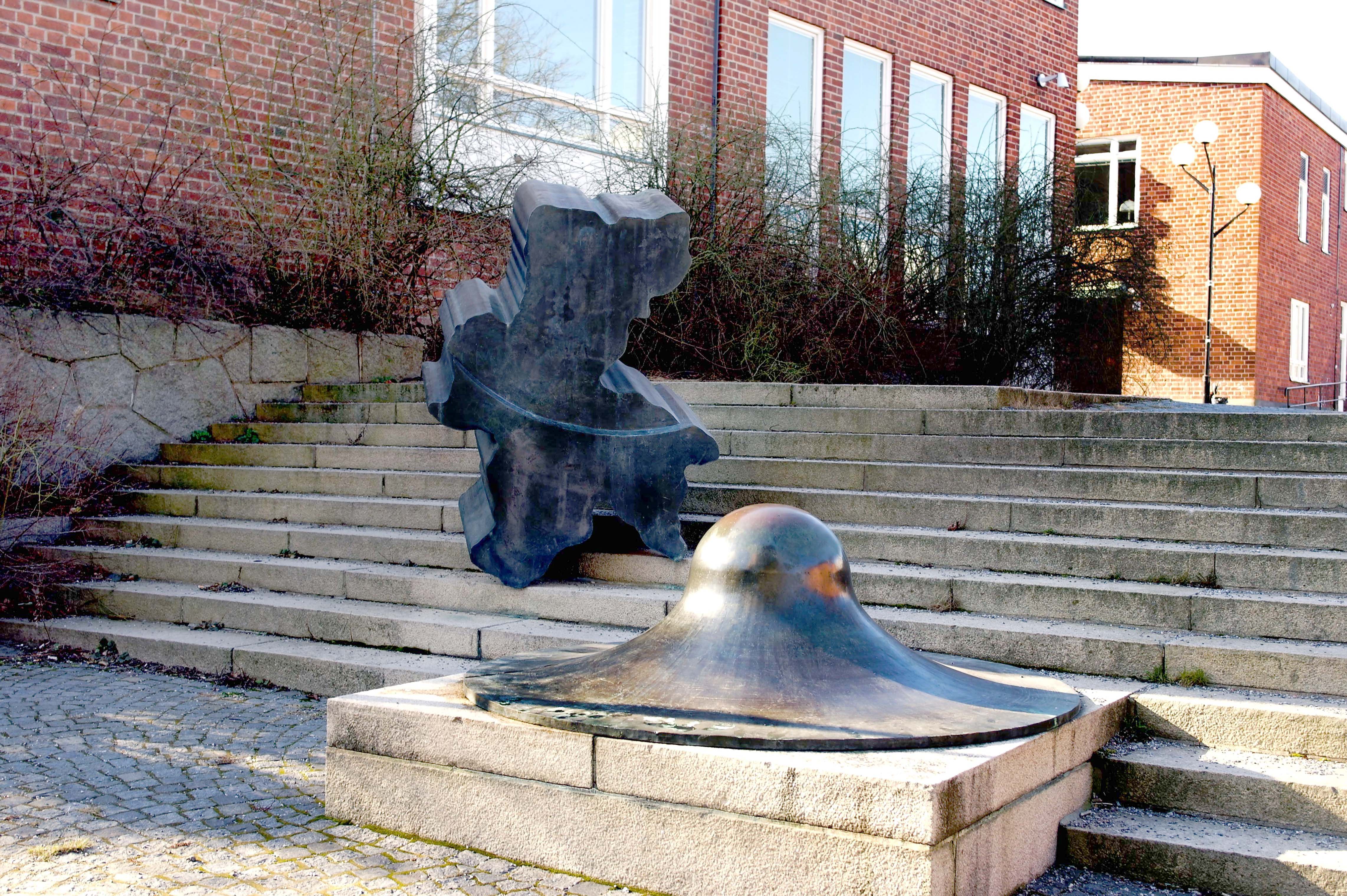
Sculpture group at Vällingby backe, next to the Fontänen cinema and where the stairs to the area's youth center used to be. This installation was Sivert's first major public commission within the framework of "The One Percent Rule".
Vällingby was a revolutionary Swedish suburb and the first so-called ABC city – an urban planning idea where work, housing, and a city center would be located in the same place. What had previously been farmland was transformed into a modern community, which was inaugurated on November 14, 1954.
Vällingby backe, also called Vällingby trappa, was one of the first public ornamentation commissions Sivert undertook. The stairs with the sculpture group are located right next to Vällingby Church, designed by architect Peter Celsing a few years earlier.
As a student at Konstfack, in 1957, Sivert had already begun a collaboration with Peter Celsing and did his internship at Celsing's architectural office. In his work on Vällingby Church, he participated, among other things, in the sculptural design of the bell tower. A large number of tower models were developed before the church received its final expression.
The collaboration with Peter Celsing's architectural office continued for many years and lasted until Celsing's death in 1974.
The sculpture group at Vällingby backe, next to the Fontänen cinema, consists of two larger bronze elements. One is a "pressed form" against the ground, placed next to another, standing object. Together they create a strange and dynamic relationship, where the forms appear to be in motion – as if one form has been pressed down towards the ground while the other is being displaced or sliding away.
The sculpture group was developed by Sivert during the years 1963–1966, when he was living in Locarno in Ticino, Switzerland, with his wife Marianne.
Locarno is a small medieval town on the northern shore of Lake Maggiore, in the Italian-speaking canton of Ticino. The canton is the only one in Switzerland located entirely south of the main ridge of the Alps. The Swiss environment and his stay in Locarno thus coincide with the period when Sivert developed these forms, although no direct connection between the place and the sculptures' motifs has been established.
The images in the gallery show parts of the works' creation and provide insight into how Sivert developed the sculptural forms.
Public Art in Vällingby
During the years 1964–1979, Svenska Bostäder engaged the artist Kurt Ullberger as a consultant for artistic ornamentation. Ullberger was not only an artist and chairman of KRO, Konstnärernas riksorganisation, but also a Social Democratic county council politician with assignments including in the Stockholm Beauty Council.
Commissioned by Svenska Bostäder, Ullberger planned and proposed the artistic ornamentation based on the principle that various artistic directions should be expressed. Modern and radical expressions would exist side by side with more traditional ones, and the embellishments would be executed with different techniques and materials.
The background was the Swedish One Percent Rule. Since 1937, artistic ornamentation of public buildings could be financed through state loans corresponding to one percent of the building's value. In connection with the Riksdag's decision in 1937, following Government Bill 157, this financing principle was established.
The then Minister of Ecclesiastical Affairs Arthur Engberg formulated the vision:
"Art is on its way to becoming everyone's property. Both in public buildings and assembly halls, as well as in workplaces, factories, and offices."
The ambition was also that both older and younger artists, women and men, should be given the opportunity to receive public commissions. Sivert was one of the artists who contributed to this development.
Seeing Sivert's Forms
"To try to analyze Sivert's art is like seeking out the sources. He rarely leaves traces, but they are there for those who take the trouble to combine his form with an association and a time perspective in their own imagination."
For those who encounter the sculpture group in Vällingby, the forms can therefore open up many different associations. Since I myself grew up near the sculptures, I naturally wondered what it was I thought I saw on the way to the youth center, which was also located in the stairs.
One of my early associations was an enlarged Roman helmet, discarded and lying on a slab that I perceived as a grave. The other form I saw as an inkblot that had become three-dimensional.
The inkblot brought to mind the so-called Rorschach test, which was developed by the Swiss psychiatrist Hermann Rorschach. There, abstract inkblots are used to evoke associations, reactions, and feelings in the viewer. At that time, I got no further than the image of an inkblot about to hit a battle helmet.
Much later, in connection with working on this text, I learned more about the so-called "iron hats" worn by infantrymen in the early Swiss armies. These were open helmets with wide brims that protected against blows and strikes from above. The design allowed the soldier to maintain unobstructed sight and hearing while simultaneously protecting the head from attacks, including from horsemen and projectiles coming from above.
The wide brim could deflect blows and strikes and was particularly useful during sieges, where arrows and other projectiles could come from higher levels. The helmet also provided some protection from the sun.
If any of this was present in Sivert's thoughts when he created the encounter between the flying, almost "inkblot-like" form and the protective helmet, we can, of course, only speculate.
Perhaps that is precisely where a part of Sivert's art lies: in the open encounter between the form and the viewer. He leaves room for associations rather than locking the work to a specific narrative. The form becomes a starting point for the viewer's own imagination, experience, and time perspective – and can therefore continue to change long after the sculpture is finished."
/JÖ
At this time, cinematographer Lasse Forsberg made a documentary film about Sivert.
Photographer: Jan Öqvist
⊙ View location⊙ Vällingby, Stockholm